Ch. 3 - Probability
Larson - Elementary Statistics: Picturing the World 8th Edition
Larson8th EditionElementary Statistics: Picturing the WorldISBN: 9780137493470Not the one you use?Change textbook
Chapter 3, Problem 3.1.55

Classifying Types of Probability In Exercises 53-58, classify the statement as an example of classical probability, empirical probability, or subjective probability. Explain your reasoning.
55. An analyst feels that the probability of a team winning an upcoming game is 60%.

Verified step by step guidance
1
Step 1: Understand the three types of probability: Classical probability is based on equally likely outcomes (e.g., rolling a die), empirical probability is based on observed data or experiments, and subjective probability is based on personal judgment or opinion.
Step 2: Analyze the given statement. The analyst 'feels' that the probability of the team winning is 60%. This indicates that the probability is not derived from a mathematical model or experimental data.
Step 3: Recognize that the use of the word 'feels' suggests the probability is based on the analyst's personal judgment or intuition rather than objective data or theoretical calculations.
Step 4: Classify the probability. Since the probability is based on personal judgment, it is an example of subjective probability.
Step 5: Conclude the reasoning. The statement is classified as subjective probability because it reflects the analyst's personal belief rather than empirical evidence or classical reasoning.

Verified video answer for a similar problem:

This video solution was recommended by our tutors as helpful for the problem above.
Video duration:
2m
Was this helpful?

Key Concepts

Here are the essential concepts you must grasp in order to answer the question correctly.

Classical Probability

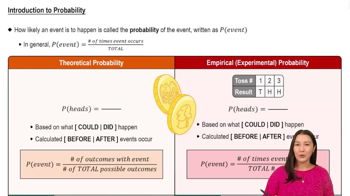
Classical probability is based on the assumption that all outcomes in a sample space are equally likely. It is calculated by dividing the number of favorable outcomes by the total number of possible outcomes. This approach is often used in games of chance, such as rolling dice or flipping coins, where the probabilities can be determined through logical reasoning.
Recommended video:
5:37
Introduction to Probability

Empirical Probability

Empirical probability, also known as experimental probability, is determined by conducting experiments or observing real-world events. It is calculated by taking the ratio of the number of times an event occurs to the total number of trials or observations. This type of probability is useful when theoretical probabilities are difficult to ascertain, as it relies on actual data.
Recommended video:
5:37
Introduction to Probability

Subjective Probability

Subjective probability is based on personal judgment, intuition, or experience rather than on exact calculations or empirical data. It reflects an individual's belief about the likelihood of an event occurring, which can vary from person to person. In the given example, the analyst's estimation of a team's winning probability as 60% is a subjective probability, as it is influenced by their personal assessment and insights.
Recommended video:
5:37
Introduction to Probability
Related Practice
Textbook Question

Boy or Girl? In Exercises 71-74, a couple plans to have three children. Each child is equally likely to be a boy or a girl.

74. What is the probability that at least one child is a boy?

111
views

Textbook Question

Matching Probabilities In Exercises 11-16, match the event with its probability.

a. 0.95

b. 0.005

c. 0.25

d. 0

e. 0.375

f. 0.5

14. A game show contestant must randomly select a door. One door doubles her money while the other three doors leave her with no winnings. What is the probability she selects the

door that doubles her money?

77
views
Textbook Question

Recognizing Mutually Exclusive Events In Exercises 9–12, determine whether the events are mutually exclusive. Explain your reasoning.

10. Event A: Randomly select a student with a birthday in April.

Event B: Randomly select a student with a birthday in May.

144
views
Textbook Question

Finding the Probability of the Complement of an Event The age distribution of the residents of Ithaca, New York, is shown at the left. In Exercises 59-62, find the probability of the event. (Source: U.S. Census Bureau)

61. Event C: A randomly chosen resident of Ithaca is not less than 18 years old.

128
views
Textbook Question

Finding the Probability of the Complement of an Event In Exercises 17-20, the probability that an event will happen is given. Find the probability that the event will not happen.

19. P(E)=0.03

287
views
Textbook Question

Finding the Probability of an Event In Exercises 21-24, the probability that an event will not happen is given. Find the probability that the event will happen. 

21. P(E') =0.95

198
views