
Ch. 5 - Normal Probability Distributions
Larson - Elementary Statistics: Picturing the World 8th Edition
Larson8th EditionElementary Statistics: Picturing the WorldISBN: 9780137493470Not the one you use?Change textbook
Chapter 5, Problem 5.1.8

Explain how to transform a given x-value of a normally distributed variable x into a z-score.

Verified step by step guidance
1
Identify the mean (μ) and standard deviation (σ) of the normally distributed variable x. These values are essential for calculating the z-score.
Recall the formula for calculating a z-score: z = x - μσ. This formula standardizes the x-value by measuring how many standard deviations it is away from the mean.
Subtract the mean (μ) from the given x-value. This step calculates the deviation of x from the mean.
Divide the result from step 3 by the standard deviation (σ). This step scales the deviation by the variability of the distribution, converting it into a z-score.
Interpret the z-score: A positive z-score indicates the x-value is above the mean, while a negative z-score indicates it is below the mean. The magnitude of the z-score shows how far the x-value is from the mean in terms of standard deviations.

Verified video answer for a similar problem:

This video solution was recommended by our tutors as helpful for the problem above.
Video duration:
1m
Was this helpful?

Key Concepts

Here are the essential concepts you must grasp in order to answer the question correctly.

Normal Distribution

Normal distribution is a probability distribution that is symmetric about the mean, showing that data near the mean are more frequent in occurrence than data far from the mean. It is characterized by its bell-shaped curve, defined by two parameters: the mean (average) and the standard deviation (which measures the spread of the data). Understanding this distribution is crucial for statistical analysis, as many statistical tests assume normality.
Recommended video:
06:23
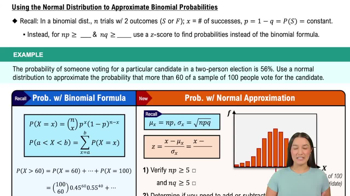
Using the Normal Distribution to Approximate Binomial Probabilities

Z-Score

A z-score is a statistical measurement that describes a value's relationship to the mean of a group of values. It is calculated by subtracting the mean from the x-value and then dividing by the standard deviation. This standardization allows for comparison between different datasets or distributions, as it indicates how many standard deviations an element is from the mean.
Recommended video:
Guided course
06:31
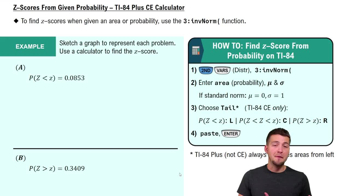
Z-Scores From Given Probability - TI-84 (CE) Calculator

Standardization Process

The standardization process involves converting a normal variable into a z-score to facilitate comparison across different scales or distributions. This is done using the formula: z = (x - μ) / σ, where x is the value, μ is the mean, and σ is the standard deviation. This transformation is essential in statistics for hypothesis testing and creating confidence intervals.
Recommended video:
Guided course
08:45
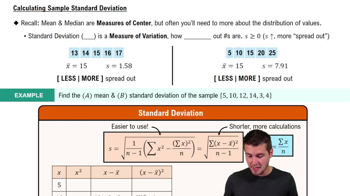
Calculating Standard Deviation
Related Practice
Textbook Question

Finding Probability In Exercises 41–46, find the probability of z occurring in the shaded region of the standard normal distribution. If convenient, use technology to find the probability.


76
views
Textbook Question

In Exercises 1–4, the sample size n, probability of success p, and probability of failure q are given for a binomial experiment. Determine whether you can use a normal distribution to approximate the distribution of x.

n=24, p=0.85, q=0.15

70
views
Textbook Question

In Exercises 1–4, a population has a mean mu and a standard deviation sigma. Find the mean and standard deviation of the sampling distribution of sample means with sample size n.


Mu = 790, sigma =48, n = 250

64
views
Textbook Question

Finding Area

In Exercises 23–36, find the indicated area under the standard normal curve. If convenient, use technology to find the area.


To the left of z=0.33

90
views
Textbook Question

Interpreting the Central Limit Theorem In Exercises 19–26, find the mean and standard deviation of the indicated sampling distribution of sample means. Then sketch a graph of the sampling distribution.


SAT Italian Subject Test The scores on the SAT Italian Subject Test for the 2018–2020 graduating classes are normally distributed, with a mean of 628 and a standard deviation of 110. Random samples of size 25 are drawn from this population, and the mean of each sample is determined.

99
views
Textbook Question

Interpreting the Central Limit Theorem In Exercises 19–26, find the mean and standard deviation of the indicated sampling distribution of sample means. Then sketch a graph of the sampling distribution.


Salaries The annual salaries for web software development managers are normally distributed, with a mean of about \$136,000 and a standard deviation of about \$11,500. Random samples of 40 are drawn from this population, and the mean of each sample is determined.

92
views