
Ch. 5 - Normal Probability Distributions
Larson - Elementary Statistics: Picturing the World 8th Edition
Larson8th EditionElementary Statistics: Picturing the WorldISBN: 9780137493470Not the one you use?Change textbook
Chapter 5, Problem 5.3.37a

Finding Specified Data Values In Exercises 31–38, answer the questions about the specified normal distribution.


Red Blood Cell Count The red blood cell counts (in millions of cells per microliter) for a population of adult males can be approximated by a normal distribution, with a mean of 5.4 million cells per microliter and a standard deviation of 0.4 million cells per microliter.


a. What is the minimum red blood cell count that can be in the top 25% of counts?

Verified step by step guidance
1
Step 1: Understand the problem. We are tasked with finding the minimum red blood cell count that falls in the top 25% of a normal distribution. This means we need to find the value (let's call it X) such that 25% of the data lies above it. This corresponds to finding the 75th percentile of the distribution.
Step 2: Recall the properties of a normal distribution. The given distribution has a mean (μ) of 5.4 million cells per microliter and a standard deviation (σ) of 0.4 million cells per microliter. The formula to standardize a value (convert it to a z-score) is: Z=X-μσ.
Step 3: Use the z-score table or a statistical calculator to find the z-score corresponding to the 75th percentile. The cumulative probability up to this z-score is 0.75. From standard z-tables, the z-score for the 75th percentile is approximately Z=0.674.
Step 4: Rearrange the z-score formula to solve for X (the red blood cell count): X=μ+Z×σ. Substitute the values: X=5.4+0.674×0.4.
Step 5: Perform the calculation to find the value of X. This will give the minimum red blood cell count that falls in the top 25% of the distribution. Ensure the units are consistent (millions of cells per microliter).

Verified video answer for a similar problem:

This video solution was recommended by our tutors as helpful for the problem above.
Video duration:
3m
Was this helpful?

Key Concepts

Here are the essential concepts you must grasp in order to answer the question correctly.

Normal Distribution

Normal distribution is a probability distribution that is symmetric about the mean, showing that data near the mean are more frequent in occurrence than data far from the mean. It is characterized by its bell-shaped curve, defined by its mean and standard deviation. In this context, the red blood cell counts follow a normal distribution, which allows us to use statistical methods to determine probabilities and percentiles.
Recommended video:
06:23
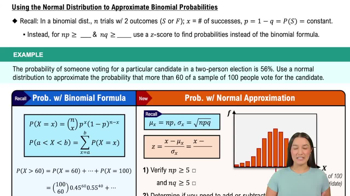
Using the Normal Distribution to Approximate Binomial Probabilities

Mean and Standard Deviation

The mean is the average of a set of values, while the standard deviation measures the amount of variation or dispersion in a set of values. In the given problem, the mean red blood cell count is 5.4 million cells per microliter, and the standard deviation is 0.4 million. These parameters are essential for calculating the specific data values and understanding the distribution of red blood cell counts.
Recommended video:
Guided course
08:45
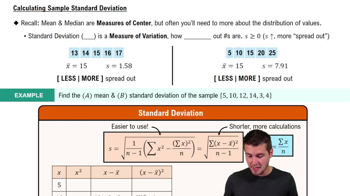
Calculating Standard Deviation

Percentiles

A percentile is a measure used in statistics indicating the value below which a given percentage of observations fall. For example, the top 25% of red blood cell counts corresponds to the 75th percentile. To find this value in a normal distribution, one can use the mean and standard deviation along with z-scores, which represent the number of standard deviations a data point is from the mean.
Related Practice
Textbook Question

Approximating Binomial Probabilities In Exercises 19–26, determine whether you can use a normal distribution to approximate the binomial distribution. If you can, use the normal distribution to approximate the indicated probabilities and sketch their graphs. If you cannot, explain why and use a binomial distribution to find the indicated probabilities. Identify any unusual events. Explain.


Advancing Research In a survey of U.S. adults, 77% said are willing to share their personal health information to advance medical research. You randomly select 500 U.S. adults. Find the probability that the number who are willing to share their personal health information to advance medical research is (a) at most 400

76
views
Textbook Question

[APPLET] Milk Consumption You are performing a study about weekly per capita milk consumption. A previous study found weekly per capita milk consumption to be normally distributed, with a mean of 48.7 fluid ounces and a standard deviation of 8.6 fluid ounces. You randomly sample 30 people and record the weekly milk consumptions shown below.

a. Draw a frequency histogram to display these data. Use seven classes. Do the consumptions appear to be normally distributed? Explain.

128
views
Textbook Question

Ice Cream The weights of ice cream cartons are normally distributed with a mean weight of 10 ounces and a standard deviation of 0.5 ounce.


a. What is the probability that a randomly selected carton has a weight greater than 10.21 ounces?


102
views
Textbook Question

Pregnancy Length Use the normal distribution in Exercise 15.


a. What percent of the new mothers had a pregnancy length of less than 290 days?

87
views
Textbook Question

Finding Probabilities for Normal Distributions In Exercises 7–12, find the indicated probabilities. If convenient, use technology to find the probabilities.


MCAT Scores In a recent year, the MCAT total scores were normally distributed, with a mean of 500.9 and a standard deviation of 10.6. Find the probability that a randomly selected medical student who took the MCAT has a total score that is (a) less than 490. Identify any unusual events in parts (a)–(c). Explain your reasoning. (Source: Association of American Medical Colleges)

126
views
Textbook Question

Manufacturer Claims You work for a consumer watchdog publication and are testing the advertising claims of a tire manufacturer. The manufacturer claims that the life spans of the tires are normally distributed, with a mean of 40,000 miles and a standard deviation of 4000 miles. You test 16 tires and record the life spans shown below.

a. Draw a frequency histogram to display these data. Use five classes. Do the life spans appear to be normally distributed? Explain.

85
views