
Ch. 5 - Normal Probability Distributions
Larson - Elementary Statistics: Picturing the World 8th Edition
Larson8th EditionElementary Statistics: Picturing the WorldISBN: 9780137493470Not the one you use?Change textbook
Chapter 5, Problem 5.1.14

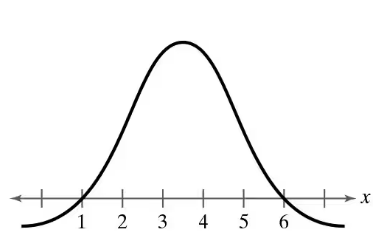
Graphical Analysis In Exercises 11–16, determine whether the graph could represent a variable with a normal distribution. Explain your reasoning. If the graph appears to represent a normal distribution, estimate the mean and standard deviation.
dist2

Verified step by step guidance
1
Step 1: Observe the graph and identify its shape. A normal distribution is characterized by a symmetric bell-shaped curve, where the highest point occurs at the mean, and the curve tapers off equally on both sides.
Step 2: Check for symmetry. In this graph, the curve appears symmetric about the center, which is a key feature of a normal distribution.
Step 3: Estimate the mean. The mean of a normal distribution corresponds to the center of the graph. Based on the x-axis, the peak of the curve is around x = 3. This suggests the mean is approximately 3.
Step 4: Estimate the standard deviation. The standard deviation can be approximated by observing the spread of the curve. For a normal distribution, about 68% of the data falls within one standard deviation from the mean. Here, the curve starts tapering off significantly around x = 2 and x = 4, suggesting a standard deviation of approximately 1.
Step 5: Conclude whether the graph represents a normal distribution. Since the graph is symmetric, bell-shaped, and has a single peak at the mean, it is reasonable to conclude that this graph could represent a variable with a normal distribution.

Verified video answer for a similar problem:

This video solution was recommended by our tutors as helpful for the problem above.
Video duration:
3m
Was this helpful?

Key Concepts

Here are the essential concepts you must grasp in order to answer the question correctly.

Normal Distribution

A normal distribution is a continuous probability distribution characterized by its bell-shaped curve, symmetric about the mean. It is defined by two parameters: the mean (average) and the standard deviation (spread). In a normal distribution, approximately 68% of the data falls within one standard deviation of the mean, 95% within two, and 99.7% within three, making it a key concept in statistics for understanding data behavior.
Recommended video:
06:23
Using the Normal Distribution to Approximate Binomial Probabilities

Mean and Standard Deviation

The mean is the average value of a dataset, calculated by summing all values and dividing by the number of observations. The standard deviation measures the dispersion of data points around the mean, indicating how spread out the values are. In the context of a normal distribution, these two parameters help define the shape and position of the curve, allowing for predictions about the likelihood of various outcomes.
Recommended video:
Guided course
08:45
Calculating Standard Deviation

Graphical Analysis

Graphical analysis involves examining visual representations of data, such as histograms or density plots, to identify patterns, trends, and distributions. In the context of normal distributions, one looks for characteristics like symmetry, a single peak (unimodal), and tails that approach the horizontal axis without touching it. This analysis is crucial for determining whether a dataset can be modeled by a normal distribution and for estimating its parameters.
Recommended video:
06:46
Introduction to ANOVA
Related Practice
Textbook Question

In Exercises 39 and 40, determine whether the finite correction factor should be used. If so, use it in your calculations when you find the probability.


Parking Infractions In a sample of 1000 fines issued by the City of Toronto for parking infractions in September of 2020, the mean fine was \$49.83 and the standard deviation was \$52.15. A random sample of size 60 is selected from this population. What is the probability that the mean fine is less than \$40?

158
views
Textbook Question

True or False? In Exercises 5–8, determine whether the statement is true or false. If it is false, rewrite it as a true statement.


A sampling distribution is normal only when the population is normal.

86
views
Textbook Question

Using and Interpreting Concepts

Finding Area In Exercises 17–22, find the area of the shaded region under the standard normal curve. If convenient, use technology to find the area.

81
views
Textbook Question

Finding a z-Score In Exercises 1–16, use the Standard Normal Table or technology to find the z-score that corresponds to the cumulative area or percentile.


P33

106
views
Textbook Question

True or False? In Exercises 5–8, determine whether the statement is true or false. If it is false, rewrite it as a true statement.


If the sample size is at least 30, then you can use z-scores to determine the probability that a sample mean falls in a given interval of the sampling distribution.

104
views
Textbook Question

Finding a z-Score In Exercises 1–16, use the Standard Normal Table or technology to find the z-score that corresponds to the cumulative area or percentile.


0.94

202
views