
Ch. 5 - Normal Probability Distributions
Larson - Elementary Statistics: Picturing the World 8th Edition
Larson8th EditionElementary Statistics: Picturing the WorldISBN: 9780137493470Not the one you use?Change textbook
Chapter 5, Problem 5.Q.4d

The random variable x is normally distributed with the given parameters. Find each probability.


d. μ = 18.5, σ ≈ 4.25, P(19.6 < x < 26.1)

Verified step by step guidance
1
Step 1: Understand the problem. The random variable x is normally distributed with a mean (μ) of 18.5 and a standard deviation (σ) of approximately 4.25. We are tasked with finding the probability that x lies between 19.6 and 26.1, i.e., P(19.6 < x < 26.1).
Step 2: Standardize the values of x to convert them into z-scores using the formula: z = (x - μ) / σ. For the lower bound (x = 19.6), calculate z₁ = (19.6 - 18.5) / 4.25. For the upper bound (x = 26.1), calculate z₂ = (26.1 - 18.5) / 4.25.
Step 3: Use the standard normal distribution table (or a calculator) to find the cumulative probabilities corresponding to z₁ and z₂. Let Φ(z₁) represent the cumulative probability for z₁ and Φ(z₂) represent the cumulative probability for z₂.
Step 4: To find the probability that x lies between 19.6 and 26.1, subtract the cumulative probability for z₁ from the cumulative probability for z₂. This can be expressed as P(19.6 < x < 26.1) = Φ(z₂) - Φ(z₁).
Step 5: Interpret the result. The value obtained represents the probability that the random variable x falls within the specified range under the given normal distribution.

Verified video answer for a similar problem:

This video solution was recommended by our tutors as helpful for the problem above.
Video duration:
3m
Was this helpful?

Key Concepts

Here are the essential concepts you must grasp in order to answer the question correctly.

Normal Distribution

The normal distribution is a continuous probability distribution characterized by its bell-shaped curve, defined by its mean (μ) and standard deviation (σ). It is symmetric around the mean, meaning that approximately 68% of the data falls within one standard deviation from the mean, and about 95% falls within two standard deviations. This distribution is fundamental in statistics as many real-world phenomena tend to follow this pattern.
Recommended video:
06:23
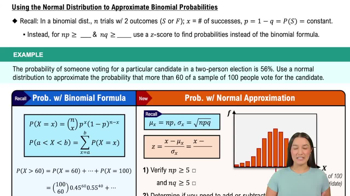
Using the Normal Distribution to Approximate Binomial Probabilities

Z-scores

A Z-score represents the number of standard deviations a data point is from the mean of a distribution. It is calculated using the formula Z = (X - μ) / σ, where X is the value of interest, μ is the mean, and σ is the standard deviation. Z-scores are essential for standardizing different normal distributions, allowing for the comparison of probabilities across different datasets.
Recommended video:
Guided course
06:31
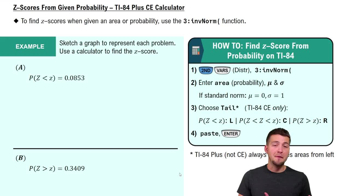
Z-Scores From Given Probability - TI-84 (CE) Calculator

Probability Calculation

Calculating probabilities for a normal distribution involves finding the area under the curve between two points, which can be done using Z-scores and standard normal distribution tables or software. For the given range P(19.6 < x < 26.1), one would first convert the values to Z-scores, then use the cumulative distribution function (CDF) to find the probabilities associated with these Z-scores and subtract them to find the desired probability.
Recommended video:
Guided course
07:09
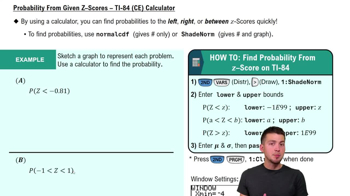
Probability From Given Z-Scores - TI-84 (CE) Calculator
Related Practice
Textbook Question

In a survey of U.S. adults, 81% feel they have little or no control over data collected about them by companies. You randomly select 250 U.S. adults and ask them whether they feel they have control over data collected about them by companies. Use this information in Exercises 11 and 12. (Source: Pew Research Center)


Determine whether you can use a normal distribution to approximate the binomial distribution. If you can, find the mean and standard deviation. If you cannot, explain why.

97
views
Textbook Question

The random variable x is normally distributed with the given parameters. Find each probability.


c. μ = 5.5, σ ≈ 0.08, P(5.36 < x < 5.64)

101
views
Textbook Question

Find each probability using the standard normal distribution.


b. P(z < 2.23)

142
views
Textbook Question

In a standardized IQ test, scores are normally distributed, with a mean score of 100 and a standardized deviation of 15. Use this information in Exercises 3–10. (Adapted from 123test)


What percent of the IQ scores are greater than 112?

226
views
Textbook Question

The random variable x is normally distributed with the given parameters. Find each probability.


a. μ = 9.2, σ ≈ 1.62, P(x < 5.97)

75
views
Textbook Question

The initial pressures for bicycle tires when first filled are normally distributed, with a mean of 70 pounds per square inch (psi) and a standard deviation of 1.2 psi.

b. A random sample of 15 tires is drawn from this population. What is the probability that the mean tire pressure of the sample is less than 69 psi?

59
views