Ch. 6 - Confidence Intervals
Larson - Elementary Statistics: Picturing the World 8th Edition
Larson8th EditionElementary Statistics: Picturing the WorldISBN: 9780137493470Not the one you use?Change textbook
Chapter 6, Problem 6.3.14

Constructing Confidence Intervals In Exercises 13 and 14, construct a 99% confidence interval for the population proportion. Interpret the results.
New Year’s Resolutions In a survey of 1790 U.S. adults in a recent year, 816 have a New Year’s resolution related to their health. (Adapted from Finder)

Verified step by step guidance
1
Step 1: Identify the sample proportion (p̂) and the sample size (n). The sample proportion is calculated as p̂ = x / n, where x is the number of successes (816) and n is the total sample size (1790).
Step 2: Determine the critical value (z*) for a 99% confidence level. For a 99% confidence interval, the critical value corresponds to the z-score that leaves 0.5% in each tail of the standard normal distribution. This value can be found using a z-table or statistical software.
Step 3: Calculate the standard error (SE) of the sample proportion using the formula SE = sqrt((p̂ * (1 - p̂)) / n). This measures the variability of the sample proportion.
Step 4: Construct the confidence interval using the formula: Confidence Interval = p̂ ± z* × SE. This provides the range of plausible values for the population proportion.
Step 5: Interpret the results. The 99% confidence interval means that we are 99% confident that the true population proportion of U.S. adults with a New Year’s resolution related to their health falls within the calculated interval.

Verified video answer for a similar problem:

This video solution was recommended by our tutors as helpful for the problem above.
Video duration:
4m
Was this helpful?

Key Concepts

Here are the essential concepts you must grasp in order to answer the question correctly.

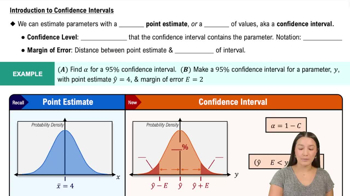
Confidence Interval

A confidence interval is a range of values, derived from sample statistics, that is likely to contain the true population parameter with a specified level of confidence, such as 99%. It provides an estimate of uncertainty around the sample proportion, allowing researchers to infer about the population based on sample data.
Recommended video:
06:33
Introduction to Confidence Intervals

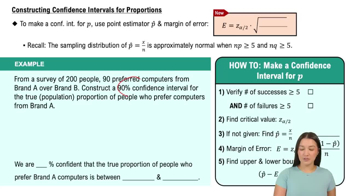
Population Proportion

The population proportion is the ratio of members of a population that have a particular characteristic, expressed as a decimal or percentage. In this context, it refers to the proportion of U.S. adults who have a New Year’s resolution related to their health, which can be estimated using sample data.
Recommended video:
05:45
Constructing Confidence Intervals for Proportions

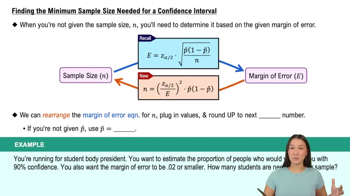
Margin of Error

The margin of error quantifies the uncertainty associated with a sample estimate. It is calculated based on the sample size and the variability of the data, and it indicates how much the sample proportion might differ from the true population proportion. A smaller margin of error leads to a more precise confidence interval.
Recommended video:
04:08
Finding the Minimum Sample Size Needed for a Confidence Interval