
Ch. 6 - Confidence Intervals
Larson - Elementary Statistics: Picturing the World 8th Edition
Larson8th EditionElementary Statistics: Picturing the WorldISBN: 9780137493470Not the one you use?Change textbook
Chapter 6, Problem 6.1.56b

When all other quantities remain the same, how does the indicated change affect the minimum sample size requirement? Explain.
b. Increase in the error tolerance

Verified step by step guidance
1
Understand the relationship between the sample size (n), error tolerance (E), and other factors. The formula for determining the minimum sample size in many cases is: n = z2σ2E2, where z is the z-score, σ is the population standard deviation, and E is the error tolerance.
Notice that the error tolerance (E) appears in the denominator of the formula, squared. This means that as E increases, the denominator becomes larger, which reduces the overall value of n.
Conclude that an increase in the error tolerance (E) will result in a decrease in the minimum sample size requirement, assuming all other quantities remain constant.
Explain why this happens: A larger error tolerance means we are willing to accept a less precise estimate, so fewer data points (a smaller sample size) are needed to achieve this level of precision.
Summarize: Increasing the error tolerance reduces the minimum sample size because the precision requirement is relaxed, leading to a smaller denominator in the sample size formula.

Verified video answer for a similar problem:

This video solution was recommended by our tutors as helpful for the problem above.
Video duration:
1m
Was this helpful?

Key Concepts

Here are the essential concepts you must grasp in order to answer the question correctly.

Sample Size

Sample size refers to the number of observations or data points collected in a study. It is crucial for ensuring that the results are statistically significant and can be generalized to a larger population. A larger sample size typically leads to more reliable estimates of population parameters.
Recommended video:
05:11
Sampling Distribution of Sample Proportion

Error Tolerance

Error tolerance, often referred to as margin of error, indicates the range within which the true population parameter is expected to fall. Increasing the error tolerance means allowing for a wider range of possible values, which can reduce the required sample size since less precision is needed in the estimates.
Recommended video:
04:08
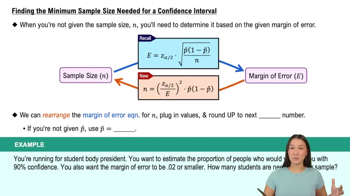
Finding the Minimum Sample Size Needed for a Confidence Interval

Statistical Power

Statistical power is the probability that a test will correctly reject a false null hypothesis. It is influenced by sample size, effect size, and significance level. When error tolerance increases, the power of the test may decrease if the sample size is not adjusted accordingly, potentially leading to less reliable conclusions.
Recommended video:
Guided course
05:53
Parameters vs. Statistics
Related Practice
Textbook Question

Constructing Confidence Intervals In Exercises 13–24, assume the sample is from a normally distributed population and construct the indicated confidence intervals for (b) the population standard deviation σ. Interpret the results.

Drug Concentration The times (in minutes) for the drug concentration to peak when the drug epinephrine is injected into 15 randomly selected patients are listed. Use a 90% level of confidence.

56
views
Textbook Question

Constructing Confidence Intervals In Exercises 13–24, assume the sample is from a normally distributed population and construct the indicated confidence intervals for (b) the population standard deviation σ. Interpret the results.

[APPLET] Earnings The annual earnings (in thousands of dollars) of 21 randomly selected level 1 computer hardware engineers are listed. Use a 99% level of confidence. (Adapted from Salary.com)

100
views
Textbook Question

Constructing Confidence Intervals In Exercises 13–24, assume the sample is from a normally distributed population and construct the indicated confidence intervals for (b) the population standard deviation σ. Interpret the results.

Drive-Thru Times The times (in seconds) spent by a random sample of 28 customers in the drive-thru of a fast-food restaurant have a sample standard deviation of 56.1. Use a 98% level of confidence.

38
views
Textbook Question

Congress You wish to estimate, with 95% confidence, the population proportion of likely U.S. voters who think Congress is doing a good or excellent job. Your estimate must be accurate within 4% of the population proportion.

b. Find the minimum sample size needed, using a prior survey that found that 21% of likely U.S. voters think Congress is doing a good or excellent job. (Source: Rasmussen Reports)

91
views
Textbook Question

Alcohol-Impaired Driving You wish to estimate, with 95% confidence, the population proportion of motor vehicle fatalities that were caused by alcohol-impaired driving. Your estimate must be accurate within 5% of the population proportion.

b. Find the minimum sample size needed, using a prior study that found that 28% of motor vehicle fatalities were caused by alcohol-impaired driving. (Source: National Highway Traffic Safety Administration)

77
views
Textbook Question

Constructing Confidence Intervals In Exercises 13–24, assume the sample is from a normally distributed population and construct the indicated confidence intervals for (a) the population variance σ^2. Interpret the results.

Volleyball The numbers of service aces scored by 15 teams randomly selected from the top 50 NCAA Division I Women’s Volleyball teams for the 2021 season have a sample standard deviation of 26.1. Use an 80% level of confidence. (Source: National Collegiate Athletic Association)

65
views