

Ch. 6 - Confidence Intervals
Larson - Elementary Statistics: Picturing the World 8th Edition
Larson8th EditionElementary Statistics: Picturing the WorldISBN: 9780137493470Not the one you use?Change textbook
Chapter 6, Problem 6.1.43b

When all other quantities remain the same, how does the indicated change affect the width of a confidence interval? Explain.
b. Increase in the sample size

Verified step by step guidance
1
Understand the relationship between sample size and the width of a confidence interval: The width of a confidence interval is inversely related to the square root of the sample size. This means that as the sample size increases, the width of the confidence interval decreases.
Recall the formula for the margin of error in a confidence interval: \( \text{Margin of Error} = z^* \cdot \frac{\sigma}{\sqrt{n}} \), where \( z^* \) is the critical value, \( \sigma \) is the population standard deviation, and \( n \) is the sample size.
Analyze the effect of increasing the sample size \( n \): Since \( n \) appears in the denominator under a square root, increasing \( n \) will decrease the value of \( \frac{\sigma}{\sqrt{n}} \), which in turn reduces the margin of error.
Conclude how this impacts the confidence interval: A smaller margin of error results in a narrower confidence interval, meaning the range of values within which the population parameter is estimated becomes more precise.
Summarize the effect: Increasing the sample size reduces the width of the confidence interval, improving the precision of the estimate while keeping all other factors constant.

Verified video answer for a similar problem:

This video solution was recommended by our tutors as helpful for the problem above.
Video duration:
1m
Was this helpful?

Key Concepts

Here are the essential concepts you must grasp in order to answer the question correctly.

Confidence Interval

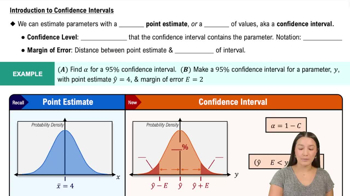
A confidence interval is a range of values, derived from sample statistics, that is likely to contain the true population parameter. It is expressed with a certain level of confidence, typically 95% or 99%, indicating the degree of certainty about the estimate. The width of the interval reflects the precision of the estimate; narrower intervals suggest more precise estimates.
Recommended video:
06:33
Introduction to Confidence Intervals

Sample Size

Sample size refers to the number of observations or data points collected in a study. A larger sample size generally leads to more reliable estimates of population parameters, as it reduces the impact of random variability. In the context of confidence intervals, increasing the sample size typically results in a narrower interval, indicating greater precision in estimating the population parameter.
Recommended video:
05:11
Sampling Distribution of Sample Proportion

Margin of Error

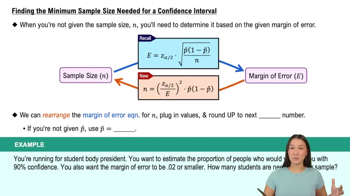
The margin of error is the amount of error that can be tolerated in the estimate of a population parameter. It is influenced by the sample size and the variability of the data. A larger sample size decreases the margin of error, which in turn reduces the width of the confidence interval, allowing for a more accurate representation of the population parameter.
Recommended video:
04:08
Finding the Minimum Sample Size Needed for a Confidence Interval
Related Practice
Textbook Question

Constructing a Confidence Interval In Exercises 25–28, use the data set to (b) find the sample standard deviation. Assume the population is normally distributed.

SAT Scores The SAT scores of 12 randomly selected high school seniors

66
views
Textbook Question

Constructing a Confidence Interval In Exercises 31 and 32, use the data set to (b) find the sample standard deviation

[APPLET] Earnings The annual earnings (in dollars) of 32 randomly selected intermediate level life insurance underwriters (Adapted from Salary.com)

72
views
Textbook Question

When all other quantities remain the same, how does the indicated change affect the width of a confidence interval? Explain.

c. Increase in the population standard deviation

84
views
Textbook Question

Fast Food You wish to estimate, with 90% confidence, the population proportion of U.S. families who eat fast food at least once per week. Your estimate must be accurate within 3% of the population proportion.

b. Find the minimum sample size needed, using a prior study that found that 83% of U.S. families eat fast food at least once per week. (Source: The Barbecue Lab)

78
views
Textbook Question

Finite Population Correction Factor In Exercises 57 and 58, use the information below.

In this section, you studied the construction of a confidence interval to estimate a population mean. In each case, the underlying assumption was that the sample size n was small in comparison to the population size N. When n ≥ 0.05N however, the formula that determines the standard error of the mean needs to be adjusted, as shown below.

[IMAGE]

Recall from the Section 5.4 exercises that the expression sqrt[(N-n)/(n-1)] is called a finite population correction factor. The margin of error is

[IMAGE]

Use the finite population correction factor to construct each confidence interval for the population mean.

c. c = 0.95, xbar = 40.3, σ = 0.5, N = 300, n = 68.

68
views
Textbook Question

Constructing a Confidence Interval In Exercises 25–28, use the data set to (c) construct a 99% confidence interval for the population mean. Assume the population is normally distributed.

Homework The weekly time spent (in hours) on homework for 18 randomly selected high school students

97
views