
Ch. 6 - Confidence Intervals
Larson - Elementary Statistics: Picturing the World 8th Edition
Larson8th EditionElementary Statistics: Picturing the WorldISBN: 9780137493470Not the one you use?Change textbook
Chapter 6, Problem 6.1.55

When estimating the population mean, why not construct a 99% confidence interval every time?

Verified step by step guidance
1
Understand the concept of a confidence interval: A confidence interval provides a range of values within which the true population parameter (e.g., the population mean) is likely to fall, based on a given confidence level (e.g., 95%, 99%). The confidence level represents the proportion of times the interval would capture the true parameter if the process were repeated many times.
Recognize the trade-off between confidence level and interval width: A higher confidence level (e.g., 99%) results in a wider confidence interval, meaning the estimate is less precise. Conversely, a lower confidence level (e.g., 90%) results in a narrower interval, providing a more precise estimate but with less certainty.
Consider the purpose of the analysis: If the goal is to make a highly precise estimate of the population mean, a narrower confidence interval (e.g., 95%) might be more appropriate. If the goal is to ensure a higher level of certainty, a wider interval (e.g., 99%) might be preferred.
Account for sample size and variability: A 99% confidence interval requires a larger sample size to maintain precision compared to a 95% confidence interval. If the sample size is small or the data is highly variable, constructing a 99% confidence interval may result in an interval that is too wide to be practically useful.
Balance precision and certainty: Constructing a 99% confidence interval every time may not always be necessary or efficient. The choice of confidence level should depend on the context of the problem, the desired balance between precision and certainty, and the resources available for data collection.

Verified video answer for a similar problem:

This video solution was recommended by our tutors as helpful for the problem above.
Video duration:
1m
Was this helpful?

Key Concepts

Here are the essential concepts you must grasp in order to answer the question correctly.

Confidence Interval

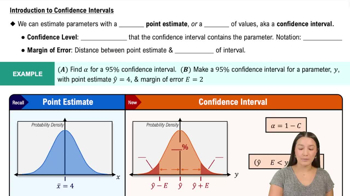
A confidence interval is a range of values, derived from sample statistics, that is likely to contain the population parameter with a specified level of confidence. For example, a 99% confidence interval suggests that if we were to take many samples and construct intervals, approximately 99% of those intervals would contain the true population mean.
Recommended video:
06:33
Introduction to Confidence Intervals

Trade-off Between Confidence Level and Precision

When constructing confidence intervals, there is a trade-off between the confidence level and the width of the interval. A higher confidence level, such as 99%, results in a wider interval, which may be less precise. Conversely, a lower confidence level, like 90%, yields a narrower interval but with less certainty that it contains the true mean.
Recommended video:
04:48
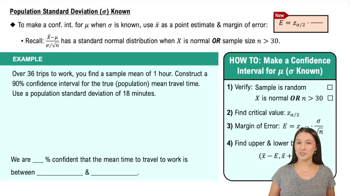
Population Standard Deviation Known

Sample Size Considerations

The sample size plays a crucial role in determining the width of a confidence interval. Larger sample sizes lead to more precise estimates of the population mean and narrower confidence intervals. Therefore, consistently using a 99% confidence interval may not be practical if the sample size is small, as it could result in overly broad intervals that are less informative.
Recommended video:
05:11
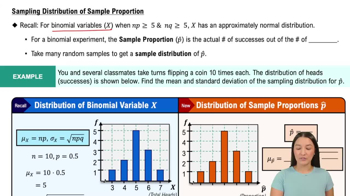
Sampling Distribution of Sample Proportion