Ch. 7 - Hypothesis Testing with One Sample
Larson - Elementary Statistics: Picturing the World 8th Edition
Larson8th EditionElementary Statistics: Picturing the WorldISBN: 9780137493470Not the one you use?Change textbook
Chapter 7, Problem 7.2.21

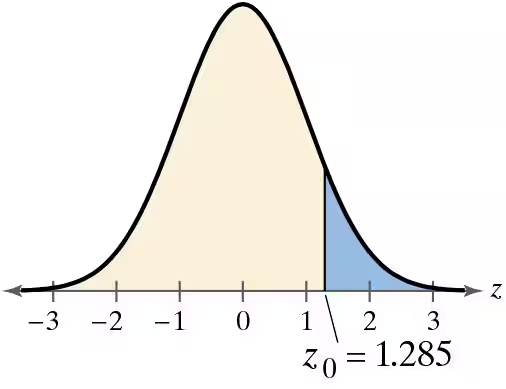
Graphical Analysis In Exercises 21 and 22, state whether each standardized test statistic z allows you to reject the null hypothesis. Explain your reasoning.


a. z = -1.301
b. z = 1.203
c. z = 1.280
d. z = 1.286


<IMAGE>

Verified step by step guidance
1
Step 1: Understand the context of the problem. The standardized test statistic z is used in hypothesis testing to determine whether to reject the null hypothesis. The decision depends on the critical value and the significance level (α). Typically, for a two-tailed test with α = 0.05, the critical z-values are approximately ±1.96.
Step 2: Compare each z-value provided in the problem (z = -1.301, z = 1.203, z = 1.280, z = 1.286) to the critical z-value. If the absolute value of z is greater than the critical value (e.g., |z| > 1.96 for α = 0.05), the null hypothesis is rejected. Otherwise, it is not rejected.
Step 3: Analyze the graph provided. The graph shows a z-distribution with a critical z-value of z₀ = 1.285, which appears to represent the boundary for rejection in a one-tailed test. This suggests that z-values greater than 1.285 fall into the rejection region.
Step 4: For each z-value: (a) z = -1.301 is less than the critical value and does not fall into the rejection region. (b) z = 1.203 is less than the critical value and does not fall into the rejection region. (c) z = 1.280 is less than the critical value and does not fall into the rejection region. (d) z = 1.286 is greater than the critical value and falls into the rejection region.
Step 5: Conclude that only z = 1.286 allows you to reject the null hypothesis based on the graph and the critical z-value provided. The reasoning is that it exceeds the critical z-value, indicating statistical significance.

Verified video answer for a similar problem:

This video solution was recommended by our tutors as helpful for the problem above.
Video duration:
1m
Was this helpful?

Key Concepts

Here are the essential concepts you must grasp in order to answer the question correctly.

Standardized Test Statistic (z)

A standardized test statistic, commonly denoted as z, measures how many standard deviations an element is from the mean. In hypothesis testing, the z-value helps determine whether to reject the null hypothesis by comparing it to critical values from the standard normal distribution.
Recommended video:
Guided course
06:34
Step 2: Calculate Test Statistic

Null Hypothesis (H0)

The null hypothesis (H0) is a statement that there is no effect or no difference, and it serves as the default assumption in hypothesis testing. The goal of statistical tests is to determine whether there is enough evidence to reject H0 in favor of an alternative hypothesis (H1).
Recommended video:
Guided course
06:21
Step 1: Write Hypotheses

Critical Value

A critical value is a threshold that defines the boundary for rejecting the null hypothesis. In the context of a z-test, if the calculated z-value exceeds the critical value (e.g., 1.285 in the provided image), it indicates that the result is statistically significant, leading to the rejection of H0.
Recommended video:
05:50
Critical Values: t-Distribution
Related Practice
Textbook Question

Describe the difference between calculating the standardized test statistic, Z^2, for a chi-square test for variance and a chi-square test for standard deviation.

90
views

Textbook Question

Deciding on a Distribution In Exercises 31 and 32, decide whether you should use the standard normal sampling distribution or a t-sampling distribution to perform the hypothesis test. Justify your decision. Then use the distribution to test the claim. Write a short paragraph about the results of the test and what you can conclude about the claim.


Tuition and Fees An education publication claims that the mean in-state tuition and fees at public four-year institutions by state is more than \$10,500 per year. A random sample of 30 states has a mean in-state tuition and fees at public four-year institutions of \$10,931 per year. Assume the population standard deviation is \$2380. At α=0.01, test the publication’s claim.

49
views
Textbook Question

Identifying Type I and Type II Errors In Exercises 31–36, describe type I and type II errors for a hypothesis test of the indicated claim.


Phone Repairs A cell phone repair shop advertises that the mean cost of repairing a phone screen is less than \$120.

216
views
Textbook Question

In Exercises 15–22, test the claim about the population variance or standard deviation at the level of significance Assume the population is normally distributed.

Claim: σ^2>19, α=0.1. Sample statistics: s^2=28, n=17

54
views
Textbook Question

Writing Hypotheses: Medicine A medical research team is investigating the mean cost of a 30-day supply of a heart medication. A pharmaceutical company thinks that the mean cost is less than \$60. You want to support this claim. How would you write the null and alternative hypotheses?

66
views
Textbook Question

In Exercises 3–8, find the critical value(s) and rejection region(s) for the type of t-test with level of significance alpha and sample size n.

Right-tailed test, α=0.05, n=23

77
views