Ch. 7 - Hypothesis Testing with One Sample
Larson - Elementary Statistics: Picturing the World 8th Edition
Larson8th EditionElementary Statistics: Picturing the WorldISBN: 9780137493470Not the one you use?Change textbook
Chapter 7, Problem 7.1.60

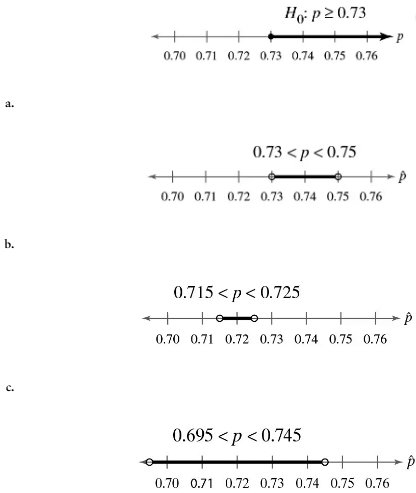
Graphical Analysis In Exercises 57–60, you are given a null hypothesis and three confidence intervals that represent three samplings. Determine whether each confidence interval indicates that you should reject H0. Explain your reasoning.
Graphical representation of null hypothesis and confidence intervals for statistical analysis.

Verified step by step guidance
1
Step 1: Understand the null hypothesis (H0). The null hypothesis states that p ≥ 0.73, where p represents the population proportion. To reject H0, the confidence interval must not include values greater than or equal to 0.73.
Step 2: Analyze confidence interval (a). The interval is 0.73 < p < 0.75. Since this interval starts at 0.73 and includes values greater than 0.73, it does not provide evidence to reject H0.
Step 3: Analyze confidence interval (b). The interval is 0.715 < p < 0.725. This interval does not include 0.73 or any values greater than 0.73, which suggests that H0 can be rejected based on this sampling.
Step 4: Analyze confidence interval (c). The interval is 0.695 < p < 0.745. This interval includes 0.73, so it does not provide evidence to reject H0.
Step 5: Summarize the findings. Confidence interval (b) indicates rejection of H0 because it excludes 0.73 and values greater than 0.73, while intervals (a) and (c) do not provide evidence to reject H0 as they include values greater than or equal to 0.73.

Verified video answer for a similar problem:

This video solution was recommended by our tutors as helpful for the problem above.
Video duration:
3m
Was this helpful?

Key Concepts

Here are the essential concepts you must grasp in order to answer the question correctly.

Null Hypothesis (H0)

The null hypothesis (H0) is a statement that there is no effect or no difference, and it serves as the default assumption in statistical testing. In this context, H0 states that the population proportion (p) is greater than or equal to 0.73. To determine whether to reject H0, we compare the confidence intervals from the samples to this hypothesis.
Recommended video:
Guided course
06:21
Step 1: Write Hypotheses

Confidence Interval

A confidence interval is a range of values derived from sample data that is likely to contain the true population parameter. Each confidence interval provides an estimate of where the true proportion (p) lies. If a confidence interval does not include the value specified in the null hypothesis, it suggests that we may reject H0.
Recommended video:
06:33
Introduction to Confidence Intervals

Statistical Significance

Statistical significance refers to the likelihood that a result or relationship is caused by something other than mere random chance. In this scenario, if the confidence intervals for the sample proportions (p̂) do not overlap with the null hypothesis value (0.73), it indicates that the results are statistically significant, leading to a potential rejection of H0.
Recommended video:
Guided course
05:53
Parameters vs. Statistics
Related Practice
Textbook Question

Hypothesis Testing Using Rejection Regions In Exercises 23–30, (a) identify the claim and state H0 and Ha, (b) find the critical value(s) and identify the rejection region(s), (c) find the standardized test statistic X^2, (d) decide whether to reject or fail to reject the null hypothesis, and (e) interpret the decision in the context of the original claim. Assume the population is normally distributed.


Salaries The annual salaries (in dollars) of 12 randomly chosen nursing supervisors are shown in the table at the left. At α=0.10, is there enough evidence to reject the claim that the standard deviation of the annual salaries is \$18,630?


84
views
Textbook Question

Graphical Analysis In Exercises 57–60, you are given a null hypothesis and three confidence intervals that represent three samplings. Determine whether each confidence interval indicates that you should reject H0. Explain your reasoning.

61
views
Textbook Question

Identifying a Test In Exercises 21–24, determine whether the hypothesis test is left-tailed, right-tailed, or two-tailed.


Ha: μ ≤ 8.0

H0: μ > 8.0

82
views
Textbook Question

Stating Hypotheses In Exercises 11–16, the statement represents a claim. Write its complement and state which is H0 and which is Ha.


σ^2 ≥ 1.2

79
views
Textbook Question

In Exercises 7–12, find the critical value(s) and rejection region(s) for the type of chi-square test with sample size n and level of significance α.


Two-tailed test, n=61,α=0.01

92
views
Textbook Question

Identifying Type I and Type II Errors In Exercises 31–36, describe type I and type II errors for a hypothesis test of the indicated claim.


Security A campus security department publicizes that at most 25% of applicants become campus security officers.

65
views