Ch. 7 - Hypothesis Testing with One Sample
Larson - Elementary Statistics: Picturing the World 8th Edition
Larson8th EditionElementary Statistics: Picturing the WorldISBN: 9780137493470Not the one you use?Change textbook
Chapter 7, Problem 7.2.44

Hypothesis Testing Using Rejection Region(s) In Exercises 39–44, (a) identify the claim and state H0 and Ha, (b) find the critical value(s) and identify the rejection region(s), (c) find the standardized test statistic z, (d) decide whether to reject or fail to reject the null hypothesis, and (e) interpret the decision in the context of the original claim.


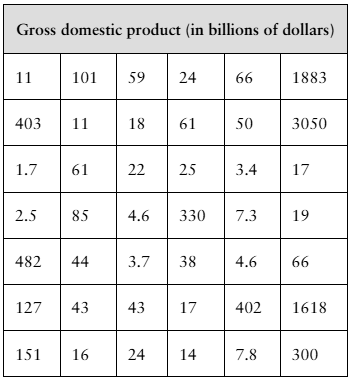
[APPLET] Gross Domestic Product A politician estimates that the mean gross domestic product (GDP) per country in a recent year is greater than \$400 billion. You want to test this estimate. To do so, you determine the GDPs of 42 randomly selected countries for that year. The results (in billions of dollars) are shown in the table at the left. Assume the population standard deviation is \$2099 billion. At alpha=0.06, can you support the politician’s estimate?


tab1

Verified step by step guidance
1
Step 1: Identify the claim and state the null hypothesis (H0) and alternative hypothesis (Ha). The claim is that the mean GDP per country is greater than \$400 billion. Thus, H0: μ = 400 (the mean GDP is \$400 billion) and Ha: μ > 400 (the mean GDP is greater than \$400 billion).
Step 2: Determine the critical value(s) and rejection region(s). Since the test is one-tailed (greater than), use the z-distribution table to find the critical value corresponding to alpha = 0.06. The rejection region is z > critical value.
Step 3: Calculate the standardized test statistic z. First, compute the sample mean (x̄) using the provided GDP data. Then, use the formula z = (x̄ - μ) / (σ / √n), where μ = 400, σ = 2099 (population standard deviation), and n = 42 (sample size).
Step 4: Compare the calculated z-value to the critical value. If the z-value falls in the rejection region (z > critical value), reject the null hypothesis; otherwise, fail to reject the null hypothesis.
Step 5: Interpret the decision in the context of the original claim. If the null hypothesis is rejected, it supports the politician's claim that the mean GDP per country is greater than \$400 billion. If the null hypothesis is not rejected, there is insufficient evidence to support the claim.

Verified video answer for a similar problem:

This video solution was recommended by our tutors as helpful for the problem above.
Video duration:
5m
Was this helpful?

Key Concepts

Here are the essential concepts you must grasp in order to answer the question correctly.

Hypothesis Testing

Hypothesis testing is a statistical method used to make decisions about a population based on sample data. It involves formulating two competing hypotheses: the null hypothesis (H0), which represents a statement of no effect or no difference, and the alternative hypothesis (Ha), which represents the claim being tested. The goal is to determine whether there is enough evidence in the sample data to reject H0 in favor of Ha.
Recommended video:
Guided course
06:21
Step 1: Write Hypotheses

Rejection Region

The rejection region is a set of values for the test statistic that leads to the rejection of the null hypothesis. It is determined based on the significance level (alpha), which defines the probability of making a Type I error (rejecting H0 when it is true). In hypothesis testing, if the calculated test statistic falls within this region, the null hypothesis is rejected, indicating that the sample provides sufficient evidence to support the alternative hypothesis.
Recommended video:
Guided course
09:56
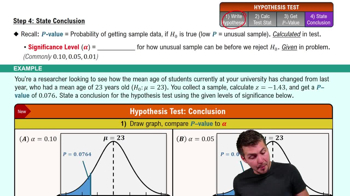
Step 4: State Conclusion

Standardized Test Statistic (z)

The standardized test statistic, often denoted as z, measures how many standard deviations an element is from the mean. In the context of hypothesis testing, it is calculated using the sample mean, population mean under the null hypothesis, population standard deviation, and sample size. This statistic is crucial for determining the position of the sample mean relative to the hypothesized population mean, allowing for the assessment of whether to reject or fail to reject the null hypothesis.
Recommended video:
Guided course
06:34
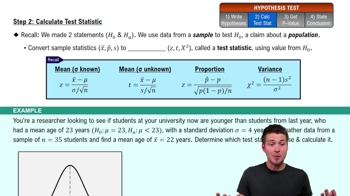
Step 2: Calculate Test Statistic