Ch. 8 - Hypothesis Testing with Two Samples
Larson - Elementary Statistics: Picturing the World 8th Edition
Larson8th EditionElementary Statistics: Picturing the WorldISBN: 9780137493470Not the one you use?Change textbook
Chapter 8, Problem 8.1.3

Describe another way you can perform a hypothesis test for the difference between the means of two populations using independent samples with and known that does not use rejection regions.

Verified step by step guidance
1
Step 1: Understand that the alternative method to perform a hypothesis test without using rejection regions is the p-value approach. This method compares the p-value to the significance level (α) to make a decision about the null hypothesis.
Step 2: Formulate the null hypothesis (H₀) and the alternative hypothesis (Hₐ). For example, H₀: μ₁ = μ₂ (the means of the two populations are equal) and Hₐ: μ₁ ≠ μ₂ (the means of the two populations are not equal).
Step 3: Calculate the test statistic using the formula for the difference between two means with independent samples. The formula is: (μ̄1-μ̄2)σ12/n1+σ22/n21, where μ̄₁ and μ̄₂ are the sample means, σ₁² and σ₂² are the population variances, and n₁ and n₂ are the sample sizes.
Step 4: Determine the p-value by finding the probability of observing a test statistic as extreme as the one calculated in Step 3, under the assumption that the null hypothesis is true. Use the appropriate distribution (e.g., the standard normal distribution if variances are known).
Step 5: Compare the p-value to the significance level (α). If the p-value is less than or equal to α, reject the null hypothesis (H₀). If the p-value is greater than α, fail to reject the null hypothesis. This decision provides the conclusion of the hypothesis test.

Verified video answer for a similar problem:

This video solution was recommended by our tutors as helpful for the problem above.
Video duration:
3m
Was this helpful?

Key Concepts

Here are the essential concepts you must grasp in order to answer the question correctly.

Hypothesis Testing

Hypothesis testing is a statistical method used to make inferences about population parameters based on sample data. It involves formulating a null hypothesis (H0) and an alternative hypothesis (H1), then using sample statistics to determine whether to reject H0. The process typically includes calculating a test statistic and comparing it to a critical value or using a p-value to assess significance.
Recommended video:
Guided course
06:21
Step 1: Write Hypotheses

Independent Samples

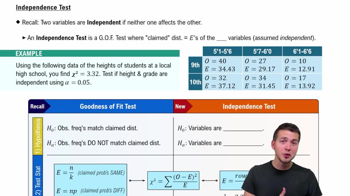
Independent samples refer to two or more groups that are not related or paired in any way. In hypothesis testing for the difference between means, it is crucial that the samples are independent to ensure that the results are not biased by any relationship between the groups. This independence allows for valid comparisons of the means of the populations from which the samples are drawn.
Recommended video:
Guided course
06:28
Independence Test

Confidence Intervals

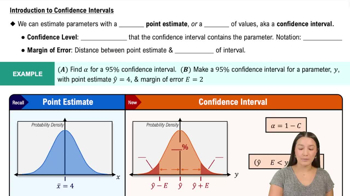
A confidence interval is a range of values derived from sample statistics that is likely to contain the true population parameter with a specified level of confidence, typically 95% or 99%. Instead of using rejection regions, one can perform hypothesis tests by checking if the difference between sample means falls within the confidence interval for the difference of means. If the interval does not include zero, it suggests a significant difference between the population means.
Recommended video:
06:33
Introduction to Confidence Intervals
Related Practice
Textbook Question

In Exercises 7–10, the statement represents a claim. Write its complement and state which is Ho and which is Ha.


μ≠2.28

40
views

Textbook Question

Gas Mileage The table shows the gas mileages (in miles per gallon) of eight cars with and without using a fuel additive. At α=0.10, is there enough evidence to conclude that the additive improved gas mileage? Assume the populations are normally distributed.


48
views
Textbook Question

A pediatrician claims that the mean birth weight of a single-birth baby is greater than the mean birth weight of a baby that has a twin. The mean birth weight of a random sample of 85 single-birth babies is 3086 grams. Assume the population standard deviation is 563 grams. The mean birth weight of a random sample of 68 babies that have a twin is 2263 grams. Assume the population standard deviation is 624 grams. At α=0.10, can you support the pediatrician’s claim? Interpret the decision in the context of the original claim.

55
views
Textbook Question

Independent and Dependent Samples In Exercises 5–8, classify the two samples as independent or dependent and justify your answer.

Sample 1: The commute times of 10 workers when they use their own vehicles

Sample 2: The commute times of the same 10 workers when they use public transportation

61
views
Textbook Question

Getting at the Concept Explain why the null hypothesis Ho: μ1=μ2 is equivalent to the null hypothesis .Ho: μ1-μ2=0

168
views
Textbook Question

Seat Belt Use In a survey of 1000 drivers from the West, 934 wear a seat belt. In a survey of 1000 drivers from the Northeast, 909 wear a seat belt. At α=0.05, can you support the claim that the proportion of drivers who wear seat belts is greater in the West than in the Northeast? (Adapted from National Highway Traffic Safety Administration)

46
views