Ch. 10 - Correlation and Regression
Triola - Elementary Statistics 14th Edition
Triola14th EditionElementary StatisticsISBN: 9780137366446Not the one you use?Change textbook
Chapter 10, Problem 10.2.2

Notation What is the difference between the regression equation y^ = b0 + b1x and the regression equation y = β0 + β1x.

Verified step by step guidance
1
Understand the context: Both equations represent linear regression models, which are used to predict the value of a dependent variable (y) based on an independent variable (x). However, the notation differs based on the context of estimation versus population parameters.
Step 1: The equation y^ = b0 + b1x represents the estimated regression line derived from sample data. Here, b0 and b1 are the sample estimates of the intercept and slope, respectively, calculated using statistical methods like least squares.
Step 2: The equation y = β0 + β1x represents the true regression line in the population. β0 and β1 are the population parameters, which are typically unknown and represent the actual relationship between x and y in the entire population.
Step 3: Recognize the distinction: b0 and b1 are sample-based estimates used to approximate β0 and β1. The sample estimates (b0, b1) are subject to sampling variability, meaning they can change depending on the sample data collected.
Step 4: Practical implication: In real-world applications, we use y^ = b0 + b1x to make predictions because the population parameters (β0, β1) are usually unknown. Statistical inference methods are used to estimate how close b0 and b1 are to β0 and β1.

Verified video answer for a similar problem:

This video solution was recommended by our tutors as helpful for the problem above.
Video duration:
1m
Was this helpful?

Key Concepts

Here are the essential concepts you must grasp in order to answer the question correctly.

Regression Equation

A regression equation is a mathematical representation that describes the relationship between a dependent variable (y) and one or more independent variables (x). The equation typically takes the form y^ = b0 + b1x, where y^ is the predicted value, b0 is the y-intercept, and b1 is the slope of the line, indicating how much y changes for a unit change in x.
Recommended video:
Guided course
08:45
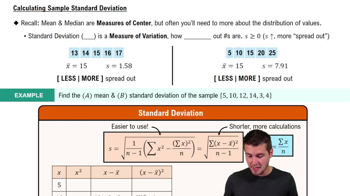
Calculating Standard Deviation

Estimation vs. Population Parameters

In statistics, the notation y^ = b0 + b1x uses 'b' coefficients, which are estimates derived from sample data, while y = β0 + β1x uses 'β' coefficients, which represent the true population parameters. The distinction highlights that 'b' values are calculated from sample data, while 'β' values are theoretical and apply to the entire population.
Recommended video:
Guided course
05:53
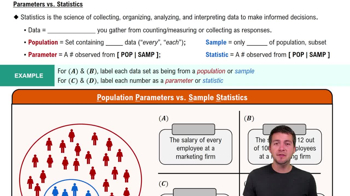
Parameters vs. Statistics

Predicted vs. Actual Values

The notation y^ indicates predicted values generated by the regression model based on the independent variable(s), while y represents the actual observed values. Understanding this difference is crucial for interpreting regression results, as it helps in assessing the model's accuracy and the extent to which the model explains the variability in the actual data.
Recommended video:
Guided course
04:39
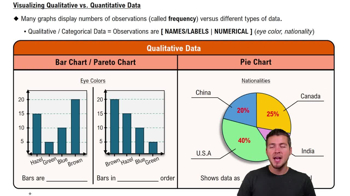
Visualizing Qualitative vs. Quantitative Data
Related Practice
Textbook Question

Finding the Best Model

In Exercises 5–16, construct a scatterplot and identify the mathematical model that best fits the given data. Assume that the model is to be used only for the scope of the given data, and consider only linear, quadratic, logarithmic, exponential, and power models.

Global Warming Listed below are mean annual temperatures (°C) of the earth for each decade, beginning with the decade of the 1880s. Find the best model and then predict the value for 2090–2099. Comment on the result.

27
views
Textbook Question

Interpreting the Coefficient of Determination

In Exercises 5–8, use the value of the linear correlation coefficient r to find the coefficient of determination and the percentage of the total variation that can be explained by the linear relationship between the two variables.

Times of Taxi Rides and Fares r = 0.953 (x = time in minutes, y = fare in dollars)

189
views
Textbook Question

Dummy Variable Refer to Data Set 18 “Bear Measurements” in Appendix B and use the sex, age, and weight of the bears. For sex, let 0 represent female and let 1 represent male. Letting the response variable represent weight, use the variable of age and the dummy variable of sex to find the multiple regression equation. Use the equation to find the predicted weight of a bear with the characteristics given below. Does sex appear to have much of an effect on the weight of a bear?


Female bear that is 20 years of age

Male bear that is 20 years of age

228
views
Textbook Question

Finding the Best Model

In Exercises 5–16, construct a scatterplot and identify the mathematical model that best fits the given data. Assume that the model is to be used only for the scope of the given data, and consider only linear, quadratic, logarithmic, exponential, and power models.

Detecting Fraud Leading digits of check amounts are often analyzed for the purpose of detecting fraud. The accompanying table lists frequencies of leading digits from checks written by the author (an honest guy).

26
views
Textbook Question

Interpreting r

In Exercises 5–8, use a significance level of α = 0.05 and refer to the accompanying displays.

Bear Length and Weight The lengths (inches) and weights (pounds) of 54 bears are obtained from Data Set 18 “Bear Measurements” in Appendix B, and results are shown in the accompanying XLSTAT display. Is there sufficient evidence to support the claim that there is a linear correlation between length and weight?

265
views