
Ch. 4 - Probability
Triola - Elementary Statistics 14th Edition
Triola14th EditionElementary StatisticsISBN: 9780137366446Not the one you use?Change textbook
Chapter 4, Problem 4.3.15a

Denomination Effect
In Exercises 13–16, use the data in the following table. In an experiment to study the effects of using four quarters versus a \$1 bill, some college students were given four quarters and others were given a \$1 bill, and they could either keep the money or spend it on gum. The results are summarized in the table (based on data from “The Denomination Effect,” by Priya Raghubir and Joydeep Srivastava, Journal of Consumer Research, Vol. 36).


Denomination Effect


a. Find the probability of randomly selecting a student who spent the money, given that the student was given four quarters.

Verified step by step guidance
1
Step 1: Understand the problem. We are tasked with finding the probability of a student spending the money, given that the student was given four quarters. This is a conditional probability problem.
Step 2: Recall the formula for conditional probability: P(A|B) = P(A ∩ B) / P(B). Here, A is the event 'student spent the money' and B is the event 'student was given four quarters'.
Step 3: Identify the relevant data from the table. The number of students who were given four quarters and spent the money is 27. The total number of students who were given four quarters is 27 + 16 = 43.
Step 4: Calculate P(A ∩ B) and P(B). P(A ∩ B) is the probability of a student being given four quarters and spending the money, which is 27/43. P(B) is the probability of a student being given four quarters, which is also 43/total number of students.
Step 5: Substitute the values into the formula P(A|B) = P(A ∩ B) / P(B). Simplify the expression to find the conditional probability.

Verified video answer for a similar problem:

This video solution was recommended by our tutors as helpful for the problem above.
Video duration:
2m
Was this helpful?

Key Concepts

Here are the essential concepts you must grasp in order to answer the question correctly.

Probability

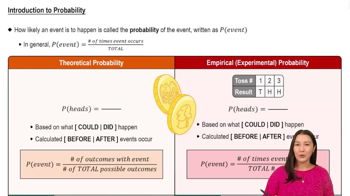
Probability is a measure of the likelihood that a particular event will occur, expressed as a number between 0 and 1. In this context, it helps determine the chance of a student spending their money on gum given that they received four quarters. The formula for calculating probability is the number of favorable outcomes divided by the total number of possible outcomes.
Recommended video:
5:37
Introduction to Probability

Conditional Probability

Conditional probability refers to the probability of an event occurring given that another event has already occurred. In this case, we are interested in the probability of students purchasing gum, conditioned on the fact that they were given four quarters. This concept is crucial for understanding how the denomination of money influences spending behavior.
Recommended video:
5:37
Introduction to Probability

Data Interpretation

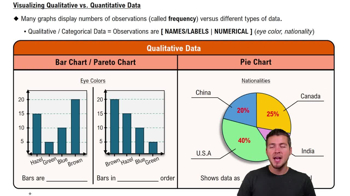
Data interpretation involves analyzing and making sense of data presented in tables or graphs. In this scenario, the table provides counts of students who purchased gum versus those who kept the money, which is essential for calculating the required probabilities. Understanding how to extract relevant information from data is key to answering statistical questions effectively.
Recommended video:
Guided course
04:39
Visualizing Qualitative vs. Quantitative Data
Related Practice
Textbook Question

Corporate Officers and Committees The Self Driving Unicycle Company was recently successfully funded via Kickstarter and must now appoint a president, chief executive officer (CEO), chief operating officer (COO), and chief financial officer (CFO), and chief human resources officer (CHR). It must also appoint a strategic planning committee with five different members. There are 15 qualified candidates, and officers can also serve on the committee.


a. How many different ways can the five officers be appointed?

151
views
Textbook Question

Redundancy in Computer Hard Drives It is generally recognized that it is wise to backup computer data. Assume that the following refer to use of Western Digital model WD60EFRX hard drives, which have an annual failure rate of 3.66% (based on data from Backblaze, Inc.).

a. If you store all of your computer data on a single hard drive, what is the probability that the drive will fail during a year?

173
views
Textbook Question

Phase I of a Clinical Trial A clinical test on humans of a new drug is normally done in three phases. Phase I is conducted with a relatively small number of healthy volunteers. For example, a phase I test of bexarotene involved only 14 subjects. Assume that we want to treat 14 healthy humans with this new drug and we have 16 suitable volunteers available.


a. If the subjects are selected and treated one at a time in sequence, how many different sequential arrangements are possible if 14 people are selected from the 16 that are available?


149
views
Textbook Question

Alarm Clock Life Hack Each of us must sometimes wake up early for something really important, such as a final exam, job interview, or an early flight. (Professional golfer Jim Furyk was disqualified from a tournament when his cellphone lost power and he overslept.) Assume that a battery-powered alarm clock has a 0.005 probability of failure, a smartphone alarm clock has a 0.052 probability of failure, and an electric alarm clock has a 0.001 probability of failure.

a. What is the probability that your single battery-powered alarm clock works successfully when you need it?

166
views
Textbook Question

Dice and Coins


a. Find the probability that when a single six-sided die is rolled, the outcome is 5.

301
views
Textbook Question

Redundancy in Computer Hard Drives The Seagate ST8000NM0055 hard drive has a 1.22% rate of failures in a year (based on data from Backblaze, Inc.). For the following, assume that all hard drives are that Seagate model.


a. If all of your computer data are stored on a hard disk drive with a copy stored on a second hard disk drive, what is the probability that during a year, you can avoid catastrophe with at least one working drive? Express the result with six decimal places.

159
views