Ch. 4 - Probability
Triola - Elementary Statistics 14th Edition
Triola14th EditionElementary StatisticsISBN: 9780137366446Not the one you use?Change textbook
Chapter 4, Problem 4.3.5

Notation For a polygraph (lie detector) used when a subject is presented with a question, let L= the subject lied and let Y = the polygraph indicated that the subject told a lie. Use your own words to translate the notation P (Y|L) into a verbal statement.

Verified step by step guidance
1
Step 1: Understand the notation P(Y|L). This represents a conditional probability, which is the probability of event Y occurring given that event L has already occurred.
Step 2: Break down the components. Here, Y represents the polygraph indicating that the subject told a lie, and L represents the subject actually lying.
Step 3: Translate the notation into words. P(Y|L) can be verbally expressed as 'the probability that the polygraph indicates the subject told a lie, given that the subject actually lied.'
Step 4: Recognize the importance of conditional probability. This notation is used to describe how likely one event (Y) is to occur under the condition that another event (L) has already happened.
Step 5: Apply this understanding to real-world contexts. Conditional probabilities like P(Y|L) are often used in evaluating the reliability of tests or systems, such as polygraphs, in detecting specific outcomes.

Verified video answer for a similar problem:

This video solution was recommended by our tutors as helpful for the problem above.
Video duration:
3m
Was this helpful?

Key Concepts

Here are the essential concepts you must grasp in order to answer the question correctly.

Conditional Probability

Conditional probability refers to the likelihood of an event occurring given that another event has already occurred. In this context, P(Y|L) represents the probability that the polygraph indicates a lie (Y) given that the subject actually lied (L). Understanding this concept is crucial for interpreting how the polygraph's results relate to the truthfulness of the subject.
Recommended video:
5:37
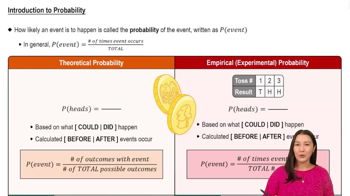
Introduction to Probability

Notation in Probability

In probability theory, notation is used to succinctly express relationships between events. The notation P(A|B) denotes the probability of event A occurring given that event B has occurred. Familiarity with this notation helps in translating mathematical expressions into verbal statements, which is essential for clear communication of statistical concepts.
Recommended video:
5:37
Introduction to Probability

Polygraph Functionality

A polygraph, or lie detector, measures physiological responses such as heart rate, blood pressure, and respiration to determine if a subject is lying. Understanding how a polygraph functions and the implications of its readings is important for interpreting the results accurately, particularly in the context of conditional probabilities like P(Y|L).
Recommended video:
Guided course
07:09
Probability From Given Z-Scores - TI-84 (CE) Calculator
Related Practice
Textbook Question

Notation What does the symbol ! represent? The five starting players of an NBA basketball team can stand in a line 5! different ways, so what is the actual number of ways that the five players can stand in a line?

230
views
Textbook Question

In Exercises 17–20, refer to the accompanying table showing results from experiments conducted by researchers Charles R. Honts (Boise State University) and Gordon H. Barland (Department of Defense Polygraph Institute). In each case, it was known whether or not the subject lied, so the table indicates when the polygraph (lie detector) test was correct.


False Negative Find the probability of selecting a subject with a negative polygraph result, given that the subject lied. What would be an unfavorable consequence of this error?

163
views
Textbook Question

Exclusive Or The exclusive or means either one or the other event occurs, but not both.

If one of the high school drivers is randomly selected, find the probability of getting one who texted while driving or drove when drinking alcohol.

b. Repeat Exercise 11 “Texting or Drinking” using the exclusive or instead of the inclusive or.

268
views
Textbook Question

Penicillin “Who discovered penicillin: Marcel Bich, William Penn, Jonas Salk, Alexander Fleming, or Louis Pasteur?” If you make a random guess for the answer to that question, what is the probability that your answer is the correct answer of Alexander Fleming?

105
views
Textbook Question

In Exercises 21-28, find the probability and answer the questions.


Mendelian Genetics When Mendel conducted his famous genetics experiments with peas, one sample of offspring consisted of 428 green peas and 152 yellow peas. Based on those results, estimate the probability of getting an offspring pea that is green. Is the result reasonably close to the expected value of as Mendel claimed?

212
views
Textbook Question

In Exercises 13–20, express the indicated degree of likelihood as a probability value between 0 and 1.


SAT Test When making a random guess for an answer to a multiple choice question on an SAT test, the possible answers are a, b, c, d, e, so there is 1 chance in 5 of being correct.

179
views