
Ch. 4 - Probability
Triola - Elementary Statistics 14th Edition
Triola14th EditionElementary StatisticsISBN: 9780137366446Not the one you use?Change textbook
Chapter 4, Problem 4.2.1

Notation When randomly selecting a new smartphone, D denotes the event that it has a manufacturing defect. What do P(D) and P(D) represent?

Verified step by step guidance
1
Step 1: Understand the notation. In probability, 'P(D)' represents the probability of event 'D' occurring. Here, 'D' is the event that a randomly selected smartphone has a manufacturing defect.
Step 2: Clarify the meaning of 'P(D)'. It quantifies the likelihood of the event 'D' happening, expressed as a value between 0 and 1, where 0 means the event is impossible and 1 means the event is certain.
Step 3: Recognize that 'P(D)' is a mathematical representation of the probability. For example, if 5% of smartphones have defects, then P(D) = 0.05.
Step 4: If the problem also refers to 'P(D)', it is likely asking for the same probability value, as 'P(D)' is the standard notation for the probability of event 'D'.
Step 5: To calculate P(D) in practice, you would divide the number of defective smartphones by the total number of smartphones in the sample or population, using the formula: P(D)=Number of defective smartphonesTotal number of smartphones.

Verified video answer for a similar problem:

This video solution was recommended by our tutors as helpful for the problem above.
Video duration:
2m
Was this helpful?

Key Concepts

Here are the essential concepts you must grasp in order to answer the question correctly.

Probability

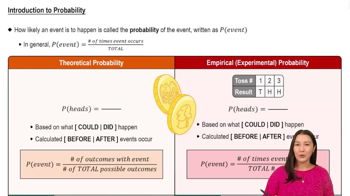
Probability is a measure of the likelihood that a particular event will occur, expressed as a number between 0 and 1. In this context, P(D) represents the probability that a randomly selected smartphone has a manufacturing defect. Understanding probability is essential for interpreting the likelihood of events in statistics.
Recommended video:
5:37
Introduction to Probability

Event

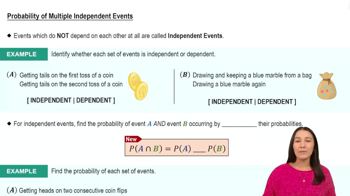
An event in probability is a specific outcome or a set of outcomes from a random experiment. In this case, D is the event that a smartphone has a manufacturing defect. Recognizing events helps in calculating probabilities and understanding the context of statistical analysis.
Recommended video:
05:54
Probability of Multiple Independent Events

Notation in Probability

Notation in probability provides a standardized way to represent events and their probabilities. P(D) specifically denotes the probability of event D occurring. Familiarity with this notation is crucial for effectively communicating and solving problems in statistics.
Recommended video:
5:37
Introduction to Probability
Related Practice
Textbook Question

In Exercises 6–10, use the following results from tests of an experiment to test the effectiveness of an experimental vaccine for children (based on data from USA Today). Express all probabilities in decimal form.


Find the probability of randomly selecting 2 subjects without replacement and finding that they both developed flu.

166
views
Textbook Question

Combination Lock The typical combination lock uses three numbers, each between 0 and 49. Opening the lock requires entry of the three numbers in the correct order. Is the name “combination” lock appropriate? Why or why not?

316
views
Textbook Question

In Exercises 9–20, use the data in the following table, which lists survey results from high school drivers at least 16 years of age (based on data from “Texting While Driving and Other Risky Motor Vehicle Behaviors Among U.S. High School Students,” by O’Malley, Shults, and Eaton, Pediatrics, Vol. 131, No. 6). Assume that subjects are randomly selected from those included in the table. Hint: Be very careful to read the question correctly.

Texting and Alcohol If four different high school drivers are randomly selected, find the probability that they all texted while driving.

144
views
Textbook Question

In Exercises 21-28, find the probability and answer the questions.


Social Networking In a Pew Research Center survey of Internet users, 3732 respondents say that they use social networking sites and 1380 respondents say that they do not use social networking sites. What is the probability that a randomly selected person uses a social networking site? Does that result suggest that it is likely (with a probability of 0.5 or greater) for someone to use social networking sites?

128
views
Textbook Question

In Exercises 13–20, express the indicated degree of likelihood as a probability value between 0 and 1.


Randomness When using a computer to randomly generate the last digit of a phone number to be called for a survey, there is 1 chance in 10 that the last digit is zero

177
views
Textbook Question

In Exercises 9–20, use the data in the following table, which lists survey results from high school drivers at least 16 years of age (based on data from “Texting While Driving and Other Risky Motor Vehicle Behaviors Among U.S. High School Students,” by O’Malley, Shults, and Eaton, Pediatrics, Vol. 131, No. 6). Assume that subjects are randomly selected from those included in the table. Hint: Be very careful to read the question correctly.


Texting or Drinking If one of the high school drivers is randomly selected, find the probability of getting one who texted while driving or drove when drinking alcohol.

137
views