
Ch. 7 - Estimating Parameters and Determining Sample Sizes
Triola - Elementary Statistics 14th Edition
Triola14th EditionElementary StatisticsISBN: 9780137366446Not the one you use?Change textbook
Chapter 7, Problem 7.1.23a

Critical Thinking. In Exercises 17–28, use the data and confidence level to construct a confidence interval estimate of p, then address the given question.


Job Interviews In a Harris poll of 514 human resource professionals, 45.9% said that body piercings and tattoos were big personal grooming red flags.


a. Among the 514 human resource professionals who were surveyed, how many of them said that body piercings and tattoos were big personal grooming red flags?

Verified step by step guidance
1
Step 1: Understand the problem. We are tasked with finding the number of human resource professionals who said that body piercings and tattoos were big personal grooming red flags. This is a simple application of percentages, where we are given the total number of surveyed professionals (514) and the percentage (45.9%).
Step 2: Recall the formula for finding a percentage of a total. The formula is: \( \text{Number} = \text{Total} \times \left( \frac{\text{Percentage}}{100} \right) \).
Step 3: Substitute the given values into the formula. Here, \( \text{Total} = 514 \) and \( \text{Percentage} = 45.9 \). The formula becomes: \( \text{Number} = 514 \times \left( \frac{45.9}{100} \right) \).
Step 4: Simplify the fraction \( \frac{45.9}{100} \) to convert the percentage into a decimal. This gives \( 0.459 \). The formula now becomes: \( \text{Number} = 514 \times 0.459 \).
Step 5: Multiply the total number of surveyed professionals (514) by the decimal value (0.459) to find the number of professionals who said body piercings and tattoos were big personal grooming red flags. This will give the final result.

Verified video answer for a similar problem:

This video solution was recommended by our tutors as helpful for the problem above.
Video duration:
1m
Was this helpful?

Key Concepts

Here are the essential concepts you must grasp in order to answer the question correctly.

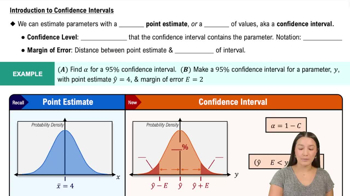
Confidence Interval

A confidence interval is a range of values, derived from sample statistics, that is likely to contain the true population parameter with a specified level of confidence. It provides an estimate of uncertainty around a sample statistic, such as a proportion. For example, if 45.9% of surveyed professionals indicated a preference, the confidence interval would help determine the range within which the true proportion of all professionals likely falls.
Recommended video:
06:33
Introduction to Confidence Intervals

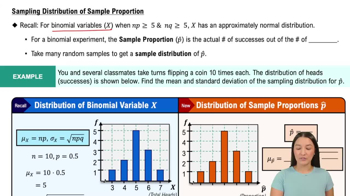
Sample Proportion

The sample proportion is the ratio of the number of successes (in this case, professionals who view body piercings and tattoos as red flags) to the total number of observations in the sample. It is calculated by dividing the number of affirmative responses by the total sample size. This value is crucial for constructing the confidence interval and understanding the survey results.
Recommended video:
05:11
Sampling Distribution of Sample Proportion

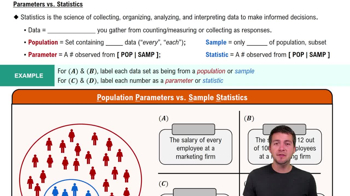
Population Parameter

A population parameter is a numerical value that summarizes a characteristic of an entire population, such as the true proportion of all human resource professionals who consider body piercings and tattoos as grooming red flags. In statistical analysis, we often use sample data to estimate this parameter, acknowledging that our estimates may vary due to sampling error.
Recommended video:
Guided course
05:53
Parameters vs. Statistics
Related Practice
Textbook Question

Space Mountain Use the following wait times (minutes) for the Space Mountain ride at Disney World (from Data Set 33 “Disney World Wait Times” in Appendix B). Construct a 95% confidence interval estimate of the mean of all wait times. Write a brief statement that interprets that confidence interval.


40 35 40 40 25 80 50 30 35 40

112
views
Textbook Question

Distributions Identify the distribution (normal, Student t, chi-square) that should be used in each of the following situations. If none of the three distributions can be used, what other method could be used?


a. In constructing a confidence interval of , you have 75 sample values and they appear to be from a population with a skewed distribution. The population standard deviation is not known.


188
views
Textbook Question

Arm Circumferences Listed below are arm circumferences (cm) of randomly selected women (based on Data Set 1 “Body Data” from Appendix B). Also shown is the normal quantile plot of those measurements.


b. Are the requirements for constructing a 95% confidence interval estimate of the population standard deviation satisfied? If so, construct that confidence interval.

86
views
Textbook Question

Voting Survey In a survey of 1002 people, 70% said that they voted in a recent presidential election (based on data from ICR Research Group). Voting records show that 61% of eligible voters actually did vote.


a. Among the 1002 people surveyed, what is the actual number of people who said that they voted?


150
views
Textbook Question

Airline Seating You are the operations manager for American Airlines and you are considering a higher fare level for passengers in aisle seats. You want to estimate the percentage of passengers who now prefer aisle seats. How many randomly selected air passengers must you survey? Assume that you want to be 95% confident that the sample percentage is within 2.5 percentage points of the true population percentage.


a. Assume that nothing is known about the percentage of passengers who prefer aisle seats.


100
views
Textbook Question

Astrology A sociologist plans to conduct a survey to estimate the percentage of adults who believe in astrology. How many people must be surveyed if we want a confidence level of 99% and a margin of error of four percentage points?


a. Assume that nothing is known about the percentage to be estimated.


89
views