
Ch. 7 - Estimating Parameters and Determining Sample Sizes
Triola - Elementary Statistics 14th Edition
Triola14th EditionElementary StatisticsISBN: 9780137366446Not the one you use?Change textbook
Chapter 7, Problem 7.4.28

Estimating the Median Use the sample data listed in Exercise 1 “Bootstrap Requirements” to generate 1000 bootstrap samples, and find the median in each of those samples. After obtaining the 1000 sample medians, find the 95% confidence interval estimate of the population median by evaluating p2.5 and p97.5 from the sorted 1000 medians. Given that the sample times in Exercise 1 are from the 50 times in Data Set 20 “Alcohol and Tobacco in Movies” and those 50 times have a median of 5.5, how well did the bootstrap method work to create a “good” confidence interval?

Verified step by step guidance
1
Step 1: Understand the problem. The goal is to use the bootstrap method to estimate the 95% confidence interval for the population median based on the sample data provided. Bootstrap involves resampling the original data with replacement to create multiple samples and then calculating a statistic (in this case, the median) for each sample.
Step 2: Generate 1000 bootstrap samples. To do this, randomly select data points from the original sample (with replacement) to create a new sample of the same size as the original. Repeat this process 1000 times to create 1000 bootstrap samples.
Step 3: Calculate the median for each bootstrap sample. For each of the 1000 bootstrap samples, compute the median value. This will result in a distribution of 1000 medians.
Step 4: Sort the 1000 medians in ascending order. Once sorted, identify the 2.5th percentile (p2.5) and the 97.5th percentile (p97.5) of the sorted medians. These values represent the lower and upper bounds of the 95% confidence interval for the population median.
Step 5: Compare the confidence interval obtained using the bootstrap method to the known median of the original data (5.5). Evaluate how well the bootstrap method worked by assessing whether the confidence interval includes the true median and whether it provides a reasonable range for the population median.

Verified video answer for a similar problem:

This video solution was recommended by our tutors as helpful for the problem above.
Video duration:
2m
Was this helpful?

Key Concepts

Here are the essential concepts you must grasp in order to answer the question correctly.

Bootstrap Sampling

Bootstrap sampling is a resampling technique used to estimate the distribution of a statistic by repeatedly sampling with replacement from the original data set. This method allows for the creation of multiple simulated samples, which can be analyzed to derive estimates such as means, medians, or confidence intervals. It is particularly useful when the sample size is small or when the underlying distribution is unknown.
Recommended video:
05:11
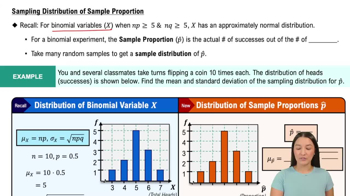
Sampling Distribution of Sample Proportion

Median

The median is a measure of central tendency that represents the middle value of a data set when it is ordered from least to greatest. If the data set has an odd number of observations, the median is the middle number; if even, it is the average of the two middle numbers. The median is less affected by outliers and skewed data than the mean, making it a robust measure for understanding the center of a distribution.
Recommended video:
Guided course
03:26
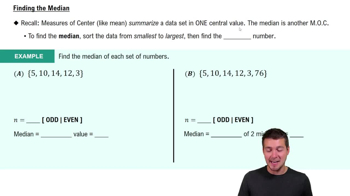
Calculating the Median

Confidence Interval

A confidence interval is a range of values, derived from sample statistics, that is likely to contain the true population parameter with a specified level of confidence, typically 95%. It is constructed using the sample data and reflects the uncertainty associated with estimating the population parameter. The endpoints of the interval, such as p2.5 and p97.5 in this context, indicate the lower and upper bounds of the interval, providing insight into the precision of the estimate.
Recommended video:
06:33
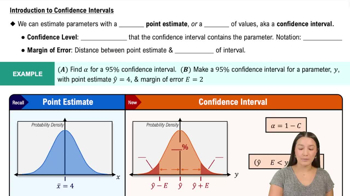
Introduction to Confidence Intervals
Related Practice
Textbook Question

Cell Phone Radiation. Listed below are amounts of cell phone radiation (W/kg) measured from randomly selected cell phones (based on data from the Federal Communications Commission). Use these values for Exercises 1–6.


[Image]


Level of Measurement What is the level of measurement of these data (nominal, ordinal, interval, ratio)? Are the original unrounded amounts of radiation continuous data or discrete data?

248
views
Textbook Question

Los Angeles Commute Time Listed below are 15 Los Angeles commute times (based on a sample from Data Set 31 “Commute Times” in Appendix B). Construct a 99% confidence interval estimate of the population mean. Is the confidence interval a good estimate of the population mean?


113
views
Textbook Question

Ages of Prisoners The accompanying frequency distribution summarizes sample data consisting of ages of randomly selected inmates in federal prisons (based on data from the Federal Bureau of Prisons). Use the data to construct a 95% confidence interval estimate of the mean age of all inmates in federal prisons.


199
views
Textbook Question

Archeology Archeologists have studied sizes of Egyptian skulls in an attempt to determine whether breeding occurred between different cultures. Listed below are the widths (mm) of skulls from 150 A.D. (based on data from Ancient Races of the Thebaid by Thomson and Randall-Maciver). Construct a 99% confidence interval estimate of the mean skull width.


166
views
Textbook Question

Degrees of Freedom In general, what does “degrees of freedom” refer to? For the sample data described in Exercise 7 “Requirements,” find the number of degrees of freedom, assuming that you want to construct a confidence interval estimate of u using the t distribution.

166
views
Textbook Question

Mean Body Temperature Data Set 5 “Body Temperatures” in Appendix B includes a sample of 106 body temperatures having a mean of 98.20 F and a standard deviation of 0.62 F. Construct a 95% confidence interval estimate of the mean body temperature for the entire population. What does the result suggest about the common belief that 98.6 F is the mean body temperature?

186
views