Ch. 7 - Estimating Parameters and Determining Sample Sizes
Triola - Elementary Statistics 14th Edition
Triola14th EditionElementary StatisticsISBN: 9780137366446Not the one you use?Change textbook
Chapter 7, Problem 7.1.5

Finding Critical Values.


In Exercises 5–8, find the critical value z=a/2 that corresponds to the given confidence level.


90%

Verified step by step guidance
1
Step 1: Understand the problem. The critical value zₐ/₂ corresponds to the z-score that separates the middle area (confidence level) from the tails in a standard normal distribution. For a 90% confidence level, the middle area under the curve is 0.90, leaving 0.10 in the tails.
Step 2: Divide the remaining area (0.10) equally between the two tails. Since the standard normal distribution is symmetric, each tail will have an area of 0.05.
Step 3: Determine the cumulative area to the left of the critical value zₐ/₂. For the upper critical value, this area is 1 - 0.05 = 0.95. For the lower critical value, the cumulative area is 0.05.
Step 4: Use a z-table or statistical software to find the z-score corresponding to the cumulative area of 0.95 (upper critical value) and 0.05 (lower critical value). These z-scores are the critical values.
Step 5: Interpret the result. The critical values zₐ/₂ are symmetric around the mean (0) of the standard normal distribution. The positive z-score corresponds to the upper critical value, and the negative z-score corresponds to the lower critical value.

Verified video answer for a similar problem:

This video solution was recommended by our tutors as helpful for the problem above.
Video duration:
3m
Was this helpful?

Key Concepts

Here are the essential concepts you must grasp in order to answer the question correctly.

Critical Value

A critical value is a point on the scale of the test statistic that separates the region where the null hypothesis is rejected from the region where it is not rejected. In the context of confidence intervals, it corresponds to the z-score that captures the desired level of confidence, indicating how far from the mean we need to go to encompass a certain percentage of the data.
Recommended video:
05:50
Critical Values: t-Distribution

Confidence Level

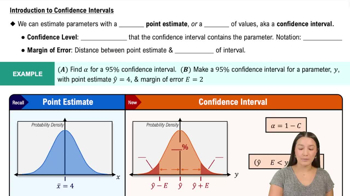
The confidence level represents the probability that the confidence interval will contain the true population parameter. Common confidence levels are 90%, 95%, and 99%. A 90% confidence level means that if we were to take many samples and build a confidence interval from each, approximately 90% of those intervals would contain the true parameter.
Recommended video:
06:33
Introduction to Confidence Intervals

Z-Score

A z-score is a statistical measurement that describes a value's relation to the mean of a group of values, expressed in terms of standard deviations. In the context of finding critical values, z-scores are used to determine the cutoff points for the desired confidence level, allowing statisticians to understand how extreme a value is within a normal distribution.
Recommended video:
Guided course
06:31
Z-Scores From Given Probability - TI-84 (CE) Calculator
Related Practice
Textbook Question

Finding Critical Values


In Exercises 5–8, find the critical value z=a/2 that corresponds to the given confidence level.


99.5%

183
views

Textbook Question

Seating Choice In a 3M Privacy Filters poll, respondents were asked to identify their favorite seat when they fly, and the results include these responses: window, window, other, other. Letting “window” and letting “other”, those four responses can be represented as {1, 1, 0, 0}. Here are ten bootstrap samples for those responses: [Image]

Using only the ten given bootstrap samples, construct an 80% confidence interval estimate of the proportion of respondents who indicated their favorite seat is “window.”

116
views
Textbook Question

Professor Evaluation Scores Listed below are student evaluation scores of professors from Data Set 28 “Course Evaluations” in Appendix B. Construct a 95% confidence interval estimate of for each of the two data sets. Does there appear to be a difference in variation?

111
views
Textbook Question

Critical Thinking. In Exercises 17–28, use the data and confidence level to construct a confidence interval estimate of p, then address the given question.


Births A random sample of 860 births in New York State included 426 boys. Construct a 95% confidence interval estimate of the proportion of boys in all births. It is believed that among all births, the proportion of boys is 0.512. Do these sample results provide strong evidence against that belief?

126
views
Textbook Question

Use the given information to find the number of degrees of freedom, the critical values X2L and X2R, and the confidence interval estimate of σ. It is reasonable to assume that a simple random sample has been selected from a population with a normal distribution:


Nicotine in Menthol Cigarettes 95% confidence; n = 25, s = 0.24 mg

149
views
Textbook Question

Medical Malpractice In a study of 1228 randomly selected medical malpractice lawsuits, it was found that 856 of them were dropped or dismissed (based on data from the Physicians Insurers Association of America). Use the bootstrap method to construct a 95% confidence interval estimate of the proportion of lawsuits that are dropped or dismissed. Use 1000 bootstrap samples. How does the result compare to the confidence interval found in Exercise 16 “Medical Malpractice” from Section 7-1?

173
views