

Ch. 8 - Hypothesis Testing
Triola - Elementary Statistics 14th Edition
Triola14th EditionElementary StatisticsISBN: 9780137366446Not the one you use?Change textbook
Chapter 8, Problem 8.2.17

Testing Claims About Proportions
In Exercises 9–32, test the given claim. Identify the null hypothesis, alternative hypothesis, test statistic, P-value, or critical value(s), then state the conclusion about the null hypothesis, as well as the final conclusion that addresses the original claim. Use the P-value method unless your instructor specifies otherwise. Use the normal distribution as an approximation to the binomial distribution, as described in Part 1 of this section.


Births A random sample of 860 births in New York State included 426 boys. Use a 0.05 significance level to test the claim that 51.2% of newborn babies are boys. Do the results support the belief that 51.2% of newborn babies are boys?

Verified step by step guidance
1
Step 1: Define the null hypothesis (H₀) and the alternative hypothesis (H₁). The null hypothesis is that the proportion of boys among newborns is 51.2%, or H₀: p = 0.512. The alternative hypothesis is that the proportion is different from 51.2%, or H₁: p ≠ 0.512. This is a two-tailed test.
Step 2: Calculate the sample proportion (p̂). The sample proportion is given by p̂ = x / n, where x is the number of boys (426) and n is the total number of births (860). Substitute the values to find p̂.
Step 3: Compute the test statistic (z). Use the formula z = (p̂ - p₀) / √(p₀(1 - p₀) / n), where p₀ is the hypothesized population proportion (0.512), p̂ is the sample proportion, and n is the sample size. Substitute the values to calculate z.
Step 4: Determine the P-value. Using the z-value from Step 3, find the P-value by looking up the corresponding area under the standard normal distribution curve. Since this is a two-tailed test, multiply the area by 2.
Step 5: Compare the P-value to the significance level (α = 0.05). If the P-value is less than or equal to 0.05, reject the null hypothesis (H₀). Otherwise, fail to reject H₀. Based on this decision, state whether the results support the claim that 51.2% of newborn babies are boys.

Verified video answer for a similar problem:

This video solution was recommended by our tutors as helpful for the problem above.
Video duration:
4m
Was this helpful?

Key Concepts

Here are the essential concepts you must grasp in order to answer the question correctly.

Hypothesis Testing

Hypothesis testing is a statistical method used to make decisions about a population based on sample data. It involves formulating two competing hypotheses: the null hypothesis (H0), which represents a statement of no effect or no difference, and the alternative hypothesis (H1), which represents the claim being tested. The goal is to determine whether there is enough evidence in the sample data to reject the null hypothesis in favor of the alternative.
Recommended video:
Guided course
06:21
Step 1: Write Hypotheses

P-value

The P-value is a measure that helps determine the strength of the evidence against the null hypothesis. It represents the probability of obtaining a test statistic at least as extreme as the one observed, assuming the null hypothesis is true. A smaller P-value indicates stronger evidence against the null hypothesis, and if the P-value is less than the significance level (e.g., 0.05), the null hypothesis is rejected.
Recommended video:
Guided course
06:50
Step 3: Get P-Value

Normal Approximation to the Binomial Distribution

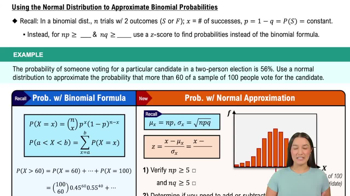
The normal approximation to the binomial distribution is a technique used when dealing with binomial experiments, particularly when the sample size is large. It allows us to use the normal distribution to approximate the probabilities of the binomial distribution, making calculations easier. This approximation is valid when both np and n(1-p) are greater than 5, where n is the number of trials and p is the probability of success.
Recommended video:
06:23
Using the Normal Distribution to Approximate Binomial Probabilities
Related Practice
Textbook Question

Finding P-values

In Exercises 5–8, either use technology to find the P-value or use Table A-3 to find a range of values for the P-value. Based on the result, what is the final conclusion?


Weights of Quarters The claim is that weights (grams) of quarters made after 1964 have a mean equal to 5.670 g as required by mint specifications. The sample size is and the test statistic is t = -3.135.

173
views
Textbook Question

Using Technology

In Exercises 5–8, identify the indicated values or interpret the given display. Use the normal distribution as an approximation to the binomial distribution, as described in Part 1 of this section. Use a 0.05 significance level and answer the following:


a. Is the test two-tailed, left-tailed, or right-tailed?

b. What is the test statistic?

c. What is the P-value?

d. What is the null hypothesis, and what do you conclude about it?

e. What is the final conclusion?


Adverse Reactions to Drug The drug Lipitor (atorvastatin) is used to treat high cholesterol. In a clinical trial of Lipitor, 47 of 863 treated subjects experienced headaches (based on data from Pfizer). The accompanying TI-83/84 Plus calculator display shows results from a test of the claim that fewer than 10% of treated subjects experience headaches.

151
views
Textbook Question

Testing Claims About Variation

In Exercises 5–16, test the given claim. Identify the null hypothesis, alternative hypothesis, test statistic, P-value, or critical value(s), then state the conclusion about the null hypothesis, as well as the final conclusion that addresses the original claim. Assume that a simple random sample is selected from a normally distributed population.


Bank Lines The Jefferson Valley Bank once had a separate customer waiting line at each teller window, but it now has a single waiting line that feeds the teller windows as vacancies occur. The standard deviation of customer waiting times with the old multiple-line configuration was 1.8 min. Listed below is a simple random sample of waiting times (minutes) with the single waiting line. Use a 0.05 significance level to test the claim that with a single waiting line, the waiting times have a standard deviation less than 1.8 min. What improvement occurred when banks changed from multiple waiting lines to a single waiting line?


6.5 6.6 6.7 6.8 7.1 7.3 7.4 7.7 7.7 7.7

121
views
Textbook Question

Finding Critical Values of (chi)^2 For large numbers of degrees of freedom, we can approximate critical values of as follows:

(chi)^2 = (1/2)(z + sqrt(2k-1))


Here k is the number of degrees of freedom and z is the critical value(s) found from technology or Table A-2. In Exercise 12 “Spoken Words” we have df = 55, so Table A-4 does not list an exact critical value. If we want to approximate a critical value of (chi)^2 in the right-tailed hypothesis test with α = 0.01 and a sample size of 56, we let k =55 with z = 2.33 (or the more accurate value of z = 2.326348 found from technology). Use this approximation to estimate the critical value of for Exercise 12. How close is it to the critical value of (chi)^2 = 82.292 obtained by using Statdisk and Minitab?

235
views
Textbook Question

Testing Claims About Variation

In Exercises 5–16, test the given claim. Identify the null hypothesis, alternative hypothesis, test statistic, P-value, or critical value(s), then state the conclusion about the null hypothesis, as well as the final conclusion that addresses the original claim. Assume that a simple random sample is selected from a normally distributed population.

Pulse Rates of Men A simple random sample of 153 men results in a standard deviation of 11.3 beats per minute (based on Data Set 1 “Body Data” in Appendix B). The normal range of pulse rates of adults is typically given as 60 to 100 beats per minute. If the range rule of thumb is applied to that normal range, the result is a standard deviation of 10 beats per minute. Use the sample results with a 0.05 significance level to test the claim that pulse rates of men have a standard deviation equal to 10 beats per minute; see the accompanying StatCrunch display for this test. What do the results indicate about the effectiveness of using the range rule of thumb with the “normal range” from 60 to 100 beats per minute for estimating in this case?

140
views
Textbook Question

Finding P-values

In Exercises 5–8, either use technology to find the P-value or use Table A-3 to find a range of values for the P-value. Based on the result, what is the final conclusion?


Cotinine in Smokers The claim is that smokers have a mean cotinine level greater than the level of 2.84 ng/mL found for nonsmokers. (Cotinine is used as a biomarker for exposure to nicotine.) The sample size is n = 902 and the test statistic is t = 56.319.

165
views