Test Statistic and Critical Value The statistics for the sample data in Exercise 1 are n = 15, x_bar = 6.133333, and s = 8.862978, where the units are millions of dollars. Find the test statistic and critical value(s) for a test of the claim that the salaries are from a population with a mean greater than 5 million dollars. Assume that a 0.05 significance level is used.
Testing Claims About Variation
In Exercises 5–16, test the given claim. Identify the null hypothesis, alternative hypothesis, test statistic, P-value, or critical value(s), then state the conclusion about the null hypothesis, as well as the final conclusion that addresses the original claim. Assume that a simple random sample is selected from a normally distributed population.
Minting of Pennies Data Set 40 “Coin Weights” lists weights (grams) of pennies minted after 1983. Here are the statistics for those weights: n = 37, xbar = 2.49910 g, s = 0.01648 g . Use a 0.05 significance level to test the claim that the sample is from a population of pennies with weights having a standard deviation greater than 0.01000 g.
Verified step by step guidance
Verified video answer for a similar problem:
Key Concepts
Hypothesis Testing
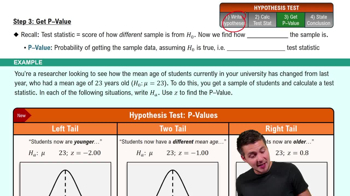
P-value
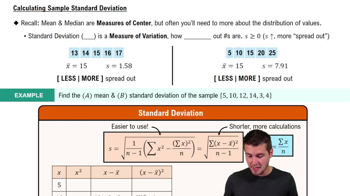
Standard Deviation
Estimates vs. Hypothesis Tests Labels on cans of Dr. Pepper soda indicate that they contain 12 oz of the drink. We could collect samples of those cans and accurately measure the actual contents, then we could use methods of Section 7-2 for making an estimate of the mean amount of Dr. Pepper in cans, or we could use those measured amounts to test the claim that the cans contain a mean of 12 oz. What is the difference between estimating the mean and testing a hypothesis about the mean?
Final Conclusions
In Exercises 21–24, use a significance level of α = 0.05 and use the given information for the following:
State a conclusion about the null hypothesis. (Reject H0 or fail to reject H0.)
Without using technical terms or symbols, state a final conclusion that addresses the original claim.
Original claim: The mean pulse rate (in beats per minute) of adult males is 72 bpm. The hypothesis test results in a P-value of 0.0095.
Randomization: Testing a Claim About a Mean
In Exercises 9–12, use the randomization procedure for the indicated exercise.
Section 8-3, Exercise 23 “Cell Phone Radiation”
Testing Claims About Proportions
In Exercises 9–32, test the given claim. Identify the null hypothesis, alternative hypothesis, test statistic, P-value, or critical value(s), then state the conclusion about the null hypothesis, as well as the final conclusion that addresses the original claim. Use the P-value method unless your instructor specifies otherwise. Use the normal distribution as an approximation to the binomial distribution, as described in Part 1 of this section.
Internet Use A random sample of 5005 adults in the United States includes 751 who do not use the Internet (based on three Pew Research Center polls). Use a 0.05 significance level to test the claim that the percentage of U.S. adults who do not use the Internet is now less than 48%, which was the percentage in the year 2000. If there appears to be a difference, is it dramatic?

Testing Claims About Proportions
In Exercises 9–32, test the given claim. Identify the null hypothesis, alternative hypothesis, test statistic, P-value, or critical value(s), then state the conclusion about the null hypothesis, as well as the final conclusion that addresses the original claim. Use the P-value method unless your instructor specifies otherwise. Use the normal distribution as an approximation to the binomial distribution, as described in Part 1 of this section.
Belief in Ghosts In a Harris Interactive poll of 2250 adults, 42% of the respondents said that they believe in ghosts. Use a 0.01 significance level to test the claim that more than of adults believe in ghosts.