
Ch. 9 - Inferences from Two Samples
Triola - Elementary Statistics 14th Edition
Triola14th EditionElementary StatisticsISBN: 9780137366446Not the one you use?Change textbook
Chapter 9, Problem 9.3.3a

Confidence Interval Assume that we want to use the sample data in Exercise 1 for constructing a confidence interval to be used for testing the given claim.


a. What is the confidence level that should be used for the confidence interval?

Verified step by step guidance
1
Identify the confidence level based on the context of the problem. Typically, the confidence level is determined by the significance level (α) used in hypothesis testing. For example, if α = 0.05, the confidence level is 1 - α = 0.95 or 95%.
Review the problem or any accompanying information to determine if a specific significance level (α) is provided. If not explicitly stated, assume a common value such as α = 0.05 (95% confidence) or α = 0.01 (99% confidence).
Understand that the confidence level represents the proportion of confidence intervals that would contain the true population parameter if the procedure were repeated many times.
If the problem involves a two-tailed test, ensure that the confidence level corresponds to the total area outside the tails (e.g., for α = 0.05, the confidence level is 95%).
Conclude by stating the confidence level to be used for constructing the confidence interval, based on the information provided or the standard assumptions in hypothesis testing.

Verified video answer for a similar problem:

This video solution was recommended by our tutors as helpful for the problem above.
Video duration:
1m
Was this helpful?

Key Concepts

Here are the essential concepts you must grasp in order to answer the question correctly.

Confidence Level

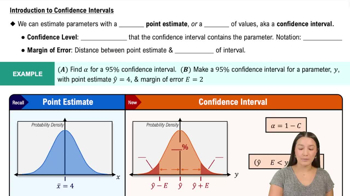
The confidence level represents the degree of certainty that the true population parameter lies within the confidence interval. Common confidence levels are 90%, 95%, and 99%, indicating the proportion of times the interval would capture the true parameter if the same sampling method were repeated multiple times.
Recommended video:
06:33
Introduction to Confidence Intervals

Confidence Interval

A confidence interval is a range of values derived from sample data that is likely to contain the true population parameter. It is calculated using the sample mean, standard deviation, and the critical value corresponding to the chosen confidence level, providing a measure of uncertainty around the estimate.
Recommended video:
06:33
Introduction to Confidence Intervals

Sample Data

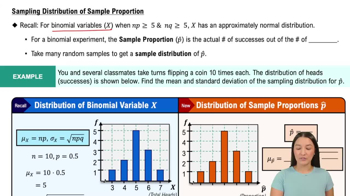
Sample data refers to the subset of observations drawn from a larger population, used to make inferences about that population. The quality and size of the sample affect the reliability of the confidence interval, as larger and more representative samples tend to yield more accurate estimates of the population parameters.
Recommended video:
05:11
Sampling Distribution of Sample Proportion
Related Practice
Textbook Question

In Exercises 5–20, assume that the two samples are independent simple random samples selected from normally distributed populations, and do not assume that the population standard deviations are equal. (Note: Answers in Appendix D include technology answers based on Formula 9-1 along with “Table” answers based on Table A-3 with df equal to the smaller of n1-1 and n2-1)


Queues Listed on the next page are waiting times (seconds) of observed cars at a Delaware inspection station. The data from two waiting lines are real observations, and the data from the single waiting line are modeled from those real observations. These data are from Data Set 30 “Queues” in Appendix B. The data were collected by the author.


a. Use a 0.01 significance level to test the claim that cars in two queues have a mean waiting time equal to that of cars in a single queue.


87
views
Textbook Question

Can Dogs Detect Malaria? A study was conducted to determine whether dogs could detect malaria from socks worn by malaria patients and socks worn by patients without malaria. Among 175 socks worn by malaria patients, the dogs made correct identifications 123 times. Among 145 socks worn by patients without malaria, the dogs made correct identifications 131 times (based on data presented at an annual meeting of the American Society of Tropical Medicine, by principal investigator Steve Lindsay). Use a 0.05 significance level to test the claim of no difference between the two rates of correct responses.


a. Test the claim using a hypothesis test.

128
views
Textbook Question

Independent Samples Which of the following involve independent samples?


a. Data Set 4 “Measured and Reported” includes measured heights matched with the heights that were reported when the subjects were asked for those values.


136
views
Textbook Question

Hypotheses and Conclusions Refer to the hypothesis test described in Exercise 1.


a. Identify the null hypothesis and the alternative hypothesis.


190
views
Textbook Question

In Exercises 5–20, assume that the two samples are independent simple random samples selected from normally distributed populations, and do not assume that the population standard deviations are equal. (Note: Answers in Appendix D include technology answers based on Formula 9-1 along with “Table” answers based on Table A-3 with df equal to the smaller of n1-1 and n2-1)


Color and Creativity Researchers from the University of British Columbia conducted trials to investigate the effects of color on creativity. Subjects with a red background were asked to think of creative uses for a brick; other subjects with a blue background were given the same task. Responses were scored by a panel of judges and results from scores of creativity are given below. Higher scores correspond to more creativity. The researchers make the claim that “blue enhances performance on a creative task.”


a. Use a 0.01 significance level to test the claim that blue enhances performance on a creative task.


" style="" width="460">

111
views
Textbook Question

In Exercises 5–16, use the listed paired sample data, and assume that the samples are simple random samples and that the differences have a distribution that is approximately normal.


Measured and Reported Weights Listed below are measured and reported weights (lb) of random female subjects (from Data Set 4 “Measured and Reported” in Appendix B).


a. Use a 0.05 significance level to test the claim that for females, the measured weights tend to be higher than the reported weights.


92
views