Ch. 9 - Inferences from Two Samples
Triola - Elementary Statistics 14th Edition
Triola14th EditionElementary StatisticsISBN: 9780137366446Not the one you use?Change textbook
Chapter 9, Problem 9.2.1b

Independent Samples Which of the following involve independent samples?


b. Data Set 6 “Births” includes birth weights of a sample of baby boys and a sample of baby girls.

Verified step by step guidance
1
Step 1: Understand the concept of independent samples. Independent samples are those where the observations in one sample do not influence or depend on the observations in another sample. This is a key distinction from dependent samples, where there is a relationship or pairing between the samples.
Step 2: Analyze the given data set. In this case, the data set includes birth weights of baby boys and baby girls. Consider whether the birth weights of boys are influenced by or related to the birth weights of girls.
Step 3: Evaluate the independence of the samples. Since the birth weights of baby boys and baby girls are measured separately and there is no indication that one sample affects the other, they can be considered independent samples.
Step 4: Confirm the criteria for independence. Ensure that the samples are drawn from separate groups (baby boys and baby girls) and that there is no pairing or matching between the observations in the two groups.
Step 5: Conclude that the samples are independent. Based on the analysis, the birth weights of baby boys and baby girls meet the criteria for independent samples.

Verified video answer for a similar problem:

This video solution was recommended by our tutors as helpful for the problem above.
Video duration:
1m
Was this helpful?

Key Concepts

Here are the essential concepts you must grasp in order to answer the question correctly.

Independent Samples

Independent samples refer to two or more groups of data that are collected separately and do not influence each other. In statistical analysis, this means that the selection of one sample does not affect the selection of another. This concept is crucial for certain statistical tests, such as the independent t-test, which compares the means of two independent groups.
Recommended video:
05:11
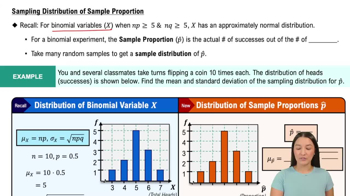
Sampling Distribution of Sample Proportion

Sample Size

Sample size is the number of observations or data points collected from a population for analysis. A larger sample size generally provides more reliable estimates of population parameters and increases the power of statistical tests. In the context of independent samples, it is important to ensure that each group has a sufficient sample size to draw valid conclusions.
Recommended video:
05:11
Sampling Distribution of Sample Proportion

Comparative Analysis

Comparative analysis involves evaluating two or more groups to identify differences or similarities in their characteristics. In the context of independent samples, this often includes comparing means, variances, or proportions. Understanding how to conduct comparative analysis is essential for interpreting results and making informed decisions based on statistical data.
Recommended video:
Guided course
04:48
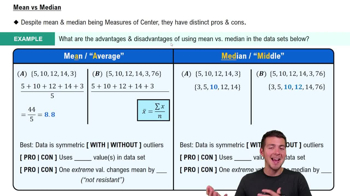
Comparing Mean vs. Median
Related Practice
Textbook Question

In Exercises 5–20, assume that the two samples are independent simple random samples selected from normally distributed populations, and do not assume that the population standard deviations are equal. (Note: Answers in Appendix D include technology answers based on Formula 9-1 along with “Table” answers based on Table A-3 with df equal to the smaller of n1-1 and n2-1)


Color and Cognition Researchers from the University of British Columbia conducted a study to investigate the effects of color on cognitive tasks. Words were displayed on a computer screen with background colors of red and blue. Results from scores on a test of word recall are given below. Higher scores correspond to greater word recall.


b. Construct a confidence interval appropriate for the hypothesis test in part (a). What is it about the confidence interval that causes us to reach the same conclusion from part (a)?


" style="max-width: 100%; white-space-collapse: preserve;" width="440">

91
views
Textbook Question

Second-Hand Smoke Samples from Data Set 15 “Passive and Active Smoke” include cotinine levels measured in a group of smokers ( n = 40, x_bar = 172.48 ng/mL, 119.50 ng/mL ) and a group of nonsmokers not exposed to tobacco smoke ( n = 40, x_bar = 16.35 ng/mL, 62.53 ng/mL ). Cotinine is a metabolite of nicotine, meaning that when nicotine is absorbed by the body, cotinine is produced.


b. The 40 cotinine measurements from the nonsmoking group consist of these values (all in ng/mL): 1, 1, 90, 244, 309, and 35 other values that are all 0. Does this sample appear to be from a normally distributed population? If not, how are the results from part (a) affected?

91
views
Textbook Question

In Exercises 5–16, use the listed paired sample data, and assume that the samples are simple random samples and that the differences have a distribution that is approximately normal.


The Freshman 15 The “Freshman 15” refers to the belief that college students gain 15 lb (or 6.8 kg) during their freshman year. Listed below are weights (kg) of randomly selected male college freshmen (from Data Set 13 “Freshman 15” in Appendix B). The weights were measured in September and later in April.


b. Construct the confidence interval that could be used for the hypothesis test described in part (a). What feature of the confidence interval leads to the same conclusion reached in part (a)?

105
views
Textbook Question

In Exercises 5–16, use the listed paired sample data, and assume that the samples are simple random samples and that the differences have a distribution that is approximately normal.


Heights of Presidents A popular theory is that presidential candidates have an advantage if they are taller than their main opponents. Listed are heights (cm) of presidents along with the heights of their main opponents (from Data Set 22 “Presidents” in Appendix B).


b. Construct the confidence interval that could be used for the hypothesis test described in part (a). What feature of the confidence interval leads to the same conclusion reached in part (a)?

106
views
Textbook Question

F Test Statistic


c. If testing the claim that sigma2,1 is not equals to sigma2,2 what do we know about the two samples if the test statistic F is very close to 1?


138
views
Textbook Question

Can Dogs Detect Malaria? A study was conducted to determine whether dogs could detect malaria from socks worn by malaria patients and socks worn by patients without malaria. Among 175 socks worn by malaria patients, the dogs made correct identifications 123 times. Among 145 socks worn by patients without malaria, the dogs made correct identifications 131 times (based on data presented at an annual meeting of the American Society of Tropical Medicine, by principal investigator Steve Lindsay). Use a 0.05 significance level to test the claim of no difference between the two rates of correct responses.


b. Test the claim by constructing an appropriate confidence interval.


71
views