Skip to main content
Trigonometry
My Course
Learn
Exam Prep
AI Tutor
Study Guides
Textbook Solutions
Flashcards
Explore
Try the app
My Course
Learn
Exam Prep
AI Tutor
Study Guides
Textbook Solutions
Flashcards
Explore
Try the app
Back
Complex Numbers definitions
You can tap to flip the card.
Complex Number
You can tap to flip the card.
👆
Complex Number
An expression combining a real value and an imaginary value, always written in the form a+bi.
Track progress
Control buttons has been changed to "navigation" mode.
1/15
Related flashcards
Related practice
Recommended videos
Complex Numbers quiz #1
Complex Numbers
10 Terms
Complex Numbers
0. Review of College Algebra
3 problems
Topic
ErnestBlazevic
Solving Quadratic Equations
0. Review of College Algebra
1 problem
Topic
0. Review of College Algebra - Part 1 of 2
4 topics
9 problems
Chapter
Patrick
0. Review of College Algebra - Part 2 of 2
5 topics
10 problems
Chapter
Patrick
Guided course
3:18
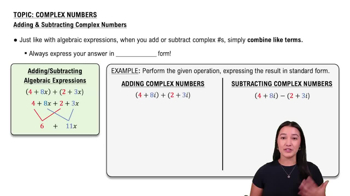
Adding and Subtracting Complex Numbers
758
views
4
rank
Guided course
5:02
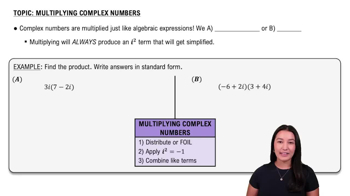
Multiplying Complex Numbers
718
views
2
rank
Guided course
4:22
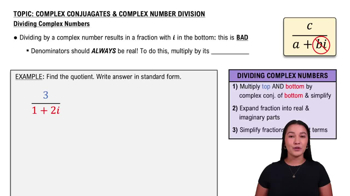
Dividing Complex Numbers
700
views
3
rank
Terms in this set (15)
Hide definitions
Complex Number
An expression combining a real value and an imaginary value, always written in the form a+bi.
Standard Form
A representation where the real and imaginary parts are written as a+bi, with a and b as real numbers.
Real Part
The component in a complex expression not multiplied by the imaginary unit, often denoted as 'a'.
Imaginary Part
The coefficient of the imaginary unit in a complex expression, often denoted as 'b'.
Imaginary Unit
A mathematical symbol, usually 'i', defined so that its square equals negative one.
I Squared
A value resulting from multiplying the imaginary unit by itself, always equal to negative one.
Complex Conjugate
A related expression formed by reversing the sign of the imaginary part in a complex number.
Addition
A process where real and imaginary components of two complex expressions are combined separately.
Subtraction
A process where real and imaginary components of two complex expressions are separated and then combined.
Multiplication
An operation using distribution or FOIL, often resulting in an I squared term that simplifies to a real value.
FOIL Method
A technique for multiplying two binomials, applied to complex expressions to expand and combine terms.
Distribution
A method for multiplying a single term across a binomial, used in complex number operations.
Division
A process involving multiplication by a conjugate to eliminate the imaginary unit from the denominator.
Fraction
A form resulting from division, often split into real and imaginary parts with a common denominator.
Like Terms
Components in complex expressions that share the same unit, allowing for combination during operations.
 BackBack

 3:18
3:18