Skip to main content
Trigonometry
My Course
Learn
Exam Prep
AI Tutor
Study Guides
Textbook Solutions
Flashcards
Explore
Try the app
My Course
Learn
Exam Prep
AI Tutor
Study Guides
Textbook Solutions
Flashcards
Explore
Try the app
Back
Convert Equations Between Polar and Rectangular Forms definitions
You can tap to flip the card.
Rectangular Form
You can tap to flip the card.
👆
Rectangular Form
An equation format using x and y variables, often representing lines or circles in Cartesian coordinates.
Track progress
Control buttons has been changed to "navigation" mode.
1/15
Related flashcards
Related practice
Recommended videos
Convert Equations Between Polar and Rectangular Forms quiz
Convert Equations Between Polar and Rectangular Forms
15 Terms
Convert Equations Between Polar and Rectangular Forms
9. Polar Equations
3 problems
Topic
ErnestBlazevic
Graphing Other Common Polar Equations
9. Polar Equations
3 problems
Topic
ErnestBlazevic
9. Polar Equations
4 topics
10 problems
Chapter
Patrick
Guided course
3:37
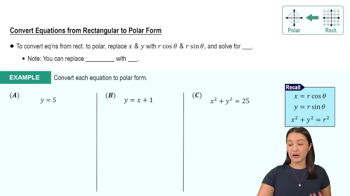
Convert Equations from Rectangular to Polar
691
views
3
rank
Guided course
3:03
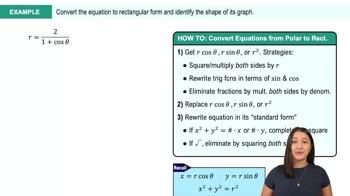
Convert Equations from Polar to Rectangular Example 2
620
views
1
rank
Guided course
6:50
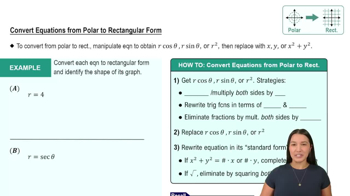
Convert Equations from Polar to Rectangular
533
views
2
rank
Terms in this set (15)
Hide definitions
Rectangular Form
An equation format using x and y variables, often representing lines or circles in Cartesian coordinates.
Polar Form
An equation format using r and theta, describing points or curves based on distance and angle from the origin.
r Cosine Theta
An expression representing the x-coordinate in polar coordinates, linking radius and angle.
r Sine Theta
An expression representing the y-coordinate in polar coordinates, linking radius and angle.
r Squared
A term equivalent to x squared plus y squared, often used to convert circles between forms.
Cosecant Theta
A trigonometric function equal to one divided by sine theta, used in polar equations.
Secant Theta
A trigonometric function equal to one divided by cosine theta, useful for rewriting polar equations.
Completing the Square
A method for rewriting quadratic equations to reveal standard forms, especially for circles.
Standard Form
A recognizable equation format, such as x squared plus y squared equals a constant, identifying geometric shapes.
Circle
A geometric shape represented by x squared plus y squared equals a constant, or r equals a constant in polar.
Vertical Line
A graph described by x equals a constant in rectangular form, or r cosine theta equals a constant in polar.
Shifted Circle
A circle whose center is not at the origin, shown by equations like x squared plus (y minus k) squared equals a constant.
Fraction Elimination
A strategy involving multiplying both sides by a denominator to simplify polar equations for conversion.
Trigonometric Function
A mathematical function involving angles, such as sine, cosine, secant, or cosecant, used in polar equations.
Algebraic Manipulation
The process of rearranging and simplifying equations to facilitate conversion between forms.
 BackBack

 3:37
3:37