Skip to main content
Trigonometry
My Course
Learn
Exam Prep
AI Tutor
Study Guides
Textbook Solutions
Flashcards
Explore
Try the app
My Course
Learn
Exam Prep
AI Tutor
Study Guides
Textbook Solutions
Flashcards
Explore
Try the app
Back
Convert Equations Between Polar and Rectangular Forms quiz
You can tap to flip the card.
What substitutions are used to convert x and y in rectangular equations to polar form?
You can tap to flip the card.
👆
What substitutions are used to convert x and y in rectangular equations to polar form?
x is replaced with r*cos(theta) and y is replaced with r*sin(theta).
Track progress
Control buttons has been changed to "navigation" mode.
1/15
Related flashcards
Related practice
Recommended videos
Convert Equations Between Polar and Rectangular Forms definitions
Convert Equations Between Polar and Rectangular Forms
15 Terms
Convert Equations Between Polar and Rectangular Forms
9. Polar Equations
3 problems
Topic
ErnestBlazevic
Graphing Other Common Polar Equations
9. Polar Equations
3 problems
Topic
ErnestBlazevic
9. Polar Equations
4 topics
10 problems
Chapter
Patrick
Guided course
3:37
Convert Equations from Rectangular to Polar
691
views
3
rank
Guided course
3:03
Convert Equations from Polar to Rectangular Example 2
620
views
1
rank
Guided course
6:50
Convert Equations from Polar to Rectangular
533
views
2
rank
Terms in this set (15)
Hide definitions
What substitutions are used to convert x and y in rectangular equations to polar form?
x is replaced with r*cos(theta) and y is replaced with r*sin(theta).
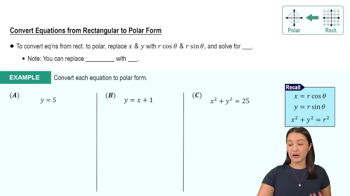
How do you convert y = 5 to polar form?
Replace y with r*sin(theta), solve for r, and get r = 5*csc(theta).
What is the polar form of y = x + 1?
The polar form is r = 1 / (sin(theta) - cos(theta)).
How do you convert x^2 + y^2 = 25 to polar form?
Replace x^2 + y^2 with r^2, then solve to get r = 5.
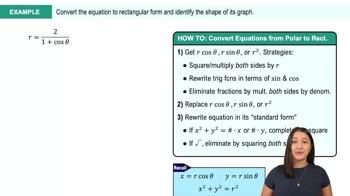
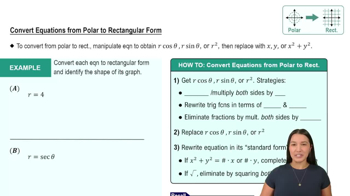
What is the rectangular equivalent of r = 4?
Square both sides to get r^2 = 16, then replace r^2 with x^2 + y^2 to get x^2 + y^2 = 16.
How do you convert r = sec(theta) to rectangular form?
Rewrite sec(theta) as 1/cos(theta), multiply both sides by cos(theta), and replace r*cos(theta) with x to get x = 1.
What is the rectangular form of r = 6*sin(theta)?
Multiply both sides by r to get r^2 = 6r*sin(theta), then replace r^2 with x^2 + y^2 and r*sin(theta) with y, resulting in x^2 + y^2 = 6y.
What strategy is used to rewrite x^2 + y^2 = 6y into a standard form?
Complete the square for the y terms to get x^2 + (y - 3)^2 = 9.
What is the standard form of a circle in rectangular coordinates?
The standard form is (x - h)^2 + (y - k)^2 = r^2.
What is the polar form of a circle centered at the origin with radius 5?
The polar form is r = 5.
How do you convert r*cos(theta) = 1 to rectangular form?
Replace r*cos(theta) with x to get x = 1.
What manipulation is often used when a polar equation contains a fraction?
Multiply both sides by the denominator to eliminate the fraction.
What is the rectangular form of r = 5*csc(theta)?
Replace r with y/sin(theta), solve for y, and get y = 5.
What is the rectangular form of r = 1/(sin(theta) - cos(theta))?
Replace r*sin(theta) with y and r*cos(theta) with x, rearrange, and get y - x = 1.
What is the purpose of completing the square when converting equations?
Completing the square helps rewrite equations into standard forms, such as circles, for easier identification and graphing.
 BackBack

 3:37
3:37