Skip to main content
Trigonometry
My Course
Learn
Exam Prep
AI Tutor
Study Guides
Textbook Solutions
Flashcards
Explore
Try the app
My Course
Learn
Exam Prep
AI Tutor
Study Guides
Textbook Solutions
Flashcards
Explore
Try the app
Back
Geometric Vectors definitions
You can tap to flip the card.
Vector
You can tap to flip the card.
👆
Vector
Quantity represented by an arrow, possessing both magnitude and direction, used to describe movement or force.
Track progress
Control buttons has been changed to "navigation" mode.
1/13
Related flashcards
Related practice
Recommended videos
Geometric Vectors quiz #1
Geometric Vectors
14 Terms
Geometric Vectors
8. Vectors
7 problems
Topic
Patrick
Vectors in Component Form
8. Vectors
3 problems
Topic
ErnestBlazevic
8. Vectors
5 topics
11 problems
Chapter
Patrick
Guided course
03:12
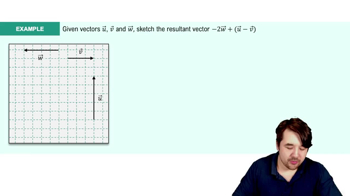
Multiplying Vectors By Scalars Example 1
1129
views
10
rank
Guided course
05:05
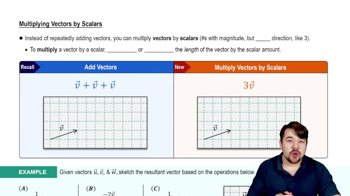
Multiplying Vectors By Scalars
1221
views
5
rank
Guided course
05:29
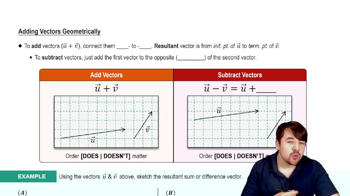
Adding Vectors Geometrically
1270
views
10
rank
Terms in this set (13)
Hide definitions
Vector
Quantity represented by an arrow, possessing both magnitude and direction, used to describe movement or force.
Magnitude
Length of an arrow, indicating the size or amount of a quantity, independent of its direction.
Direction
Orientation of an arrow, determined by its angle, specifying where a quantity is headed.
Initial Point
Starting location of an arrow, marking where a quantity begins in space.
Terminal Point
Ending location of an arrow, marking where a quantity finishes in space.
Zero Vector
Arrow with no length and no orientation, representing absence of movement or force.
Negative Vector
Arrow with same length as its counterpart but pointing in the opposite orientation.
Tip-to-Tail Method
Visual technique for combining arrows by connecting the end of one to the start of another.
Resultant Vector
Arrow drawn from the start of the first to the end of the last in a sequence, representing combined effect.
Scalar
Numerical value with size but no orientation, used to stretch or shrink arrows.
Scalar Multiplication
Operation that changes the length of an arrow and may reverse its orientation if the value is negative.
Vector Addition
Process of combining two arrows to form a new arrow, with order not affecting the outcome.
Vector Subtraction
Process of combining an arrow with the opposite of another, where order changes the result.
 BackBack

 03:12
03:12