Skip to main content
Trigonometry
My Course
Learn
Exam Prep
AI Tutor
Study Guides
Textbook Solutions
Flashcards
Explore
Try the app
My Course
Learn
Exam Prep
AI Tutor
Study Guides
Textbook Solutions
Flashcards
Explore
Try the app
Back
Graphing Other Common Polar Equations definitions
You can tap to flip the card.
Polar Equation
You can tap to flip the card.
👆
Polar Equation
Mathematical expression involving R, theta, and trigonometric functions, used to describe curves in polar coordinates.
Track progress
Control buttons has been changed to "navigation" mode.
1/15
Related flashcards
Related practice
Recommended videos
Graphing Other Common Polar Equations quiz
Graphing Other Common Polar Equations
15 Terms
Graphing Other Common Polar Equations
9. Polar Equations
3 problems
Topic
ErnestBlazevic
Convert Equations Between Polar and Rectangular Forms
9. Polar Equations
3 problems
Topic
ErnestBlazevic
9. Polar Equations
4 topics
10 problems
Chapter
Patrick
Guided course
02:33
Lemniscates
723
views
2
rank
Guided course
3:47
Introduction to Common Polar Equations
1334
views
9
rank
Guided course
3:19
Limacons
714
views
Terms in this set (15)
Hide definitions
Polar Equation
Mathematical expression involving R, theta, and trigonometric functions, used to describe curves in polar coordinates.
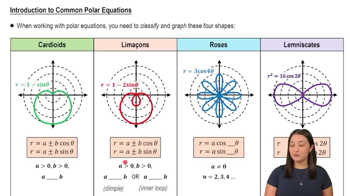
Cardioid
Heart-shaped curve formed when A and B are equal in the equation R = A ± B cos(theta) or R = A ± B sin(theta).
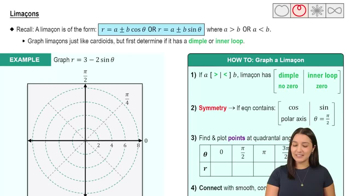
Limaçon
Curve with a dimple or inner loop, defined by A ≠ B in R = A ± B cos(theta) or R = A ± B sin(theta).
Rose
Flower-like curve with multiple petals, described by R = A cos(N*theta) or R = A sin(N*theta), where N ≥ 2.
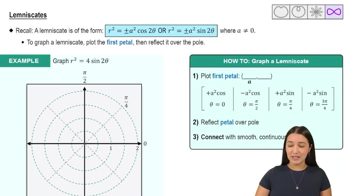
Lemniscate
Infinity-shaped curve defined by R² = ± A² cos(2*theta) or R² = ± A² sin(2*theta), unique for its squared R.
Petal
Distinct loop or segment in rose or lemniscate graphs, whose number and placement depend on N and symmetry.
Symmetry
Characteristic of a graph indicating reflection about the polar axis or specific lines, determined by the equation's trigonometric function.
Polar Axis
Reference line in polar coordinates, analogous to the positive x-axis, used for symmetry and plotting.
Quadrantal Angle
Angles at 0, π/2, π, and 3π/2, crucial for plotting key points in polar graphs.
Inner Loop
Feature in a limaçon graph appearing when A < B, causing the curve to pass through the pole.
Dimple
Indentation in a limaçon graph occurring when A > B, resulting in a curve without an inner loop.
Pole
Origin in polar coordinates, central point from which curves radiate or reflect.
Trigonometric Function
Cosine or sine function used in polar equations to define the shape and orientation of curves.
Integer N
Parameter in rose equations determining the number of petals; must be ≥ 2.
Continuous Curve
Smooth connection of plotted points in polar graphs, ensuring the shape is accurately represented.
 BackBack

 02:33
02:33