Skip to main content
Trigonometry
My Course
Learn
Exam Prep
AI Tutor
Study Guides
Textbook Solutions
Flashcards
Explore
Try the app
My Course
Learn
Exam Prep
AI Tutor
Study Guides
Textbook Solutions
Flashcards
Explore
Try the app
Back
Polar Form of Complex Numbers definitions
You can tap to flip the card.
Polar Form
You can tap to flip the card.
👆
Polar Form
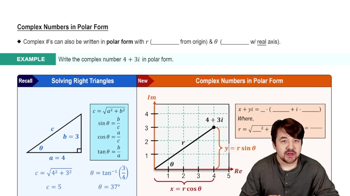
A representation using distance from origin and angle with real axis, expressed as r(cos θ + i sin θ).
Track progress
Control buttons has been changed to "navigation" mode.
1/15
Related flashcards
Related practice
Recommended videos
Polar Form of Complex Numbers quiz
Polar Form of Complex Numbers
15 Terms
Polar Form of Complex Numbers
11. Graphing Complex Numbers
3 problems
Topic
Patrick
Products and Quotients of Complex Numbers
11. Graphing Complex Numbers
2 problems
Topic
Patrick
11. Graphing Complex Numbers
4 topics
8 problems
Chapter
Patrick
Guided course
03:58
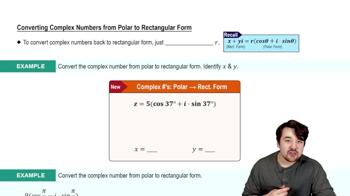
Converting Complex Numbers from Polar to Rectangular Form
676
views
1
rank
Guided course
04:47
Complex Numbers In Polar Form
930
views
4
rank
Terms in this set (15)
Hide definitions
Polar Form
A representation using distance from origin and angle with real axis, expressed as r(cos θ + i sin θ).
Rectangular Form
A representation using real and imaginary parts, written as x + yi.
Magnitude
The distance from the origin to the complex number, calculated with the Pythagorean theorem.
Argument
The angle measured from the positive real axis to the complex number, adjusted by quadrant.
Quadrant
One of four regions in the complex plane, determining how the angle is adjusted.
Pythagorean Theorem
A formula used to find the magnitude, combining squares of real and imaginary parts.
Inverse Tangent
A function used to determine the angle from the ratio of imaginary to real parts.
Unit Circle
A circle with radius one, providing known values for sine and cosine to simplify calculations.
Cosine
A trigonometric function used to find the real part when converting from polar to rectangular form.
Sine
A trigonometric function used to find the imaginary part when converting from polar to rectangular form.
Real Part
The horizontal component of a complex number, found using magnitude and cosine of the angle.
Imaginary Part
The vertical component of a complex number, found using magnitude and sine of the angle.
Degree Mode
A calculator setting for measuring angles in degrees, important for correct angle calculation.
Radian
A unit for measuring angles, often used in trigonometric calculations and unit circle values.
Distribution
A process of multiplying the magnitude into cosine and sine components to convert forms.
 BackBack
 03:58
03:58