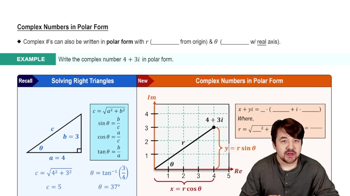
The polar form is r(cos θ + i sin θ), where r is the distance from the origin and θ is the angle with the real axis.
How do you calculate r for a complex number x + yi?
Use the Pythagorean theorem: r = √(x² + y²), where x is the real part and y is the imaginary part.
How do you find the angle θ for a complex number x + yi?
θ is found using tan θ = y/x, and then taking the inverse tangent (arctan) of y/x.
What adjustment must you make to θ based on the quadrant of the complex number?
Add 180° if the number is in quadrant II or III, and add 360° if it is in quadrant IV.
How do you convert from polar form to rectangular form?
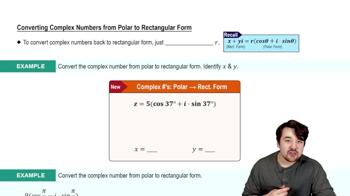
Distribute r: z = r(cos θ + i sin θ), then evaluate the cosine and sine to find the real and imaginary parts.
What is the rectangular form of a complex number?
The rectangular form is x + yi, where x is the real part and y is the imaginary part.
If a complex number in polar form is 5(cos 37° + i sin 37°), what is its rectangular form?
Its rectangular form is approximately 4 + 3i.
Why might you need to use the unit circle when converting from polar to rectangular form?
The unit circle provides known values for sine and cosine, which can simplify calculations.
What is the cosine and sine of π/6?
cos(π/6) = √3/2 and sin(π/6) = 1/2.
Convert 8(cos(π/6) - i sin(π/6)) to rectangular form.
The rectangular form is 4√3 - 4i.
What does the variable r represent in polar form?
r represents the distance from the origin to the point (the modulus of the complex number).
What does the variable θ represent in polar form?
θ is the angle the line from the origin to the point makes with the positive real axis.
What is the main strategy for converting from polar to rectangular form?
Distribute the r value to both cosine and sine, then evaluate to find x and y.
If a complex number is in quadrant III, what must you do to θ after finding arctan(y/x)?
Add 180° to the angle to get the correct θ for quadrant III.
Why is finding r always straightforward, but finding θ sometimes requires adjustment?
r is always positive and found with the Pythagorean theorem, but θ depends on the quadrant and may need to be adjusted to reflect the correct direction.
 Back
Back
 03:58
03:58