
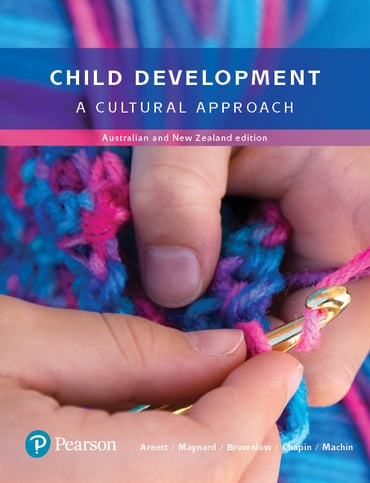
Child Development: A Cultural Approach, Australian Edition, 1st edition
Published by Pearson Education Australia (1 October 2019) © 2020
- Jeffrey Jensen Arnett Clark University
- Ashley Maynard University of Hawaii at Manoa
- Laurie Chapin Victoria University
- Tanya Machin University of Southern Queensland
eTextbook
- Easy-to-use search and navigation
- Add notes and highlights
- Quizzes and flashcards help streamline study
- Access online and offline via mobile app
Revel
- Inspire engagement through active learning
- Provide an immersive reading experience
- Assess student progress with performance insights
- A print text (hardcopy or paperback)
- Free shipping
Title overview
Child Development: A Cultural Approach examines human development from genetics and prenatal development through infancy, childhood, adolescence and emerging adulthood. Taking a global perspective with particular attention to Australia and New Zealand, it explores the many ways people grow and develop within different cultural environments. Drawing on research and examples from around the world, the content highlights how developmental experiences vary across communities, societies and life stages.
Develop the skills to analyse child development within a broader social and cultural context. Compare research from Australia, New Zealand and international settings, interpret developmental data and evaluate the influence of culture on behaviour, relationships and life outcomes. Dedicated coverage of toddlerhood and emerging adulthood provides deeper insight into key transitional stages, while professional examples help connect developmental theory to real-world practice and career pathways.
Who It's For
Designed for students studying child development, human development and related disciplines who want to understand how culture influences development across the lifespan, with particular relevance to Australia, New Zealand and the Asia-Pacific region.
Samples
Download the detailed table of contents >
Preview a sample chapter from Child Development: A Cultural Approach >
Student resources:
How to load the testbank cartridges for Moodle, Blackboard and Canvas.
Key Features
- Analyse child development through a cultural framework that highlights the diversity of human experiences around the world.
- Explore developmental stages from genetics and prenatal development through infancy, childhood, adolescence and emerging adulthood.
- Examine research and examples from Australia, New Zealand, the United States and other global contexts to understand how culture shapes development.
- Investigate the experiences and perspectives of Indigenous Australian and Māori communities as part of the study of human development.
- Evaluate the unique developmental changes that occur during toddlerhood and emerging adulthood through dedicated coverage of these life stages.
- Apply developmental theories and concepts to professional and industry contexts through career-focused examples.
- Build understanding through learning supports including review questions, chapter quizzes and summary features.
Please note that videos are found in Revel.
Key features
What is Pearson eTextbook?
Pearson eTextbook is more than a textbook. It's a flexible digital learning experience designed to help students engage more deeply with their course content, build confidence and study more effectively.
Accessible on any device through a browser or the Pearson app, it combines trusted Pearson content with tools that support learning wherever and whenever it happens.
More than a textbook. A practical toolkit for smarter studying.
Whether you're learning a new concept, revising for an exam or reviewing class material, Pearson eTextbook helps you stay engaged and make the most of your study time.
- More flexibility. Study on your laptop, tablet or phone, with access online or on the go.
- More engagement. Interactive content, media and learning activities help bring concepts to life.
- More understanding. AI-powered study support provides explanations, guided practice and help when you need it.
- More confidence. Reinforce learning with flashcards, notes, highlights and personalised study tools.
- More clarity. Quickly find key concepts, images, media and your own notes with powerful search tools.
- More accessibility. Use audio playback and instant translation features to learn in ways that work for you.
- More connection. Assignments and learning activities help students stay engaged with course content between classes.
- More support. Trusted Pearson authors combine clear explanations, real-world examples and practice opportunities to help students succeed.
*Features vary by title.
Digital updates
The introduction of new content specifically relating to Indigenous Psychology. The new content comprises of three videos, accompanied with questions for student feedback/discussion and to encourage reflection and critical thinking.
The updates also include 10 additional ABC videos that present real-world examples of psychology relating to topics on diversity and inclusion and mental health during COVID. All videos are included in the Appendix.
Each chapter now concludes with a 'Breaking Development' case study, summarising exciting recent research findings and cultural trends pertaining to human development research Discussion questions follow each 'Breaking Development' case study to promote reflection on the topic presented.
What is Revel?
Dynamic content designed for the way today's students read, think, and learn.
Integrated within the narrative, theory and concepts are brought to life through interactives and videos created to empower students to engage with concepts, and take an active role in learning. Revel's media interactives have been designed to be completed quickly, and videos are brief, so students stay focused and on task.
Revel's quizzing, integrated throughout as well as at the end of each module, provides students opportunities to check their understanding at regular intervals before moving on.
Revel's writing functionality, available in select courses, enables educators to integrate writing - among the best ways to foster and assess critical thinking - into the course without significantly impacting their grading burden. Self-paced Journaling Prompts throughout the narrative encourage students to express their thoughts without breaking stride in their reading. Assignable Shared Writing Activities direct students to share written responses with classmates, fostering peer discussion.
Highlighting, note taking, and a glossary let students customise their reading and studying experience. Instructors can add notes for students too, including reminders or study tips.
Table of contents
- 1. A cultural approach to child development
- 2. Genetics and prenatal development
- 3. Birth and the newborn child
- 4. Infancy
- 5. Toddlerhood
- 6. Early childhood
- 7. Middle childhood
- 8. Adolescence
- 9. Emerging adulthood
Author bios
Jeffrey Jensen Arnett is a Research Professor in the Department of Psychology at Clark University in Worcester, Massachusetts. He received his Ph.D. in developmental psychology in 1986 from the University of Virginia, and did 3 years of postdoctoral work at the University of Chicago.
Ashley Maynard is Professor and Chair of the Department of Psychology at the University of Hawai'i at Manoa, where she has been on the faculty since 2001. She received her Ph.D. in Psychology in 1999 from the University of California, Los Angeles (UCLA) and did two years of postdoctoral study in Anthropology and Cultural Psychology in the Department of Neuropsychiatry and Biobehavioral Sciences at UCLA.
Charlotte Brownlow is an Associate Professor in the School of Psychology and Counselling at the University of Southern Queensland, Australia. Originally from the United Kingdom, she received her PhD in 2007 from The University of Brighton, focusing on the identity construction of people with autism/autistic people.
Laurie Chapin is a Psychology Lecturer at Victoria University in Melbourne, Australia. Originally from the United States, in 2010 she completed her PhD in applied social psychology, with an emphasis on life span development, at Colorado State University.
Tanya Machin is a Psychology and Counselling Lecturer in the School of Psychology and Counselling at the University of Southern Queensland, Australia. She received her PhD in 2016, which focused on the social cues of rejection and acceptance on Facebook.
Need help?Get in touch
 Play
Help students learn, wherever life takes them
Your students deserve more than just a digital textbook. Revel® combines content, media, and assessment to create an engaging, immersive experience that lets them learn on the go — anytime, anywhere, on any device.