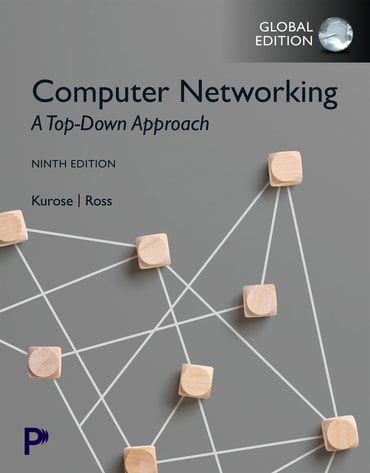

Computer Networking, Global Edition, 9th edition

Published by Pearson (15 August 2026) © 2026

  • James F. Kurose University of Massachusetts, Amherst
  • Keith Ross NYU Abu Dhabi
Products list

This product is expected to ship within 5-7 business days for Australian customers.

Products list

This product is expected to ship within 5-7 business days for Australian customers.

Title overview

Hallmark features of this title

  • A balanced presentation focuses on the Internet as a specific motivating example of a network, and introduces students to protocols in a more theoretical context.
  • Principles and Practice boxes demonstrate real-world applications of the principles studied.
  • Case History boxes help tell the story of the history and development of computer networking.
  • Application programming development material is included, along with numerous programming assignments.
  • A highly developed art program enhances the descriptions of concepts.
  • The author-maintained website offers additional resources and exercises that allow students to generate (and view solutions for) problems similar to those in the text for additional practice.

Table of contents

1: Computer Networks and the Internet

  • Introduction
  • 1.1 What Is the Internet?
    • 1.1.1 A Nuts-and-Bolts Description
    • 1.1.2 A Services Description
    • 1.1.3 What Is a Protocol?
  • 1.2 The Network Edge
    • 1.2.1 Access Networks
    • 1.2.2 Physical Media
  • 1.3 The Network Core
    • 1.3.1 Packet Switching
    • 1.3.2 Circuit Switching
    • 1.3.3 A Network of Networks
  • 1.4 Delay, Loss, and Throughput in Packet-Switched Networks
    • 1.4.1 Overview of Delay in Packet-Switched Networks
    • 1.4.2 Queuing Delay and Packet Loss
    • 1.4.3 End-to-End Delay
    • 1.4.4 Throughput in Computer Networks
  • 1.5 Protocol Layers and Their Service Models
    • 1.5.1 Layered Architecture
    • 1.5.2 Encapsulation
  • 1.6 Networks Under Attack
  • 1.7 History of Computer Networking and the Internet
    • 1.7.1 The Development of Packet Switching: 1961-1972
    • 1.7.2 Proprietary Networks and Internetworking: 1972-1980
    • 1.7.3 A Proliferation of Networks: 1980-1990
    • 1.7.4 The Internet Explosion: The 1990s
    • 1.7.5 The New Millennium
  • 1.8 Summary
  • Homework Problems and Questions
  • Problems
  • Wireshark Lab
  • Interview: Leonard Kleinrock

2: Application Layer

  • Introduction
  • 2.1 Principles of Network Applications
    • 2.1.1 Network Application Architectures
    • 2.1.2 Processes Communicating
    • 2.1.3 Transport Services Available to Applications
    • 2.1.4 Transport Services Provided by the Internet
    • 2.1.5 Application-Layer Protocols
    • 2.1.6 Network Applications Covered in This Book
  • 2.2 The Web and HTTP
    • 2.2.1 Overview of HTTP
    • 2.2.2 Non-Persistent and Persistent Connections
    • 2.2.3 HTTP Message Format
    • 2.2.4 User-Server Interaction: Cookies
    • 2.2.5 Web Caching
    • 2.2.6 HTTP/2
    • 2.2.7 HtTP/3 and QUIC
  • 2.3 Electronic Mail in the Internet
    • 2.3.1 SMTP
    • 2.3.2 Mail Message Formats
    • 2.3.3 Mail Access Protocols
  • 2.4 DNS: The Internet’s Directory Service
    • 2.4.1 Services Provided by DNS
    • 2.4.2 Overview of How DNS Works
    • 2.4.3 DNS Records and Messages
  • 2.5 Video Streaming and Content Distribution Networks
    • 2.5.1 Internet Video
    • 2.5.2 HTTP Streaming and DASH
    • 2.5.3 Content Distribution Networks
    • 2.5.4 Case Studies: Netflix and YouTube
  • 2.6 Socket Programming: Creating Network Applications
    • 2.6.1 Socket Programming with UDP
    • 2.6.2 Socket Programming with TCP
    • 2.6.3 Socket Programming with QUIC
  • 2.7 Summary
  • Homework Problems and Questions
  • Problems
  • Socket Programming Assignments
  • Wireshark Labs: HTTP, DNS
  • Interview: Paul Mockapetris

3: Transport Layer

  • Introduction
  • 3.1 Introduction and Transport-Layer Services
    • 3.1.1 Relationship Between Transport and Network Layers
    • 3.1.2 Overview of the Transport Layer in the Internet
  • 3.2 Multiplexing and Demultiplexing
  • 3.3 Connectionless Transport: UDP
    • 3.3.1 UDP Segment Structure
    • 3.3.2 UDP Checksum
  • 3.4 Principles of Reliable Data Transfer
    • 3.4.1 Building a Reliable Data Transfer Protocol
    • 3.4.2 Pipelined Reliable Data Transfer Protocols
    • 3.4.3 Go-Back-N (GBN)
    • 3.4.4 Selective Repeat (SR)
  • 3.5 Connection-Oriented Transport: TCP
    • 3.5.1 The TCP Connection
    • 3.5.2 TCP Segment Structure
    • 3.5.3 Round-Trip Time Estimation and Timeout
    • 3.5.4 Reliable Data Transfer
    • 3.5.5 Flow Control
    • 3.5.6 TCP Connection Management
  • 3.6 Principles of Congestion Control
    • 3.6.1 The Causes and the Costs of Congestion
    • 3.6.2 End-to-end and Network-assisted Approaches to Congestion Control
  • 3.7 TCP Congestion Control
    • 3.7.1 Classic End-End TCP Congestion Control
    • 3.7.2 More Recent End-End TCP Congestion Control Algorithms
    • 3.7.3 Network-Assisted Explicit Congestion Notification
    • 3.7.4 Fairness
  • 3.8 Evolution of Transport-Layer Functionality
  • 3.9 Summary
  • Homework Problems and Questions
  • Problems
  • Programming Assignments
  • Wireshark Labs: Exploring TCP, UDP
  • Interview: Van Jacobson

4: The Network Layer: Data Plane

  • Introduction
  • 4.1 Overview of Network Layer
    • 4.1.1 Forwarding and Routing: The Network Data and Control Planes
    • 4.1.2 Network Service Models
  • 4.2 What’s Inside a Router?
    • 4.2.1 Input Port Processing and Destination-Based Forwarding
    • 4.2.2 Switching
    • 4.2.3 Output Port Processing
    • 4.2.4 Where Does Queuing Occur?
    • 4.2.5 Packet Scheduling
  • 4.3 The Internet Protocol (IP): IPv4, Addressing, IPv6, and More
    • 4.3.1 IPv4 Datagram Format
    • 4.3.2 IPv4 Addressing
    • 4.3.3 Network Address Translation (NAT)
    • 4.3.4 IPv6
  • 4.4 Generalized Forwarding and SDN
    • 4.4.1 Match
    • 4.4.2 Action
    • 4.4.3 OpenFlow Examples of Match-plus-action in Action
    • 4.4.4 Middleboxes
  • 4.5 Architectural Principles of the Internet
  • 4.6 Summary
  • Homework Problems and Questions
  • Problems
  • Wireshark Lab: IP
  • Interview: Vinton G. Cerf

5: The Network Layer: Control Plane

  • Introduction
  • 5.1 Introduction
  • 5.2 Routing Algorithms
    • 5.2.1 The Link-State (LS) Routing Algorithm
    • 5.2.2 The Distance-Vector (DV) Routing Algorithm
  • 5.3 Intra-AS Routing in the Internet: OSPF
  • 5.4 Routing Among the ISPs: BGP
    • 5.4.1 The Role of BGP
    • 5.4.2 Advertising BGP Route Information
    • 5.4.3 Determining the Best Routes
    • 5.4.4 IP-Anycast
    • 5.4.5 Routing Policy
    • 5.4.6 Putting the Pieces Together: Obtaining Internet Presence
  • 5.5 The SDN Control Plane
    • 5.5.1 The SDN Control Plane: SDN Controller and SDN Network-Control Applications
    • 5.5.2 OpenFlow Protocol
    • 5.5.3 Data and Control Plane Interaction: An Example
    • 5.5.4 SDN: Past and Future
  • 5.6 ICMP: The Internet Control Message Protocol
  • 5.7 Network Management, SNMP, and NETCONF/YANG
    • 5.7.1 The Network Management Framework
    • 5.7.2 The Simple Network Management Protocol (SNMP) and the Management Information Base (MIB)
    • 5.7.3 The Network Configuration Protocol (NETCONF) and YANG
  • 5.8 Summary
  • Homework Problems and Questions
  • Problems
  • Socket Programming Assignment 5: ICMP Ping
  • Programming Assignment: Routing
  • Wireshark Lab: ICMP
  • Interview: Jennifer Rexford

6: The Link Layer and LANs

  • Introduction
  • 6.1 Introduction to the Link Layer
    • 6.1.1 The Services Provided by the Link Layer
    • 6.1.2 Where Is the Link Layer Implemented?
  • 6.2 Error-Detection and -Correction Techniques
    • 6.2.1 Parity Checks
    • 6.2.2 Checksumming Methods
    • 6.2.3 Cyclic Redundancy Check (CRC)
  • 6.3 Multiple Access Links and Protocols
    • 6.3.1 Channel Partitioning Protocols
    • 6.3.2 Random Access Protocols
    • 6.3.3 Taking-Turns Protocols
    • 6.3.4 DOCSIS: The Link-Layer Protocol for Cable Internet Access
  • 6.4 Switched Local Area Networks
    • 6.4.1 Link-Layer Addressing and ARP
    • 6.4.2 Ethernet
    • 6.4.3 Link-Layer Switches
    • 6.4.4 Virtual Local Area Networks (VLANs)
  • 6.5 Link Virtualization: A Network as a Link Layer
    • 6.5.1 Multiprotocol Label Switching (MPLS)
    • 6.5.2 VXLANs: Ethernet Over IP
  • 6.6 Data Center Networking
    • 6.6.1 Data Center Architectures
    • 6.6.2 Trends in Data Center Networking
  • 6.7 Retrospective: A Day in the Life of a Web Page Request
    • 6.7.1 Getting Started: DHCP, UDP, IP, and Ethernet
    • 6.7.2 Still Getting Started: DNS and ARP
    • 6.7.3 Still Getting Started: Intra-Domain Routing to the DNS Server
    • 6.7.4 Web Client-Server Interaction: TCP and HTTP
  • 6.8 Summary
  • Homework Problems and Questions
  • Problems
  • Wireshark Labs: Ethernet and Home Networking
  • Interview: Vahdat

7: Wireless and Mobile Networks

  • Introduction
  • 7.1 Introduction
  • 7.2 The Physical Layer in Wireless Networks
    • 7.2.1 Characteristics of wireless Channel
    • 7.2.2 Coding and Modulation: from bits to symbols to waveforms
  • 7.3 The Wireless Access Network
    • 7.3.1 Sharing the Wireless Channel
    • 7.3.2 WiFi: the 802.11 Wireless LAN
    • 7.3.3 The 5G Radio Access Network
    • 7.3.4 Discovery: Attaching to a Wireless Network
    • 7.3.5 Scheduling Transmissions over the RAN/WLAN
    • 7.3.6 Energy Considerations: wake/sleep
  • 7.4 The Wireless Core Network
    • 7.4.1 The 5G Core and Network Functions
    • 7.4.2 User-plane Function
    • 7.4.3 User identity, registration, and session establishment
  • 7.5 Mobility
    • 7.5.1 Mobility Principles
    • 7.5.2 Mobility in a WiFi Network
    • 7.5.3 Mobility in a 5G Network
  • 7.6 Bluetooth, Satellite and IoT Networks
    • 7.6.1 Bluetooth Networks
    • 7.6.2 Satellite Networks
    • 7.6.3 Internet of Things (IoT) Networks
  • 7.7 Summary
  • Homework Problems and Questions
  • Problems
  • Programming Assignment: Implementing a 4G/5G RAN scheduler
  • Wireshark Labs: WiFi and 4/5G
  • Interview: Deborah Estrin

8: Security in Computer Networks

  • Introduction
  • 8.1 What Is Network Security?
  • 8.2 Principles of Cryptography
    • 8.2.1 Symmetric Key Cryptography
    • 8.2.2 Public Key Encryption
  • 8.3 Message Integrity and Digital Signatures
    • 8.3.1 Cryptographic Hash Functions
    • 8.3.2 Message Authentication Code
    • 8.3.3 Digital Signatures
  • 8.4 End-Point Authentication
  • 8.5 Securing E-Mail
    • 8.5.1 Secure E-Mail
    • 8.5.2 PGP
  • 8.6 Securing TCP and HTTP Connections: TLS
    • 8.6.1 The Big Picture
    • 8.6.2 A More Complete Picture: TLS 1.3
  • 8.7 Network-Layer Security: IPsec and Virtual Private Networks
    • 8.7.1 IPsec and Virtual Private Networks (VPNs)
    • 8.7.2 The AH and ESP Protocols
    • 8.7.3 Security Associations
    • 8.7.4 The IPsec Datagram
    • 8.7.5 IKE: Key Management in IPsec
  • 8.8 Securing Wireless LANs and 4G/5G Cellular Networks
    • 8.8.1 Authentication and Key Agreement in 802.11 Wireless LANs
    • 8.8.2 Authentication and Key Agreement in 5G Cellular Networks
  • 8.9 Operational Security: Firewalls and Intrusion Detection Systems
    • 8.9.1 Firewalls
    • 8.9.2 Intrusion Detection Systems
  • 8.10 Summary
  • Homework Problems and Questions
  • Problems
  • Wireshark Lab: TLS, IPsec Labs
  • Interview: Cranor

Need help?Get in touch