
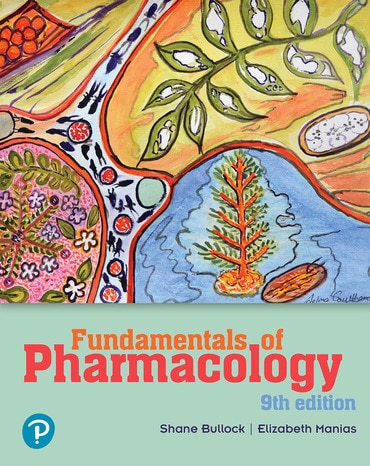
Fundamentals of Pharmacology, 9th edition
Published by Pearson Education Australia (10 May 2022) © 2022
- Shane Bullock Monash University
- Elizabeth Manias Monash University
eTextbook
- Easy-to-use search and navigation
- Add notes and highlights
- Quizzes and flashcards help streamline study
- Access online and offline via mobile app
- A print text (hardcopy or paperback)
- Free shipping
Bundle
- A print text (hardcopy or paperback)
- Free shipping
Title overview
Fundamentals of Pharmacology provides a clear introduction to the scientific principles that underpin the safe and effective use of medicines. Designed for undergraduate and postgraduate students across the health sciences, it explores how medicines interact with physiological and pathophysiological processes and how these interactions influence therapeutic and adverse effects. By focusing on the core concepts of pharmacology, including pharmacokinetics, pharmacodynamics, pharmacogenetics and medicine safety, learners build the knowledge needed to understand medication use across a wide range of clinical settings and patient populations.
Develop the confidence to apply pharmacological principles in clinical and professional practice. This resource helps learners understand how medicines work, predict expected therapeutic and adverse effects, recognise important precautions and contraindications, and interpret the factors that influence drug action. Through a focus on medicine groups and prototype medicines, students learn transferable principles that can be applied to both established and newly introduced therapies. Clinical applications, decision-making frameworks and real-world scenarios help connect scientific concepts to contemporary healthcare practice.
Request a digital sample - for educators >
Who It's For
For undergraduate and postgraduate students in the health sciences, including nursing, pharmacy, podiatry, optometry, paramedicine, physiotherapy and related disciplines. It is also suitable for students studying basic sciences and qualified health professionals undertaking continuing professional education or postgraduate study.
Samples
Key Features
- Build a strong foundation in pharmacology by understanding the mechanisms that drive medicine actions and interactions.
- Apply pharmacological knowledge to clinical decision-making through step-by-step clinical management frameworks.
- Strengthen understanding of the relationship between pharmacology and pathophysiology with integrated concept maps.
- Develop critical thinking skills by working through realistic case studies that connect theory to practice.
- Identify key characteristics of medicine classes and use these principles to understand both existing and emerging therapies.
- Navigate medicine availability across Australia and New Zealand using clear visual indicators.
- Consolidate learning and assess understanding with end-of-topic review questions.
- Explore medicine safety, toxicology, antimicrobial therapy and pharmacology across major body systems through an integrated, systems-based structure.
New to this Edition
- New body systems framework: Content is now organised using a systems-based approach, making it easier to navigate topics and connect pharmacological concepts to major body systems and clinical conditions.
- New section on Inflammation, Immunity and Cancer: Related content has been brought together into a dedicated section, creating a more logical progression through anti-inflammatory agents, antihistamines, immunomodulating medicines and cancer chemotherapy.
- Streamlined foundational content: Chapters and topics have been refined to focus on the essential pharmacology knowledge required by learners, improving clarity and supporting a stronger foundational understanding.
- Integrated related topics: Content on chemical mediators, histamine and antihistamines, prostaglandins, serotonin, nitric oxide and endothelins has been incorporated into relevant chapters to improve context and continuity.
- Greater focus on medicine safety: Selected topics have been removed or consolidated to maintain emphasis on core pharmacological principles and medicine safety concepts.
- Improved learning journey: Reorganised content and chapter structure create a more cohesive learning experience and support easier progression from foundational concepts to clinical application.
Key features
What is Pearson eTextbook?
Pearson eTextbook is more than a textbook. It's a flexible digital learning experience designed to help students engage more deeply with their course content, build confidence and study more effectively.
Accessible on any device through a browser or the Pearson app, it combines trusted Pearson content with tools that support learning wherever and whenever it happens.
More than a textbook. A practical toolkit for smarter studying.
Whether you're learning a new concept, revising for an exam or reviewing class material, Pearson eTextbook helps you stay engaged and make the most of your study time.
- More flexibility. Study on your laptop, tablet or phone, with access online or on the go.
- More engagement. Interactive content, media and learning activities help bring concepts to life.
- More understanding. AI-powered study support provides explanations, guided practice and help when you need it.
- More confidence. Reinforce learning with flashcards, notes, highlights and personalised study tools.
- More clarity. Quickly find key concepts, images, media and your own notes with powerful search tools.
- More accessibility. Use audio playback and instant translation features to learn in ways that work for you.
- More connection. Assignments and learning activities help students stay engaged with course content between classes.
- More support. Trusted Pearson authors combine clear explanations, real-world examples and practice opportunities to help students succeed.
*Features vary by title.
Table of contents
- SECTION I AN INTRODUCTION TO SOCIOCULTURAL ASPECTS, LAW AND ETHICS
- 1 Sociocultural aspects
- 2 Health professionals and the law
- 3 Ethical issues in health care
- SECTION II MEDICINE ADMINISTRATION AND PROFESSIONAL RESPONSIBILITIES
- 4 Medicine formulations, storage and routes of administration
- 5 The clinical decision-making process
- 6 Medicine administration strategies and documentation
- 7 Medication errors
- SECTION III GENERAL ASPECTS OF PHARMACOLOGY
- 8 Drug nomenclature
- 9 Pharmacokinetics
- 10 Pharmacodynamics
- 11 Pharmacogenetics
- 12 Drug interactions
- 13 Pharmacokinetic factors that modify drug action
- 14 Paediatric and geriatric pharmacology
- SECTION IV TOXICOLOGY
- 15 Poisoning and envenomation
- 16 The management of acute clinical overdose
- 17 Contemporary substances of abuse
- 18 Medicine safety
- SECTION V AUTONOMIC PHARMACOLOGY
- 19 General aspects of neuropharmacology
- 20 Adrenergic pharmacology
- 21 Cholinergic pharmacology
- SECTION VI NEUROPHARMACOLOGY
- 22 Antipsychotic agents
- 23 Anxiolytics and hypnotics
- 24 Antidepressants and mood stabilisers
- 25 Neurodegenerative disorders
- 26 Antiseizure agents and muscle relaxants
- 27 Central nervous system stimulants
- SECTION VII PAIN AND ANAESTHESIA
- 28 Analgesics
- 29 Migraine and other headaches
- 30 General anaesthesia
- 31 Local anaesthesia
- SECTION VIII INFLAMMATION, IMMUNITY AND CANCER
- 32 Anti-inflammatory agents
- 33 Antigout medicines
- 34 Antihistamines
- 35 Immunomodulating agents
- 36 Cancer chemotherapy
- SECTION IX CARDIOVASCULAR AND RESPIRATORY PHARMACOLOGY
- 37 Dyslipidaemia
- 38 Antihypertensive agents
- 39 Antianginal agents
- 40 Anticoagulant, antiplatelet, fibrinolytic and haemostatic agents
- 41 Diuretics and other renal medicines
- 42 Heart failure
- 43 Antidysrhythmic agents
- 44 Fluid and potassium imbalances
- 45 Anti-anaemic agents
- 46 Medicines used in obstructive and restrictive lung
- SECTION X THE MODULATION OF GASTROINTESTINAL FUNCTION
- 47 Coughs, colds and respiratory allergy medicines
- 48 Gastrointestinal tract medicine
- 49 Antiemetic agents
- 50 Enteral and parenteral nutrition
- SECTION XI ENDOCRINE AND METABOLIC PHARMACOLOGY
- 51 Pituitary conditions
- 52 Thyroid conditions
- 53 Diabetes mellitus and blood glucose management
- 54 Adrenal cortex conditions
- 55 Gonadal conditions
- 56 Bone disorders
- 57 Obesity
- SECTION XII ANTIMICROBIAL PHARMACOLOGY
- 58 Introduction to antimicrobial therapy
- 59 Antibacterial agents
- 60 Antituberculotic and antileprotic agents
- 61Antiseptics and disinfectants
- 62 Antiparasitic agents
- 63 Antiviral agents
- 64 Antifungal agents
- SECTION XIII SPECIAL TOPICS IN PHARMACOLOGY
- 65 Skin conditions
- 66 Ophthalmic medicines
- 67 Herbal medicines
- APPENDICES
- A Common prescription terminology
- B SI units
- C Medicine calculations
- D Common symbols used in medication charts
- E Important herbal medicine interactions
Author bios
Professor Shane Bullock OAM, Monash University, has been involved in the education of health professionals and science students for over 30 years. He is Head of the Monash University School of Rural Health, where he is involved in rural health workforce preparation and development. Professor Bullock was awarded the Medal of the Order of Australia (OAM) for service to community health.
Shane is co-author of two Australian textbooks, Fundamentals of Pharmacology, now in its tenth edition, and Psychopharmacology for Health Professionals. He has also published a number of journal articles on health professional education and health service delivery.
Professor Elizabeth Manias, Monash University, is a registered nurse and pharmacist whose areas of interest include medication safety, medication adherence, communication between health professionals, patients and family members, and patient safety and risk management. Professor Manias was named an inaugural Vice-Chancellor's Distinguished Professor at Monash University, an honour awarded to just 70 people at the University.
Her work examines organisational and environmental aspects of patient safety and consumer participation in care, using diverse research methodologies including interventional studies, ethnographic approaches, clinical audits and the validation of risk assessment tools. Elizabeth is passionate about developing, testing and implementing practices that improve patient safety and support patient and family engagement in healthcare. She also works with clinicians to improve healthcare and advocates for supporting students in their learning to facilitate high-quality patient care.
Need help?Get in touch
 Play
Pearson eTextbook: What’s on the inside just might surprise you
They say you can’t judge a book by its cover. It’s the same with your students. Meet each one right where they are with an engaging, interactive, personalized learning experience that goes beyond the textbook to fit any schedule, any budget, and any lifestyle.