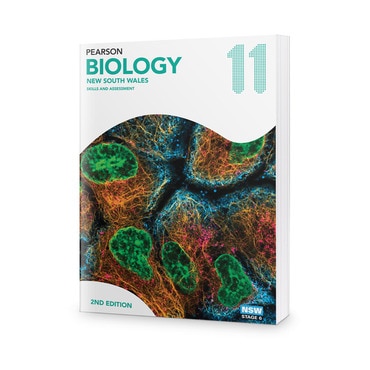
Pearson Biology NSW 11 Skills and Assessment Book, 2nd edition, 2nd edition

Published by Pearson (30 September 2026) © 2027

  • Matt Dodds et al

Paperback

ISBN-13: 9780655723844
Pearson Biology NSW 11 Skills and Assessment Book, 2nd edition
Published 2026

Title overview

Overview

Pearson Senior Science New South Wales is the science series NSW teachers trust, updated for the new Year 11–12 (2025) syllabuses for Biology, Physics and Chemistry.

Building on the success of the first edition and refined through collaboration with NSW teachers and assessment experts, Pearson Senior Science NSW provides a dependable foundation schools can trust.


Included in this bundle:

Fully updated for the New South Wales Year 11 (2025) syllabus for Biology, this bundle includes:

  • Pearson Biology NSW 11, 2nd Edition Skills and Assessment Book - A dedicated write-in resource that supports practice, application and exam preparation. Exam-style questions with space for written responses, scaffolded practical activities and mandatory investigations help students build confidence and apply their learning. Depth study guidance and clear knowledge summaries support ongoing revision and exam readiness.


Specific Features:

  • Clear structure from first lesson to final assessment: Pearson Senior Science NSW follows a clear learning sequence, so teachers always know what comes next and how each lesson aligns to the syllabus. Lessons prioritise understanding before moving into practice and application.
  • Built for explicit teaching: Our approach simplifies complex concepts into manageable, intuitive building blocks, setting learners up for confident, rigorous application.
  • Understanding before exam practice: Students build knowledge and skills before tackling exam-style questions. Assessment preparation is introduced gradually, helping students develop confidence without unnecessary pressure.
  • Designed for real NSW classrooms: Developed with Prime Minister’s Prize-winning educator Matt Dodds and expert NSW teachers, this series provides a trusted, ready-to-use foundation that reduces planning time and empowers confident teaching.


Sample pages:

Preview sample pages from Pearson Senior Science 2nd Edition


Series information:

Discover the full Pearson Senior Science 2nd Edition series


Table of contents

Working Scientifically

Chapter 1: Working Scientifically Toolkit

  • 1.1 Questioning and predicting — 1
  • 1.2 Planning scientific investigations — 9
  • 1.3 Conducting scientific investigations — 18
  • 1.4 Processing data and information — 25
  • 1.5 Analysing data and information — 44
  • 1.6 Problem solving — 58
  • 1.7 Communicating — 63
  • Chapter 1 review — 69

Focus Area 1: Cells as the Basis of Life

Chapter 2: Cell Structure and Functions

  • 2.1 Comparing prokaryotic and eukaryotic cells — 73
  • 2.2 Contrasting plant and animal cells — 74
  • 2.3 Microscopes: tools for studying cells — 82
  • Chapter 2 review — 103

Chapter 3: Cells and Their Environments

  • 3.1 Passive and active transport across membranes — 107
  • 3.2 Key materials and their movement across cell membranes — 115
  • Chapter 3 review — 126

Chapter 4: Biochemical Processes

  • 4.1 Cell requirements — 135
  • 4.2 Cellular respiration and photosynthesis — 142
  • 4.3 Enzymes and their importance in cells — 152
  • Chapter 4 review — 166

Chapter 5: Cell Division

  • 5.1 The DNA molecule — 171
  • 5.2 Somatic and gamete cells — 179
  • 5.3 The cell cycle and mitosis — 184
  • 5.4 Meiosis — 192
  • 5.5 The importance of DNA replication — 198
  • Chapter 5 review — 204

Focus Area 1 review — 208

Building exam skills — 216

Focus Area 2: Cells to Systems

Chapter 6: Cell Organisation

  • 6.1 Structures and organisation of cells — 221
  • 6.2 Hierarchical organisation in organisms — 229
  • Chapter 6 review — 241

Chapter 7: Plants as Autotrophic Organisms

  • 7.1 Requirements of life in plants — 245
  • 7.2 Structure and function of xylem and phloem — 257
  • Chapter 7 review — 268

Chapter 8: Animals as Heterotrophic Organisms

  • 8.1 The digestive system — 271
  • 8.2 The circulatory system and blood — 280
  • 8.3 The excretory system and the kidneys — 293
  • Chapter 8 review — 298

Chapter 9: Homeostasis in Humans

  • 9.1 Feedback control and the maintenance of homeostasis — 301
  • 9.2 Regulating blood sugar levels and the stress response — 318
  • 9.3 Physiological responses and tolerance limits — 326
  • Chapter 9 review — 344

Focus Area 2 review — 348

Building exam skills — 356

Focus Area 3: Evolution and Ecosystems

Chapter 10: Natural Selection

  • 10.1 Evolution by natural selection — 361
  • 10.2 Selective pressures — 372
  • 10.3 Species diversity and evolution — 386
  • 10.4 Convergent and divergent evolution — 396
  • 10.5 Evolution in Australia — 405
  • Chapter 10 review — 415

Chapter 11: Evolution and Adaptations

  • 11.1 Adaptations for survival in different environments — 422
  • 11.2 Endotherms and ectotherms — 439
  • 11.3 Indigenous knowledge of local plant and animal adaptations — 444
  • 11.4 Models of evolution and phylogenetic trees — 449
  • 11.5 Evidence of evolution — 456
  • Chapter 11 review — 467

Chapter 12: Ecosystem Dynamics

  • 12.1 Investigating abiotic and biotic factors in ecosystems — 472
  • 12.2 Sampling techniques — 498
  • Chapter 12 review — 506

Focus Area 3 review — 509

Building exam skills — 520

Glossary — 522

Need help?Get in touch