
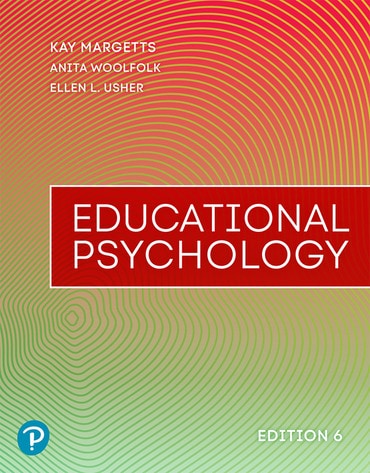
Educational Psychology, 6th edition
Published by Pearson (9 December 2022) © 2023
- Kay Margetts The University of Melbourne
- Anita Woolfolk The Ohio State University
eTextbook
- Easy-to-use search and navigation
- Add notes and highlights
- Quizzes and flashcards help streamline study
- Access online and offline via mobile app
Revel
- Inspire engagement through active learning
- Provide an immersive reading experience
- Assess student progress with performance insights
- A print text (hardcopy or paperback)
- Free shipping
Title overview
Contextualises educational psychology within an Australasian context
Request a digital sample - for educators >
There is a strong nexus between theory and practice with an emphasis on educational implications and applications of research on human development, cognitive science, learning, motivation, teaching, and assessment, showing how information and ideas drawn from educational psychology research can be applied to solve everyday problems of teaching. Numerous examples, case studies, guidelines, and practical tips from experienced teachers are used to explore connections between knowledge, understanding, and practice. The text is clear, relevant and interesting, and is as free of technical language and jargon as possible.
Additionally, this product:
- Has respected and updated/current content mapped to industry standards delivered in a range of customisable formats.
- Blends Australian and international research, content and context.
- Has a leading Australian author.
- Is used across all levels of Bachelor and Masters Education courses.
- Is mapped to the Australian Professional Standards for Graduate Teachers.
- Links and references the Instructor's Manual throughout the text.
Samples
Download the detailed table of contents >
Preview sample pages from Educational Psychology >
Student Resources:
Key features
- Teachers' casebook: What would you do? - Connects students to a scenario to critically think and collaborate on key topics and concepts straight from the start. Provides a rich, applied underpinning to all concepts learnt.
- Teachers' casebook: What would they do? - A response to the opening scenarios of 'what would you do?' by experienced teachers. This gives students the chance to reflect on how they would undertake the scenario and compare with the experienced teacher's response. This provides critical reflection, analysis and evaluation skills that need to be developed.
- Check yourself - Gives students the opportunity at the end of LOs to ensure they understand key concepts. Used as a way to ensure basic understanding is achieved by a student before moving onto the next LO.
- What would you say? - By providing possible interview questions, the student can apply their learning into a real-life scenario that they will likely encounter post-graduation.
- Stop think write - Opportunity for students to consider and better understand key topics. Great resource for tutorial discussion and personal study.
- Guidelines - Guidelines provide teaching tips and practical suggestions or examples based on the theory/research in the chapter - this provides a clear bridge for students between what they are learning and its application in the classroom.
- Point-counterpoint - Opportunity for students to critical assess and think around a key concept and the point/counterpoint. Forms an opportunity for group discussion and debate, critically assess their own viewpoint and evaluate the points to come to a personal decision. With the extension of 'Beyond either/or', this begins to show students that there is very rarely a 'right or wrong' response, but nuances to be taken into account which enhances a student's higher order thinking skill set.
- Stories of learning: tributes to teaching - Short stories of how teachers made a difference in the life of their students connects the practice of the teaching profession and ways in which a student can make a difference once they are a trained teacher.
- Reaching every student - In every classroom, a teacher will have a diverse set of learners and it's important that students have ideas on how to assess, teach and motivate students.
New to this edition
- AITSL standard tagging - As teachers, it is important that students understand how what they are learning directly correlates to the AITSL standards. As such, by mapping to LO there is clear correlation from what they are learning to what they will need to do and show in the classroom.
- Further integration of Indigenous context and experience, as well as further underpinning of diversity and inclusion throughout - It's critical for any future to-be teacher to understand the contexts, experiences and needs of a diverse group of learners. By having a text that underpins this throughout, it will embed a diverse way of working, thinking, and acting into their learning of being a teacher.
- Diversity, Equity and Inclusion specific videos (digital only) - By providing alternative ways for students to engage with learning content, and critical concepts such as how DE&I plays a key role in teaching (and life), these videos give students a more visual learning opportunity.
Key features
What is Revel?
Dynamic content designed for the way today's students read, think, and learn
Integrated within the narrative, theory and concepts are brought to life through interactives and videos created to empower students to engage with concepts, and take an active role in learning. Revel's media interactives have been designed to be completed quickly, and videos are brief, so students stay focused and on task.
Revel's quizzing, integrated throughout as well as at the end of each module, provides students opportunities to check their understanding at regular intervals before moving on.
Revel's writing functionality, available in select courses, enables educators to integrate writing - among the best ways to foster and assess critical thinking - into the course without significantly impacting their grading burden. Self-paced Journaling Prompts throughout the narrative encourage students to express their thoughts without breaking stride in their reading. Assignable Shared Writing Activities direct students to share written responses with classmates, fostering peer discussion.
Highlighting, note taking, and a glossary let students customise their reading and studying experience. Instructors can add notes for students too, including reminders or study tips.
What is Pearson eTextbook?
Pearson eTextbook is more than a textbook. It's a flexible digital learning experience designed to help students engage more deeply with their course content, build confidence and study more effectively.
Accessible on any device through a browser or the Pearson app, it combines trusted Pearson content with tools that support learning wherever and whenever it happens.
More than a textbook. A practical toolkit for smarter studying.
Whether you're learning a new concept, revising for an exam or reviewing class material, Pearson eTextbook helps you stay engaged and make the most of your study time.
- More flexibility. Study on your laptop, tablet or phone, with access online or on the go.
- More engagement. Interactive content, media and learning activities help bring concepts to life.
- More understanding. AI-powered study support provides explanations, guided practice and help when you need it.
- More confidence. Reinforce learning with flashcards, notes, highlights and personalised study tools.
- More clarity. Quickly find key concepts, images, media and your own notes with powerful search tools.
- More accessibility. Use audio playback and instant translation features to learn in ways that work for you.
- More connection. Assignments and learning activities help students stay engaged with course content between classes.
- More support. Trusted Pearson authors combine clear explanations, real-world examples and practice opportunities to help students succeed.
*Features vary by title.
Table of contents
- Teachers, teaching and educational psychology
- Culture and community
- Physical and cognitive development
- Personal, emotional, social and moral development
- Learner differences and learner needs
- Behavioural views of learning
- Cognitive views of learning
- Complex cognitive processes
- Social cognitive and constructivist views of learning
- Motivation in learning and teaching
- Creating supportive learning environments
- Teaching for learning
- Standardised testing
- Assessment and reporting
- References
- Index
Author bios
Associate Professor Kay Margetts is an Honorary Principal Fellow in the Melbourne Graduate School of Education at the University of Melbourne. An educator with more than 40 years' experience, Kay was an early years teacher for many years before entering academia. She has coordinated and taught in Bachelor and Master of Early Childhood, Primary, and International Baccalaureate teacher education courses, specialising in human development, curriculum and pedagogy, and professional practice. She has written and produced children's television programs, and is the recipient of a number of awards for excellence in tertiary teaching. Kay has published widely and her research interests have a particular focus on children's transition, social, behavioural and academic adjustment, and progress in primary school, teachers' views about learning, and early years curricula. She continues to undertake research, supervise higher-degree research students, and consult with education providers locally and internationally.
Anita Woolfolk Hoy is a Texas Longhorn - all her degrees are from the University of Texas, Austin, the last one a PhD. After graduating, she was a psychologist working with children in elementary and secondary schools in 15 counties of central Texas. She began her career in higher education as a professor of educational psychology at Rutgers University, and then moved to The Ohio State University in 1994 where she has been Professor Emeritus since 2013. Anita's research focuses on motivation and cognition, specifically, students' and teachers' sense of efficacy and teachers' beliefs about education. For many years she was the editor of Theory Into Practice, a journal that brings the best ideas from research to practising educators. With students and colleagues, she has published over 150 books, book chapters, and research articles. Anita has served as Vice-President for Division K (Teaching & Teacher Education) of the American Educational Research Association, and as President of Division 15 (Educational Psychology) of the American Psychological Association. Before completing the 14th (US) edition of Educational Psychology, she collaborated with Nancy Perry, University of British Columbia, to write the second edition of Child Development (Pearson, 2015), a book for all those who work with and love children.
Dr Ellen L. Usher received her PhD in Educational Studies from Emory University in 2007. Her research focuses on the sources and effects of beliefs of personal efficacy from the perspective of social cognitive theory. She is the research director of the P20 Motivation and Learning Lab, which aims to examine academic motivation in a variety of contexts and to identify practices that best promote and sustain the motivation learners need to acquire skills essential for success and well-being. Dr. Usher has a joint appointment in the Developmental, Social, and Health Psychology program in the Department of Psychology. Dr. Usher teaches courses in educational psychology, learning theories, and motivation at the University of Kentucky. She is a full member of the Graduate Faculty.
Need help?Get in touch
 Play
Play
Help students learn, wherever life takes them
Your students deserve more than just a digital textbook. Revel® combines content, media, and assessment to create an engaging, immersive experience that lets them learn on the go — anytime, anywhere, on any device.