Introductory Mathematical Analysis for Business, Economics, and the Life and Social Sciences, Global Edition, 14th edition

Published by Pearson (18 August 2021) © 2022

  • Ernest F Haeussler Penn State University
  • Richard S. Paul Penn State University
  • Richard J. Wood Dalhousie University

eTextbook

from$49.94 NZD
  • Anytime, anywhere learning with the Pearson+ app
  • Easy-to-use search, navigation and notebook
  • Simpler studying with flashcards

MyLab

$90.55 NZD
Access details
  • Register via our MyLab page to purchase
  • A Course ID from your instructor is required
  • Instant access once purchased (eText included)
Features
  • 5000+ exercises
  • Includes eText, Apps and study tools
  • Instant feedback on assignments
  • Help when and where you need it
$191.05 NZD
  • A print edition

Title overview

This book is ideal for one- or two-semester or two- orthree-quarter courses covering topics in college algebra, finite mathematics,and calculus for students in business, economics, and the life and socialsciences. Introductory Mathematical Analysis for Business, Economics, and the Life andSocial Sciences provides a mathematical foundation for students in avariety of fields and majors. The authors establish an emphasis on algebraiccalculations that sets this text apart from other introductory, appliedmathematics books. Because the process of calculating variables builds skillsin mathematical modeling, this emphasis paves the way for students to solvereal-world problems that use calculus. The book’s comprehensivestructure—covering college algebra in Chapters 0 through 4, finite mathematicsin Chapters 5 through 9, and calculus in Chapters 10 through 17—offersinstructors flexibility in how they use the material based on the coursethey’re teaching, the semester they’re at, or what the students’ backgroundallows and their needs dictate.

Hallmark features of this title

  • Applications: An abundance and variety of applications for the intended audience appear throughout the book so that students see frequently how the mathematics they are learning can be used. These applications cover such diverse areas as business, economics, biology, medicine, sociology, psychology, ecology, statistics, earth science, and archaeology. Many of these applications are drawn from literature and are documented by references, sometimes from the Web.
  • Now Work Problem N: Throughout the text we have retained the popular Now Work Problem N feature. The idea is that after a worked example, students are directed toan end of section problem (labeled with a colored exercise number) that reinforces theideas of the worked example. This gives students an opportunity to practice what theyhave just learned.
  • Cautions: Cautionary warnings are presented in very much the same way an instructor would warn students in class of commonly-made errors. These appear in the margin, along with other explanatory notes and emphases.
  • Definitions, key concepts, and important rules and formulas: These are clearly stated and displayed as a way to make the navigation of the book that much easier for the student. (See, for example, the Definition of Derivative in Section 11.1)

New and updated features of this title

  • We continue to make the elementary notions in the early chapters pave the way for their use in more advanced topics.
  • Chapter 5, we explicitly discuss negative interest rates and ask, somewhat rhetorically, why banks do not use continuous compounding (given that for a long time now continuous compounding has been able to simplify calculations in practice as well as in theory).
  • Most instructors and students will agree that the key to an effective textbook is in the quality and quantity of the examples and exercise sets. To that end, more than 850 examples are worked out in detail.

Key features

What is MyLab?

MyLab helps you learn, practise and build confidence in your course. It brings together trusted Pearson content, personalised study tools, homework and assessments in one online learning experience, helping you focus on the concepts and skills that matter most. 

MyLab gives you opportunities to practise what you're learning, check your understanding and get support as you progress through your course. Only purchase MyLab if your instructor has told you it's required for your course.

Features

  • Learn with trusted course content. Explore Pearson content and learning resources designed to help you understand and master key concepts.
  • Practise and build confidence. Work through homework, tutorials and assessments that reinforce what you're learning and help you identify where to focus next.
  • Get personalised support with AI. In selected courses, MyLab's AI-powered Study Tool combines Pearson content with personalised support in an easy-to-use chat experience, helping turn mistakes into opportunities to learn.
  • Build your AI literacy. AI Literacy Modules help you develop a shared understanding of responsible AI use in your studies. The short, self-paced modules can be integrated into MyLab or Mastering courses and are automatically assessed.
  • Make class time more interactive with Live Response. Built for synchronous teaching in MyLab and Mastering, Live Response gives instructors real-time insight into student engagement and understanding, helping them see what's landing and where additional support may be needed.
  • See concepts in action. Videos and digital resources help explain and reinforce important course concepts.
  • Study with more flexibility. Access digital course content and learning tools so you can keep learning beyond the classroom.

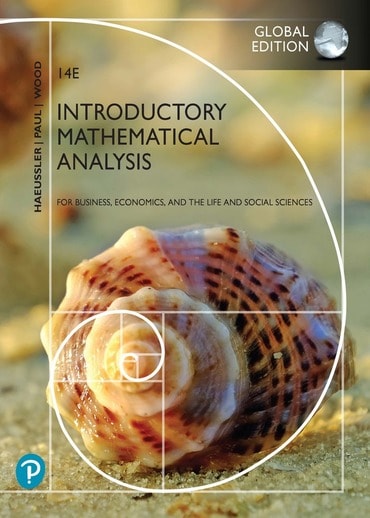
Table of contents

PART I Review of Algebra

  1. 1 Applications and More Algebra
  2. 2 Functions and Graphs
  3. 3 Lines, Parabolas, and Systems
  4. 4 Exponential and Logarithmic Functions

PART II FINITE MATHEMATICS

  1. 5 Mathematics of Finance
  2. 6 Matrix Algebra
  3. 7 Linear Programming
  4. 8 Introduction to Probability and Statistics
  5. 9 Additional Topics in Probability

PART III CALCULUS

  1. 10 Limits and Continuity
  2. 11 Differentiation
  3. 12 Additional Differentiation Topics
  4. 13 Curve Sketching
  5. 14 Integration
  6. 15 Applications of Integration
  7. 16 Continuous Random Variables
  8. 17 Multivariable Calculus

Need help?Get in touch

Pearson eText

Extend learning beyond the classroom. Pearson eText is an easy-to-use digital textbook. It lets students customise how they study and learn with enhanced search and the ability to create flashcards, highlight and add notes all in one place. The mobile app lets students learn wherever life takes them, offline or online.

Video
Play
Privacy and cookies
By viewing this third-party content from www.youtube.com, you agree to their terms and conditions, privacy notice and acknowledge they may use cookies and pixels for information and analytics gathering.

Empower your students, in class and beyond

Meet students where they are with MyLab®, and capture their attention in every lecture, activity, and assignment using immersive content, customized tools, and interactive learning experiences in your discipline.