

Principles of Marketing, 8th edition
Published by Pearson Education Australia (20 October 2020) © 2021
- Gary Armstrong University of North Carolina
- Sara Denize University of Western Sydney
- Michael Volkov La Trobe University
- Stewart Adam Deakin University
- Philip Kotler Northwestern University
- Swee Hoon Ang National University of Singapore
- Anita Love
- Sean Doherty
- Patrick van Esch
eTextbook
- Easy-to-use search and navigation
- Add notes and highlights
- Quizzes and flashcards help streamline study
- Access online and offline via mobile app
Revel
- Inspire engagement through active learning
- Provide an immersive reading experience
- Assess student progress with performance insights
- A print text (hardcopy or paperback)
- Free shipping
Bundle
- A print text (hardcopy or paperback)
- Free shipping
Title overview
Best-selling and market-leading text
Request a digital sample - for educators >
Principles of Marketing introduces marketing through the lens of creating value for customers.
With engaging real-world examples and information, Principles of Marketing shows students how customer value - creating it and capturing it - drives every effective marketing strategy.
The 8th Edition reflects the latest trends in marketing, including new coverage on online, social media, mobile, and other digital technologies to build customer engagement, brand, community and sales, as well as wider coverage of cases and examples from an Australian perspective.
Samples
Download the detailed table of contents >
Preview sample pages from Principles of Marketing, 8th Edition >
Student resources:
Key features
- Learning objectives - Each chapter begins with learning objectives that prepare the reader for the chapter material and detail the learning goals
- Concept map - The concept map graphically previews and positions each chapter and its key concepts, providing a visual guide to enable easy navigation of the chapter content.
- Linking the concepts - The key concepts are reflected upon at the end of each chapter's main sections.
- Highlighted definitions and key terms - Throughout each chapter, definitions in colour are provided in the margin adjacent to where each key term is discussed in the text.
- Marketing in action - Additional examples and important information are presented in marketing highlight exhibits throughout the book, together with questions for class and individual use.
- Student learning centre - Each chapter concludes with a section dedicated to student learning. It provides a summary of the chapter relative to the chapter learning objectives, discussion questions, critical thinking exercises and a page-referenced list of the chapter's key terms.
- Mini cases - These short application cases at the end of each chapter address current issues and company situations. Questions are linked to the chapter's learning objectives.
- Case studies - Appendix 1 sets out case studies that highlight key ideas, stories and marketing strategies. Cases involve small and medium-sized enterprises, as well as large firms.
New to this edition
- Chapter 13: Digital Marketing Content - This chapter has been thoroughly updated to reflect changes in marketing practises in using direct and digital marketing to build customer engagement, brand community and sales.
- All new Marketing in Action features bring key concepts to life by presenting current real-world examples such as the importance of culture and Social Selling.
- Update to cases and examples - All new end of product case studies cover a range of contemporary examples including Digital Marketing: how to strategically differentiate with AI
- Updated references, research and citations - References and research for all the sources cited within the book have been updated to include the latest research. This ensures students have the opportunity to develop their knowledge and skills that align with contemporary marketing practices.
- Greater breadth of examples and cases to focus on the Australasian region - To expand the breadth of coverage to an Australasian perspective, including NZ and Asian examples and cases throughout.
Key features
What is Revel?
Dynamic content designed for the way today's students read, think, and learn
Integrated within the narrative, theory and concepts are brought to life through interactives and videos created to empower students to engage with concepts, and take an active role in learning. Revel's media interactives have been designed to be completed quickly, and videos are brief, so students stay focused and on task.
Revel's quizzing, integrated throughout as well as at the end of each module, provides students opportunities to check their understanding at regular intervals before moving on.
Revel's writing functionality, available in select courses, enables educators to integrate writing - among the best ways to foster and assess critical thinking - into the course without significantly impacting their grading burden. Self-paced Journaling Prompts throughout the narrative encourage students to express their thoughts without breaking stride in their reading. Assignable Shared Writing Activities direct students to share written responses with classmates, fostering peer discussion.
Highlighting, note taking, and a glossary let students customise their reading and studying experience. Instructors can add notes for students too, including reminders or study tips.
Digital updates
New case studies that now replace the blog, and address the significant impact of the coronavirus pandemic and other societal trends on marketing and consumer behaviour. Additional audio podcasts and videos sourced from TED and ABC News are designed to link theory to a real-world context and are integrated into existing chapters. Journal prompts are included throughout the product to increase interactivity and provide more opportunities for active learning.
What is Pearson eTextbook?
- A lightweight, lower cost, digital replacement for a print textbook
- A digital reading experience that takes advantage of digital capabilities to better deliver content to learners
- Accessible on any device via browser and Pearson+ mobile app
Why choose Pearson eTextbook?
- Students can study in a flash with instant, ready-made Pearson flashcards or easily create their own
- Enhanced search allows students to search media, images, key terms and their own notes
- Pearson eTextbook features clear and engaging content from experienced authors. Each eTextbook is designed to help students reach their potential with a mix of learning features including problem-solving exercises, reflection questions and real-world examples.
Table of contents
- PART 1 Defining marketing and the marketing process
- 1 Marketing: Creating and capturing customer value
- 2 Company and marketing strategy: Partnering to build customer engagement value and relationships
- PART 2 Understanding the marketplace and consumers
- 3 The Marketplace and customers: Analysing the environment
- 4 Marketing analytics: Gaining customer insights
- 5 Buyer behaviour: Understanding consumer and business buyers
- PART 3 Designing a customer-driven strategy mix
- 6 Customer driven marketing Strategy: Creating value for target customers
- 7 Products, services and brands: Offering customer value
- 8 New products: Developing and managing innovation
- 9 Pricing: Capturing customer value
- 10 Placement: Customer value fulfilment
- 11 Communicating customer value: Advertising and public relations
- 12. Personal selling and sales promotion: Creating value in relationships
- 13 Direct and digital marketing: Interactivity and fulfilment
- PART 4 Extending marketing
- 14 Sustainable marketing: Social responsibility, ethics and legal compliance
Author bios
Gary T. Armstrong is Crist W. Blackwell Distinguished Professor Emeritus in the Kenan-Flagler Business School at the University of North Carolina at Chapel Hill. He holds Undergraduate and Master's degrees in Business from Wayne State University in Detroit and received his Ph.D in marketing from Northwestern University.
Through the years, Professor Armstrong has worked closely with business student groups and has received several UNC campus wide and Business School teaching awards. He is the only repeat recipient of the school's highly regarded Award for Excellence in Undergraduate Teaching, (three times). Most recently, Professor Armstrong received the UNC Board of Governors Award for Excellence in Teaching.
Dr Armstrong has contributed numerous articles to leading business journals. As a consultant and researcher, he has worked with many companies on marketing research, sales management, and marketing strategy.
Sara Denize is the Associate Dean, Education at UTS Business School where she has overarching responsibility for learning innovation, quality and enhancement for a large portfolio of postgraduate and undergraduate coursework programs. She holds a Bachelor of Commerce (honours) degree in marketing from the University of Otago, New Zealand, and followed up with a Master of Commerce by research a few years later. After moving to Australia, she completed her PhD at the University of Technology, Sydney. Professor Denize loves teaching and is keen to make all aspects of marketing and business education accessible and meaningful.
Michael Volkov is Associate Professor Department of Management and Marketing, La Trobe Business School, La Trobe University. He is a Senior Fellow of the Higher Education Academy (SFHEA), a Certified Practising Marketer (CPM, AMI) and a Fellow of the Australian Marketing Institute (FAMI). With over 20 years' experience as an educator within the tertiary environment, Michael loves teaching and is passionate about student support. He believes in placing the student at the centre of his endeavours and develops student-centred learning environments. He is an award-winning and recognised leader in the field of teaching and learning, having been the recipient of numerous international, national and institutional teaching and learning awards, including the 2019 and 2017 WJC Banks Award, 2018 ASCILITE Innovation Award, 2015 Australia and New Zealand Marketing Academy ANZMAC Distinguished Educator Award, and the 2013 and 2020 Australian Awards for University Teaching.
Michael's research focus is on the fields of both consumer behaviour and education. In the areas of teaching and learning, Michael has addressed investigations including best practice in teaching and learning, online teaching and learning, the ingredients for student engagement, student success, student teamwork, stakeholder perception of graduates, student academic misconduct and student approaches to learning. His research has been published in a number of international journals, including British Journal of Educational Technology; Education + Training; International Journal of Pedagogies and Learning; Information Technology, Education and Society; Australasian Journal of Educational Technology; European Journal of Marketing; Journal of Marketing Management; Journal of Consumer Marketing; Journal of Marketing Communication, Marketing Intelligence and Planning and the Australasian Marketing Journal.
Swee Hoon Ang lives and breathes marketing. As an Associate Professor of Marketing at NUS Business School and Deputy Head of the Marketing Department, her students are often enthused by her passion in marketing. It comes as no surprise that Swee Hoon has been recognised on three consecutive occasions as an outstanding educator with the university's Teaching Excellence Award, putting her on the honour roll. She was also nominated for the University Outstanding Educator Award. Her marketing mojo is evident in the leading textbooks Marketing Management: An Asian Perspective and Principles of Marketing: An Asian Perspective that she co-authors with Philip Kotler.
Patrick van Esch is a Senior Lecturer in the Department of Marketing, Auckland University of Technology. He has worked in both industry and academia. His industry experience ranges from sales and marketing, management consulting, general management, operations and non-profit board positions across Australia, Hong Kong, UK and the US. In academia, he has taught business, management and marketing at universities/colleges in Australia, New Zealand and the US. His main research interests are at the crossroads of where artificial intelligence and consumer behaviour intersect. His research has been published in international journals including Journal of Advertising Research, Business Horizons, International Journal of Consumer Studies, Journal of Retailing and Consumer Services, Marketing Intelligence and Planning, British Journal of Educational Technology, Marketing Education Review and the Australasian Marketing Journal. Patrick's research also features in media including RadioNZ, The Conversation, Stuff, NZ Herald and the Adelaide Review.
Dr Anita Love is a Senior Lecturer in the Department of Marketing at Griffith University. With over 15 years experience in marketing education and curriculum design, Anita served as Program Director for the Griffith Business School's.
Need help?Get in touch
 Play
Play
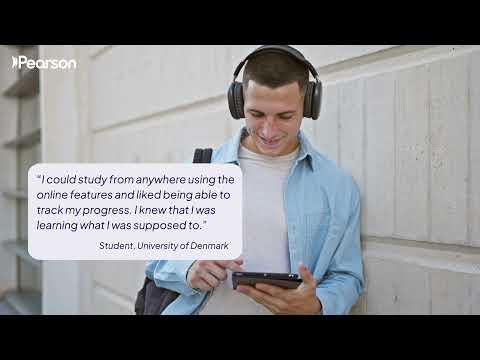
Help students learn, wherever life takes them
Your students deserve more than just a digital textbook. Revel® combines content, media, and assessment to create an engaging, immersive experience that lets them learn on the go — anytime, anywhere, on any device.