Social Psychology, Global Edition, 11th edition

Published by Pearson (May 6, 2025) © 2025

  • Elliot Aronson University of California, Santa Cruz
  • Timothy D. Wilson University of Virginia
  • Samuel R Sommers Tufts University
  • Elizabeth Page-Gould University of Toronto
  • Neil Lewis Jr. Cornell University

eTextbook

from$49.94 NZD
  • Easy-to-use search and navigation
  • Add notes and highlights
  • Quizzes and flashcards help streamline study
  • Access online and offline via mobile app

Revel

$79.95 NZD
  • Inspire engagement through active learning
  • Provide an immersive reading experience
  • Assess student progress with performance insights
$185.94 NZD
  • A print text (hardcopy or paperback)
  • Free shipping

Title overview

For courses in Social Psychology.

Request a digital sample - for educators >

Make research relevant through a storytelling approach. Social Psychology introduces the key concepts of the field through a storytelling approach that makes research relevant. Drawing upon their extensive experience as researchers and teachers, the authors present classic studies alongside the cutting-edge research that is the future of social psychology

The 11th Edition includes engaging contributions from new co-authors Elizabeth Page-Gould and Neil Lewis Jr. plus coverage of the COVID-19 pandemic, political upheaval in the US, and other recent developments through a social psychological lens.

Key features

  • Try It! exercises invite students to apply specific concepts to their everyday behaviour. These exercises encourage students to become more active participants in the learning process. Many of these have been updated for the 11th Edition.
  • What do YOU think? features prompt students to answer survey questions that illustrate important concepts. Accompanying writing exercises bring learning full circle.
  • Learning objectives at the beginning and end of each chapter guide students as they work through the text.
  • Key terms are defined in the margins and collected in a glossary at the end of the text.
  • Headings and subheadings keep students focused on the big picture.
  • Chapter-ending summaries wrap up the key information presented in the chapter.

New to this edition

  • Co-authors Elizabeth Page-Gould, University of Toronto, and Neil Lewis Jr., Cornell University, help continue the text's legacy of accessible and narrative-driven exploration of cutting-edge scientific research. Both award-winning and prolific researchers, they bring their expertise to bear on pressing societal issues such as intergroup relations and racial inequity.
  • Fresh content throughout the 11th Edition focuses a social psychological lens on key contemporary developments, including:
    • the COVID-19 pandemic
    • the ubiquity of web-based classrooms and workplaces
    • sobering spikes in racial violence
    • political upheaval in the United States

Key features

What is Revel?

Dynamic content designed for the way today's students read, think, and learn.

Integrated within the narrative, theory and concepts are brought to life through interactives and videos created to empower students to engage with concepts, and take an active role in learning. Revel's media interactives have been designed to be completed quickly, and videos are brief, so students stay focused and on task.

Revel's quizzing, integrated throughout as well as at the end of each module, provides students opportunities to check their understanding at regular intervals before moving on.

Revel's writing functionality, available in select courses, enables educators to integrate writing - among the best ways to foster and assess critical thinking - into the course without significantly impacting their grading burden. Self-paced Journaling Prompts throughout the narrative encourage students to express their thoughts without breaking stride in their reading. Assignable Shared Writing Activities direct students to share written responses with classmates, fostering peer discussion.

Highlighting, note taking, and a glossary let students customise their reading and studying experience. Instructors can add notes for students too, including reminders or study tips.

Revel is an instructor-led product.

What is Pearson eTextbook?

  • A lightweight, lower cost, digital replacement for a print textbook
  • A digital reading experience that takes advantage of digital capabilities to better deliver content to learners
  • Accessible on any device via browser and Pearson+ mobile app

Why choose Pearson eTextbook?

  • Students can study in a flash with instant, ready-made Pearson flashcards or easily create their own
  • Enhanced search with a minimum of three characters allows students to search media, images, key terms and their own notes
  • Pearson eTextbook embed videos and other interactives directly in the text to bring concepts to life
  • Pearson eTextbook features clear and engaging content from experienced authors. Each eTextbook is designed to help students reach their potential with a mix of learning features including problem-solving exercises, reflection questions and real-world examples.
  • Pearson eTextbook, optimised for mobile, seamlessly integrates videos and other rich media with the text and gives students access to their textbook anytime, anywhere.

Table of contents

  • 1. Introducing Social Psychology
  • 2. Methodology: How Social Psychologists Do Research
  • 3. Social Cognition: How We Think About the Social World
  • 4. Social Perception: How We Come to Understand Other People
  • 5. The Self: Understanding Ourselves in a Social Context
  • 6. Cognitive Dissonance and the Need to Protect Our Self-Esteem
  • 7. Attitudes and Attitude Change: Influencing Thoughts and Feelings
  • 8. Conformity and Obedience: Influencing Behavior
  • 9. Group Processes: Influence in Social Groups
  • 10. Attraction and Relationships: From Initial Impressions to Long-Term Intimacy
  • 11. Prosocial Behavior: Why Do People Help?
  • 12. Aggression: Why Do We Hurt Other People? Can We Prevent It?
  • 13. Prejudice: Causes, Consequences, and Cures
  • Social Psychology in Action 1: Using Social Psychology to Achieve a Sustainable and Happy Future
  • Social Psychology in Action 2: Social Psychology and Health
  • Social Psychology in Action 3: Social Psychology and the Law

Author bios

Elliot Aronson is Professor Emeritus at the University of California at Santa Cruz and 1 of the most renowned social psychologists in the world. In 2002, he was chosen as 1 of the 100 most eminent psychologists of the twentieth century. Dr. Aronson is the only person in the 120-year history of the American Psychological Association to have received all 3 of its major awards: for distinguished writing, distinguished teaching and distinguished research. Many other professional societies have honored his research and teaching as well. These include the American Association for the Advancement of Science, which gave him its highest honor, the Distinguished Scientific Research award; the American Council for the Advancement and Support of Education, which named him Professor of the Year of 1989; the Society for the Psychological Study of Social Issues, which awarded him the Gordon Allport prize for his contributions to the reduction of prejudice among racial and ethnic groups; and the William James Award from the Association for Psychological Science. In 1992, he was named a Fellow of the American Academy of Arts and Sciences. A collection of papers and tributes by his former students and colleagues, The Scientist and the Humanist, celebrates his contributions to social psychological theory and its application to real-world problems. Dr. Aronson's own recent books for general audiences include Mistakes Were Made (but not by ME), with Carol Tavris, and a memoir, Not by Chance Alone: My Life as a Social Psychologist.

Tim Wilson did his undergraduate work at Williams College and Hampshire College and received his Ph.D. from the University of Michigan. Currently Sherrell J. Aston Professor of Psychology at the University of Virginia, he has published numerous articles in the areas of introspection, attitude change, self-knowledge and affective forecasting, as well as the books Redirect: The Surprising New Science of Psychological Change and Strangers to Ourselves: Discovering the Adaptive Unconscious. He has received numerous honors, including elections to the National Academy of Sciences and the American Academy of Arts and Sciences. In 2015 he received the William James Fellow Award from the Association for Psychological Science, which honors recipients "for their lifetime of significant intellectual contributions to the basic science of psychology." Wilson has taught the Introduction to Social Psychology course at the University of Virginia for more than 40 years. In 2001 he was awarded the University of Virginia All-University Outstanding Teaching Award, and in 2015, was awarded the University of Virginia's highest honor, the Thomas Jefferson Award for Excellence in Scholarship.

Sam Sommers earned his B.A. from Williams College and his Ph.D. from the University of Michigan. Since 2003 he has been a faculty member in the Department of Psychology at Tufts University in Medford, Massachusetts, where he is now Department Chair. His research examines issues related to racial equity and group diversity, with a particular interest in how these processes play out in the legal domain. He has won multiple teaching awards at Tufts, including the Lerman-Neubauer Prize for Outstanding Teaching and Advising and the Gerald R. Gill Professor of the Year Award. He was also inducted into the Tufts Hall of Diversity for his efforts to promote an inclusive climate on campus for all students. He has testified as an expert witness on issues related to racial bias, jury decision making and eyewitness memory in criminal trial proceedings in 8 states. He has written 2 general audience books related to social psychology: Situations Matter: Understanding How Context Transforms Your World (2011) and This Is Your Brain on Sports: The Science of Underdogs, the Value of Rivalry, and What We Can Learn from the T-shirt Cannon (2016). He is also co-author of Invitation to Psychology (8th edition) and Psychology (13th edition), along with Carole Wade, Carol Tavris and Lisa Shin.

Elizabeth Page-Gould earned a B.S. in psychology and statistics from Carnegie Mellon University in 2002 and a Ph.D. in psychology from the University of California, Berkeley in 2008, before completing a Mind/Brain/Behavior Postdoctoral Fellowship at Harvard University. She is now the Canada Research Chair in Social Psychophysiology, an Associate Professor of Psychology and currently the Chair of the Graduate Department of Psychology at the University of Toronto. She researches how social interactions with friends and strangers shape experiences in diverse societies, with a focus on the role of stress in social interactions, friendship and individual thriving. Dr. Page-Gould's research employs multiple methodological approaches, integrating across physiological, behavioral and subjective (self-reported) data collected from multiple people at once to develop a rich picture of social interactions. Dr. Page-Gould's research was recognised by the Gordon Allport Intergroup Relations Prize, a Fellowship in the Association for Psychological Science and the Society for Experimental Social Psychology, the Early Researcher Award from the Ontario Ministry of Research and Innovation, and being named a "Rising Star" by the Association for Psychological Science. While predominantly teaching Introduction to Social Psychology, she received the Professor of the Year award and Scarborough Students Union Teaching Award at the University of Toronto Scarborough.

Neil Lewis, Jr. earned his B.A. in economics and psychology at Cornell University and his M.S. and Ph.D. in social psychology at the University of Michigan. He is currently an assistant professor at Cornell University and Weill Cornell Medicine in the Department of Communication, division of general internal medicine, and graduate field of psychology. His research examines how people's social contexts and identities influence (1) how they interpret and make meaning of the world around them, (2) their motivations to pursue their goals and success in goal pursuit efforts and (3) the implications of these processes for individual and collective outcomes in education, health and environmental sustainability. He is particularly interested in these processes as they relate to broader inequities in society, as well as their implications for the effectiveness of interventions and policies to improve equity in social outcomes. In 2019 he was named a 'Rising Star' by the Association for Psychological Science, and in 2020 he won the SAGE Young Scholar early career award from the Society for Personality and Social Psychology.

Need help?Get in touch

Revel

Improve results by empowering students to actively participate in learning. Revel® is an end-to-end teaching and learning experience. It delivers an engaging blend of author content, media and assessment to help students to read and practice in one continuous experience. User-friendly, with Revel students can study anytime, anywhere, on any device.

Pearson eText

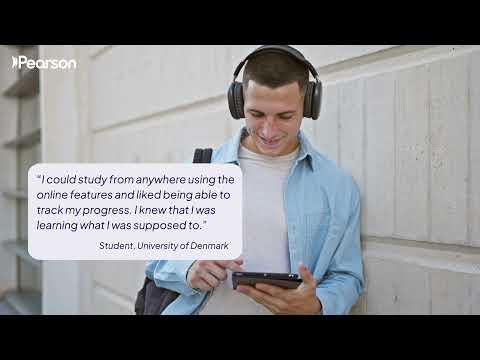
Extend learning beyond the classroom. Pearson eText is an easy-to-use digital textbook. It lets students customise how they study and learn with enhanced search and the ability to create flashcards, highlight and add notes all in one place. The mobile app lets students learn wherever life takes them, offline or online.

Video
Play
Privacy and cookies
By watching, you agree Pearson can share your viewership data for marketing and analytics for one year, revocable upon changing cookie preferences. Disabling cookies may affect video functionality. More info...

Help students learn, wherever life takes them

Your students deserve more than just a digital textbook. Revel® combines content, media, and assessment to create an engaging, immersive experience that lets them learn on the go — anytime, anywhere, on any device.