
Four ways to keep kindergarten ESL students focused all day

Heath Pulliam
A teacher sat in a classroom with a child, sharing crayons with eachother and smiling
Reading time: 5 minutes

Heath Pulliam is an independent education writer with a focus on the language learning space. He’s taught English in South Korea and various subjects in the United States to a variety of ages. He’s also a language learning enthusiast and studies Spanish in his free time.

Those who have taught children anywhere between the ages of 4 and 8 know that one of the biggest challenges of getting through to them is keeping your presentation style interesting. As someone who taught ESL in South Korea to kindergarteners, there are a few factors that make keeping students engaged a challenge. In countries where students learn English, students often have a heavy courseload and high expectations. As a first-year teacher, I learned a lot about what worked and what didn’t through trial and error. These are four methods that I consistently used to keep my students interested and engaged all day.

Students are quick to lose focus at such a young age. You’re not speaking their mother tongue and some parts of an ESL curriculum are less than exciting. With young students, you can’t lecture your way through the material all day. Kindergarteners have a small window of focus and it must be capitalized on. The following methods are ones that worked for me and can be modified to cover any topic you’ll run into in an ESL curriculum.

Activities to engage pre-primary ESL students all day
Play
隱私和Cookies

觀看此視頻表示你同意培生可於一年內使用你觀看的數據以作分析及營銷之用。你可以通過清除cookies撤銷設定。

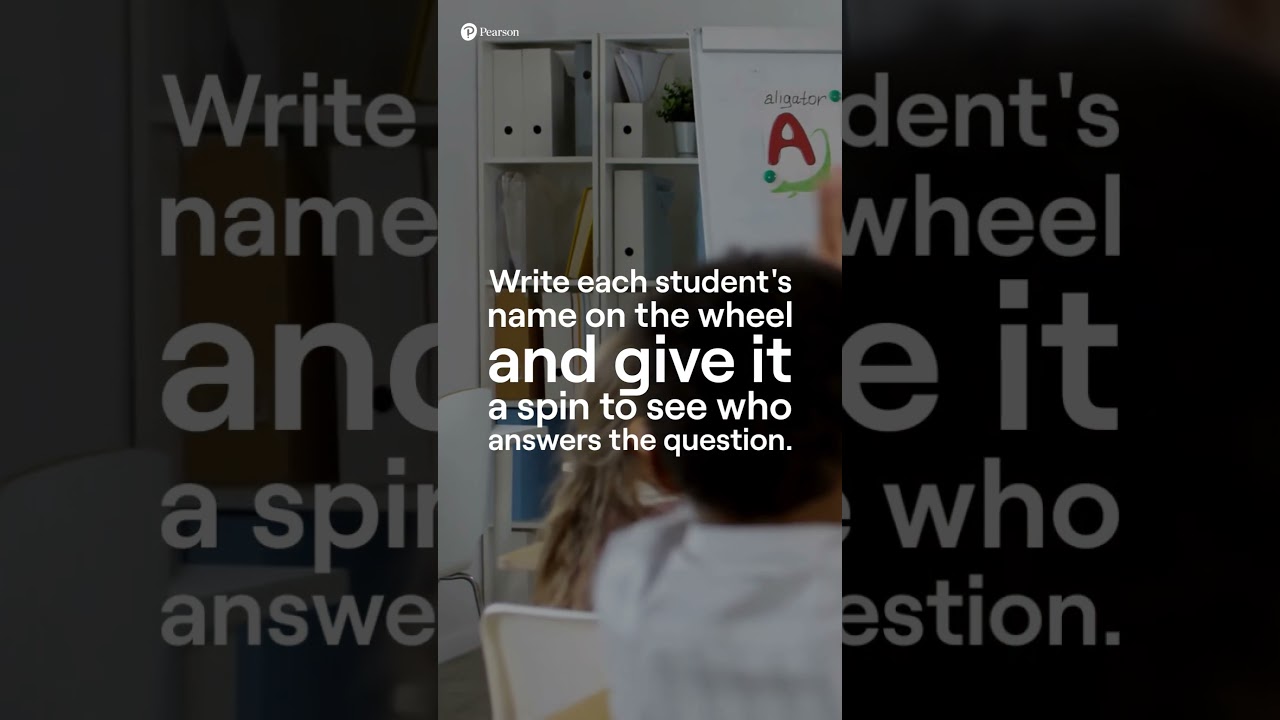
1. The wheel of names

Don't let the simplicity of this tool fool you. The Wheel of Names, which is exactly what it sounds like, is a very simple tool that you can put the names of your students on to randomly (or not) select a student. The Wheel of Names crushes hand-raising and it’s a constant struggle to get everyone raising their hands. (We can’t let the quiet ones just slip through the cracks!)

The beauty of the Wheel of Names is the guaranteed excitement on every spin. They’re kindergarteners. The nature of randomizing who’s going to answer the question, come up to the board, or go first in a game is so exciting to them. Use it however you want. The suspense has kids excited to see who will be chosen and has them cheering on whichever classmate gets chosen.

I used this tool mostly during review sessions to choose students to answer questions. It can also be used for creating small groups, making sure everyone gets a chance to speak during activities and seeing who’s going to get to do the next fun thing in the classroom. You’re teaching kindy, have fun with it.

https://spinthewheel.io/

2. Team-based review game

We never came up with a good name for this game, but we used it a lot. Every Friday, during our chapter review, this was undoubtedly the best compromise between fun and effectiveness for reviewing material. It also fosters speaking, one of the most important parts of learning a language.

Here’s how it works. The class is separated into two teams. (For a little extra fun, use the wheel of names or a cup of popsicle sticks with students’ names on them to select the teams.) The teacher has a set of review questions or vocabulary words. On each turn, one person from each team has a chance to answer the question. You can do hand-raising or a randomization method to pick who answers.

If the student representative from the team gets it right, they earn a point. If they get it wrong, the opposing team gets a chance to answer for a point. Alternating between each team, the first to a certain number of points wins. A simple game, but at this age many students are just getting used to team-based activities.

This game is so effective because it makes use of children’s natural competitive spirit. When one student is up, the rest of their team cheers them on. Learning material is important, but a big part of teaching young students is teaching them social skills, too. This game gets everyone excited and gets the material to stick. It also teaches them the importance of teamwork and how to win and lose gracefully. (Not everyone can win every time).

3. Creating super sentences

At the end of the year, the students in my class ended up being the best writers in their respective age groups. I think this activity, making ‘Super Sentences” a few times a week was a big contributor to that. Inspired by a textbook we had, here’s how this activity works.

We’d create sentences with this formula:

Who or what – The owl

Did what – hunted for mice

Where – in the forest

When – at night

The owl hunted for mice in the forest at night.

Before students got to work on their own, We’d fill out a little table on the board as a class that looked something like this – but changed every time.

Who or what?

(noun)

Did what? (verb)

Where?

(prepositional phrase)

When?

(prepositional phrase)

The dog

The raccoon

Joey

Mr. Heath

Chloe

The thief

Ran

Slept

Attacked _______

Found _________

Learned to ________

sneaked

On top of __________

Under __________

Through the ________

Next to the  ________

Inside of the _______

Behind the ________

At sunset

At 4:00 PM

In the middle of the day

In March

In the evening

After this, students can get to work making their own sentences and drawing what is happening below. After a few times, many students began to make up their own nouns, verbs and prepositions that were not listed on the board. And when everyone gets comfortable writing sentences, you can add a ‘Why?’ section at the end.

This activity is one of my favorites because it helps bring out children’s natural creativity. In an ESL curriculum, there’s a lot of material that’s less than exciting, so any way to give the kids a little freedom can be a game-changer. It’s also great for vocabulary, grammar and writing practice.

To finish off the activity, have each student read their sentence and have the class vote on their favorite for a prize!

4. Vocabulary bingo

Something to know about teaching ESL in non-English-speaking countries is that often, no time is allowed to be spent not learning. This is definitely the case in South Korea. Even after lunch and towards the end of the day, students are rarely allowed to do anything if it isn’t enriching. Because of this, playing games that are fun and learning-effective is a must.

Now, I’m certainly not the first one to play Bingo. This version however, is slightly modified to be as enriching as possible. We played this version often at the end of the day, because focus runs low around that time.

Essentially, this is just vocabulary bingo with a little bit of charades mixed in. For this activity, make a basic bingo board with some of your current vocabulary words or target language. There are plenty of sites that make this easy.

What makes this version different is that on each turn, rather than telling everyone the word, describe it to the class and try to get them to guess what the word is. So, if the word was ‘teamwork’, you might say something like “This is what it’s called when everyone works together to help their team win.” You can even have a student helper that helps facilitate the game by giving the descriptions.

After the word is guessed, reiterate it to the class and proceed with Bingo as usual.

Conclusion

Part of being an effective teacher, especially with the younger ages, is harnessing kids’ natural excitement, energy and innate curiosity to their own benefit. Instead of suppressing it, it’s essential to adapt your teaching style to work for your students.

Teaching ESL to young children has its own set of challenges. They can hardly sit still for an hour of lecture, let alone a whole day. Make use of, or draw inspiration from these methods and see how they can work for you.

Teaching young learners? Read our post 'Effective classroom management routines for very young learners'.

More blogs from Pearson

  • University students walking outside on campus
    Elevate your agency’s brand: The PTE Express effect
    By Alice Bazzi
    Reading time: 2 minutes

    In the competitive world of international education, your agency’s reputation is everything. Families trust you to guide them through one of the most important decisions of their children’s lives, and institutions rely on you to send well-prepared students. Every recommendation you make reflects on your brand.

    That’s why it’s important to choose solutions backed by a strong, trusted global reputation. PTE Express, powered by Pearson, is more than an English test; it also helps strengthen your organisation’s credibility in a competitive market.

    Why reputation matters in student recruitment

    Parents and students do not just look for speed and convenience, but also look for efficiency, reliability and integrity. When you recommend a test that universities recognize, you strengthen your own position as a trusted advisor. Furthermore, Pearson assessments are renowned for their quality and transparency: values that resonate with both your customers and your university partners.

    The Pearson advantage: Global recognition and trust

    Pearson is known throughout the education sector for its excellence. With decades of experience in learning and assessments, Pearson has built a reputation that institutions around the world rely on. PTE Express reflects this heritage, offering a secure, reliable English proficiency test designed with admissions in mind.

    When you recommend PTE Express, you are not just offering speed to your students but also offering a test backed by credibility, innovation and a well-trusted brand.

    How PTE Express enhances your brand

    • Professionalism: Recommending a Pearson-backed test signals that your agency prioritizes quality and compliance.
    • Reliability: Institutions know PTE Express scores are authentic and secure, reducing friction in the admissions process.
    • Client confidence: Families feel reassured when they see a globally-recognized name associated with their child’s academic future.

    The alignment positions your agency as a market leader, capable of delivering solutions that meet university standards.

    Security and speed: A winning combination

    PTE Express not only protects integrity through its high-quality security but also accelerates success. Students receive certified results within 48 hours, enabling them to meet tight deadlines without compromising quality.

    For agents, this means fewer delays, smoother workflows and happier clients who will most likely refer more students in the long run. By promoting a test that combines speed with security, you differentiate yourself from competitors.

    Building long-term relationships through trust

    Your reputation grows through consistently supporting your students and earning the trust of families who recommend you to others. As more students progress to your partners, your agency gains wider recognition.

    When you offer a secure and efficient English test, families feel more confident in your process. That trust supports stronger partnerships, repeat business, and referrals.

    Lead with value in every interaction

    When discussing PTE Express with students or institutions, emphasize the benefits of what matters the most:

    • Pearson’s global reputation
    • Secure testing environment that is also flexible for the student
    • Rapid turnaround for results

    Elevate your brand today and find out more about PTE Express here.

  • Teacher talking to girl working on laptop in classroom smiling
    Designed for learning, built for growth: How Big Ben Education Group reimagined short-term programs
    By Emma Currie
    Reading time: 3 minutes

    The challenge: Creating meaningful learning in short-term programs

    In recent years, Big Ben Education Group faced a challenge: how to deliver meaningful learning within short-term programs. Although teachers were passionate and students motivated, their short-term courses lacked a clear academic structure, making learning feel rushed and less impactful. At the same time, they relied heavily on a single market and sought to attract a more diverse, global student mix.

    This raised a critical question: How do you design a short-term program that is both academically meaningful and appealing to a global student audience? That question led to the launch of their first Winter Camp in 2024.

    The turning point: From camp to structured learning experience

    The Winter Camp marked a major shift. For the first time, students from across China, Korea, Japan, Central Asia and the Middle East were brought together. Managing this level of cultural and linguistic diversity required more than enthusiasm; it required structure.

    The school introduced Big English as a core academic framework, giving teachers clarity on learning objectives and ensuring consistency across levels, even within a condensed timeframe.

    But the transformation didn’t stop in the classroom. Excursions were redesigned with clear learning goals, turning them into opportunities for real-world language application. This shift from activities to outcomes required careful planning and strong collaboration between academic and operations teams.  What emerged was something new – a structured, student-centered learning experience that balanced academic rigor with real-world engagement.

  • Students sat at a table with microphones talking
    Building fluent, confident speakers: better ways to assess speaking
    By Charlotte Guest
    Reading time: 6 minutes

    Why traditional speaking assessments can make students feel stressed

    Traditional speaking tests often feel high-stakes and performative. Students are asked to respond on demand, usually in front of a teacher or peers, with little room for hesitation or self-correction. This setup can make it harder for students to show what they can really do because:

    • Time pressure shifts focus from communicating meaning to avoiding mistakes
    • Teacher-centered evaluation can feel judgmental rather than supportive
    • One-off testing may not capture a learner's true abilitiy, especially if they're nervous. 

    When people feel anxious, it often affects their fluency. They find it harder to think so they pause more, forget words and feel less confident. As a result, assessments may reflect how comfortable someone feels under pressure, rather than how effectively they can communicate.

    Key components of speaking fluency to evaluate

    Fluency isn't just about talking fast. It involves several clear signs.