Ch. 7 - Estimating Parameters and Determining Sample Sizes
Triola - Elementary Statistics 14th Edition
Triola14th EditionElementary StatisticsISBN: 9780137366446Not the one you use?Change textbook
Chapter 7, Problem 7.2.15

Los Angeles Commute Time Listed below are 15 Los Angeles commute times (based on a sample from Data Set 31 “Commute Times” in Appendix B). Construct a 99% confidence interval estimate of the population mean. Is the confidence interval a good estimate of the population mean?


Verified step by step guidance
1
Step 1: Calculate the sample mean (\( \bar{x} \)) by summing all the commute times and dividing by the total number of observations (15). Use the formula \( \bar{x} = \frac{\sum x_i}{n} \), where \( x_i \) represents each commute time and \( n \) is the sample size.
Step 2: Compute the sample standard deviation (\( s \)) using the formula \( s = \sqrt{\frac{\sum (x_i - \bar{x})^2}{n-1}} \). This measures the spread of the commute times around the mean.
Step 3: Determine the standard error of the mean (\( SE \)) using the formula \( SE = \frac{s}{\sqrt{n}} \). This represents the variability of the sample mean.
Step 4: Find the critical value (\( t \)) for a 99% confidence level using a t-distribution table. The degrees of freedom (\( df \)) are \( n-1 \), where \( n \) is the sample size.
Step 5: Construct the confidence interval using the formula \( \text{Confidence Interval} = \bar{x} \pm t \cdot SE \). Interpret the interval and discuss whether it is a good estimate of the population mean based on the sample size and variability.

Verified video answer for a similar problem:

This video solution was recommended by our tutors as helpful for the problem above.
Video duration:
6m
Was this helpful?

Key Concepts

Here are the essential concepts you must grasp in order to answer the question correctly.

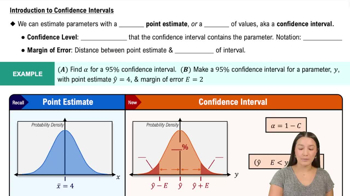
Confidence Interval

A confidence interval is a range of values, derived from a data set, that is likely to contain the population mean with a specified level of confidence, such as 99%. It is calculated using the sample mean, the standard deviation, and the sample size, providing a measure of uncertainty around the estimate of the population parameter.
Recommended video:
06:33
Introduction to Confidence Intervals

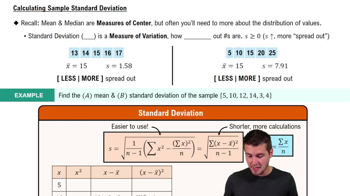
Sample Mean and Standard Deviation

The sample mean is the average of a set of observations, calculated by summing all values and dividing by the number of observations. The standard deviation measures the dispersion of the data points from the mean, indicating how spread out the values are. Both are essential for constructing confidence intervals.
Recommended video:
Guided course
08:45
Calculating Standard Deviation

Normal Distribution and Central Limit Theorem

The Central Limit Theorem states that the distribution of the sample mean will approach a normal distribution as the sample size increases, regardless of the original distribution of the data. This is crucial for constructing confidence intervals, as it allows the use of normal distribution properties even for non-normally distributed data when the sample size is sufficiently large.
Recommended video:
06:23
Using the Normal Distribution to Approximate Binomial Probabilities
Related Practice
Textbook Question

Genes Samples of DNA are collected, and the four DNA bases of A, G, C, and T are coded as 1, 2, 3, and 4, respectively. The results are listed below. Construct a 95% confidence interval estimate of the mean. What is the practical use of the confidence interval?


2 2 1 4 3 3 3 3 4 1

185
views
Textbook Question

Constructing and Interpreting Confidence Intervals. In Exercises 13–16, use the given sample data and confidence level. In each case, (a) find the best point estimate of the population proportion p; (b) identify the value of the margin of error E; (c) construct the confidence interval; (d) write a statement that correctly interprets the confidence interval.


Tennis Challenges In a recent U.S. Open tennis tournament, men playing singles matches used challenges on 240 calls made by the line judges. Among those challenges, 88 were found to be successful with the call overturned. Construct a 95% confidence interval for the proportion of successful challenges.

201
views
Textbook Question

Confidence Levels

Given specific sample data, such as the data given in Exercise 1, which confidence interval is wider: the 95% confidence interval or the 80% confidence interval? Why is it wider?

174
views
Textbook Question

Ages of Prisoners The accompanying frequency distribution summarizes sample data consisting of ages of randomly selected inmates in federal prisons (based on data from the Federal Bureau of Prisons). Use the data to construct a 95% confidence interval estimate of the mean age of all inmates in federal prisons.


199
views
Textbook Question

Estimating the Median Use the sample data listed in Exercise 1 “Bootstrap Requirements” to generate 1000 bootstrap samples, and find the median in each of those samples. After obtaining the 1000 sample medians, find the 95% confidence interval estimate of the population median by evaluating p2.5 and p97.5 from the sorted 1000 medians. Given that the sample times in Exercise 1 are from the 50 times in Data Set 20 “Alcohol and Tobacco in Movies” and those 50 times have a median of 5.5, how well did the bootstrap method work to create a “good” confidence interval?

109
views
Textbook Question

Mean Body Temperature Data Set 5 “Body Temperatures” in Appendix B includes a sample of 106 body temperatures having a mean of 98.20 F and a standard deviation of 0.62 F. Construct a 95% confidence interval estimate of the mean body temperature for the entire population. What does the result suggest about the common belief that 98.6 F is the mean body temperature?

186
views