Ch. 2 - Exploring Data with Tables and Graphs
Triola - Elementary Statistics 14th Edition
Triola14th EditionElementary StatisticsISBN: 9780137366446Not the one you use?Change textbook
Chapter 2, Problem 2.c.2

In Exercises 1–5, use the data listed in the margin, which are magnitudes (Richter scale) and depths (km) of earthquakes from Data Set 24 “Earthquakes” in Appendix B
[Image]
Frequency Distribution For the frequency distribution from Exercise 1, find the following.


a. Class limits of the first class
b. Class boundaries of the first class
c. Class midpoint of the first class

Verified step by step guidance
1
Step 1: Identify the data range and the number of classes. The data range is the difference between the maximum and minimum values in the dataset. Divide this range by the number of classes to determine the class width. Round up to the nearest whole number if necessary.
Step 2: Determine the class limits for the first class. The lower class limit of the first class is the smallest value in the dataset. Add the class width to the lower limit to find the upper class limit of the first class.
Step 3: Calculate the class boundaries for the first class. Subtract 0.5 from the lower class limit to find the lower class boundary, and add 0.5 to the upper class limit to find the upper class boundary.
Step 4: Compute the class midpoint for the first class. The class midpoint is the average of the lower and upper class limits. Use the formula: Midpoint=Lower+Upper2.
Step 5: Verify your results by ensuring that the class boundaries and midpoint align with the data distribution and the class width is consistent across all classes.

Verified video answer for a similar problem:

This video solution was recommended by our tutors as helpful for the problem above.
Video duration:
2m
Was this helpful?

Key Concepts

Here are the essential concepts you must grasp in order to answer the question correctly.

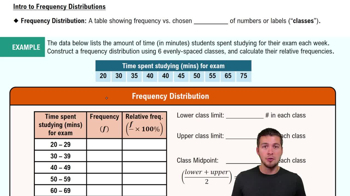
Frequency Distribution

A frequency distribution is a summary of how often each value occurs in a dataset. It organizes data into classes or intervals, allowing for easier analysis of patterns and trends. In the context of the question, understanding frequency distributions is essential for determining class limits, boundaries, and midpoints, which are foundational for statistical analysis.
Recommended video:
Guided course
06:38
Intro to Frequency Distributions

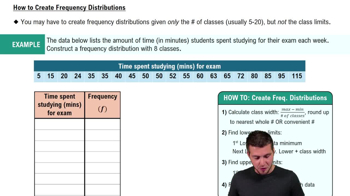
Class Limits

Class limits define the range of values that fall within a specific class in a frequency distribution. The lower class limit is the smallest value in the class, while the upper class limit is the largest. Identifying class limits is crucial for accurately categorizing data points and ensuring that all values are accounted for in the analysis.
Recommended video:
Guided course
06:29
How to Create Frequency Distributions

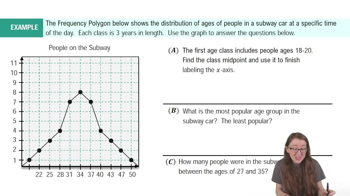
Class Midpoint

The class midpoint is the value that lies halfway between the upper and lower limits of a class in a frequency distribution. It is calculated by averaging the class limits and serves as a representative value for that class. Understanding class midpoints is important for summarizing data and performing further statistical calculations, such as finding the mean.
Recommended video:
04:15
Frequency Polygons Example 1
Related Practice
Textbook Question

In Exercises 1–5, use the data listed in the margin, which are magnitudes (Richter scale) and depths (km) of earthquakes from Data Set 24 “Earthquakes” in Appendix B

Frequency Distribution Construct a frequency distribution of the magnitudes. Use a class width of 0.50 and use a starting value of 1.00.

107
views
Textbook Question

Estimating r For each of the following, estimate the value of the linear correlation coefficient r for the given paired data obtained from 50 randomly selected adults.


a. Their heights are measured in inches and those same heights are recorded in centimeters .

148
views
Textbook Question

Interpreting Normal Quantile Plots Which of the following normal quantile plots appear to represent data from a population having a normal distribution? Explain.


a. " style="" width="380">

236
views
1
rank
Textbook Question

Estimating r For each of the following, estimate the value of the linear correlation coefficient r for the given paired data obtained from 50 randomly selected adults.


c. Their pulse rates are measured and their IQ scores are measured .

128
views
Textbook Question

In Exercises 1–5, use the data listed in the margin, which are magnitudes (Richter scale) and depths (km) of earthquakes from Data Set 24 “Earthquakes” in Appendix B


Histogram Construct the histogram corresponding to the frequency distribution from Exercise 1. For the values on the horizontal axis, use the class midpoint values. Which of the following comes closest to describing the distribution: uniform, normal, skewed left, skewed right?


113
views
Textbook Question

Estimating r For each of the following, estimate the value of the linear correlation coefficient r for the given paired data obtained from 50 randomly selected adults.


d. The 50 adults all drove cars from Jacksonville, Florida, to Richmond, Virginia. Their average (mean) speeds are recorded along with the times it took to complete that trip.

147
views