Ch. 2 - Exploring Data with Tables and Graphs
Triola - Elementary Statistics 14th Edition
Triola14th EditionElementary StatisticsISBN: 9780137366446Not the one you use?Change textbook
Chapter 2, Problem 2.c.1

In Exercises 1–5, use the data listed in the margin, which are magnitudes (Richter scale) and depths (km) of earthquakes from Data Set 24 “Earthquakes” in Appendix B
Table displaying earthquake magnitudes and depths, with columns for magnitude (Richter scale) and depth (km).
Frequency Distribution Construct a frequency distribution of the magnitudes. Use a class width of 0.50 and use a starting value of 1.00.

Verified step by step guidance
1
Step 1: Identify the range of magnitudes in the dataset. Look at the smallest and largest values in the 'Magnitude' column from the table provided. This will help determine the number of classes needed for the frequency distribution.
Step 2: Determine the class width. The problem specifies a class width of 0.50, and the starting value is 1.00. Create intervals starting from 1.00, such as [1.00–1.50), [1.50–2.00), [2.00–2.50), and so on, until the largest magnitude is covered.
Step 3: Count the number of magnitudes that fall into each interval. For each interval, go through the 'Magnitude' column and tally how many values fall within that range. Ensure that the intervals are non-overlapping and exhaustive.
Step 4: Construct the frequency distribution table. Create a table with two columns: one for the intervals (e.g., [1.00–1.50), [1.50–2.00), etc.) and another for the frequency (the count of magnitudes in each interval).
Step 5: Verify the frequency distribution. Ensure that the sum of the frequencies equals the total number of magnitudes in the dataset. This confirms that all data points have been accounted for.

Verified video answer for a similar problem:

This video solution was recommended by our tutors as helpful for the problem above.
Video duration:
3m
Was this helpful?

Key Concepts

Here are the essential concepts you must grasp in order to answer the question correctly.

Frequency Distribution

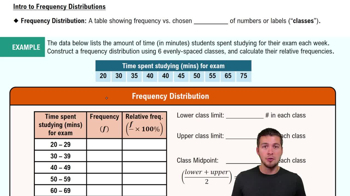
A frequency distribution is a summary of how often each value occurs in a dataset. It organizes data into classes or intervals, allowing for easier analysis of patterns and trends. In this case, the magnitudes of earthquakes will be grouped into intervals of 0.50, which helps visualize the distribution of earthquake magnitudes.
Recommended video:
Guided course
06:38
Intro to Frequency Distributions

Class Width

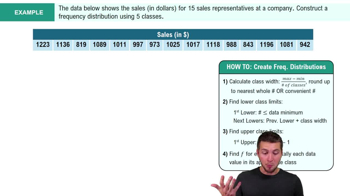
Class width refers to the size of the intervals used in a frequency distribution. It determines how data points are grouped together. For this exercise, a class width of 0.50 means that each interval will cover a range of 0.50 units, starting from the specified value of 1.00, which helps in organizing the data systematically.
Recommended video:
Guided course
05:18
How to Create Frequency Distributions Example 2

Richter Scale

The Richter scale is a logarithmic scale used to measure the magnitude of earthquakes. It quantifies the amount of energy released during an earthquake, with each whole number increase on the scale representing a tenfold increase in measured amplitude and approximately 31.6 times more energy release. Understanding this scale is crucial for interpreting the magnitudes listed in the dataset.
Recommended video:
04:52
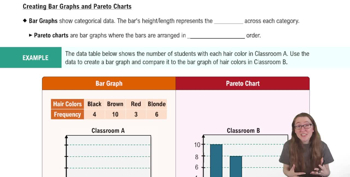
Creating Bar Graphs and Pareto Charts
Related Practice
Textbook Question

Interpreting Normal Quantile Plots Which of the following normal quantile plots appear to represent data from a population having a normal distribution? Explain.

204
views

Textbook Question

In Exercises 1–5, use the data listed in the margin, which are magnitudes (Richter scale) and depths (km) of earthquakes from Data Set 24 “Earthquakes” in Appendix B

[Image]

Frequency Distribution For the frequency distribution from Exercise 1, find the following.


a. Class limits of the first class

b. Class boundaries of the first class

c. Class midpoint of the first class

162
views
Textbook Question

Estimating r For each of the following, estimate the value of the linear correlation coefficient r for the given paired data obtained from 50 randomly selected adults.


a. Their heights are measured in inches and those same heights are recorded in centimeters .

148
views
Textbook Question

Estimating r For each of the following, estimate the value of the linear correlation coefficient r for the given paired data obtained from 50 randomly selected adults.


c. Their pulse rates are measured and their IQ scores are measured .

128
views
Textbook Question

In Exercises 1–5, use the data listed in the margin, which are magnitudes (Richter scale) and depths (km) of earthquakes from Data Set 24 “Earthquakes” in Appendix B


Histogram Construct the histogram corresponding to the frequency distribution from Exercise 1. For the values on the horizontal axis, use the class midpoint values. Which of the following comes closest to describing the distribution: uniform, normal, skewed left, skewed right?


113
views
Textbook Question

Estimating r For each of the following, estimate the value of the linear correlation coefficient r for the given paired data obtained from 50 randomly selected adults.


d. The 50 adults all drove cars from Jacksonville, Florida, to Richmond, Virginia. Their average (mean) speeds are recorded along with the times it took to complete that trip.

147
views