
Ch. 2 - Exploring Data with Tables and Graphs
Triola - Elementary Statistics 14th Edition
Triola14th EditionElementary StatisticsISBN: 9780137366446Not the one you use?Change textbook
Chapter 2, Problem 2.CRE.4b

In Exercises 1–5, use the data listed in the margin, which are magnitudes (Richter scale) and depths (km) of earthquakes from Data Set 24 “Earthquakes” in Appendix B
[Image]
Data Type


b. For the listed earthquake depths, are the data categorical or quantitative?

Verified step by step guidance
1
Understand the difference between categorical and quantitative data: Categorical data represent characteristics or qualities that can be divided into groups, while quantitative data represent numerical values that can be measured and ordered.
Identify the nature of the data in question: The problem refers to earthquake depths, which are measured in kilometers.
Determine if the data are numerical: Since depths are given in kilometers, they are numerical values that can be measured and ordered.
Classify the data type: Since the earthquake depths are numerical and can be measured, they are considered quantitative data.
Conclude that the earthquake depths are quantitative data because they represent measurable numerical values.

Verified video answer for a similar problem:

This video solution was recommended by our tutors as helpful for the problem above.
Video duration:
1m
Was this helpful?

Key Concepts

Here are the essential concepts you must grasp in order to answer the question correctly.

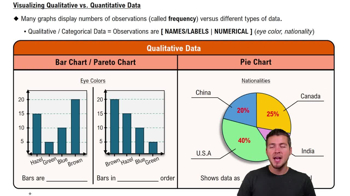
Categorical Data

Categorical data refers to variables that can be divided into distinct categories or groups. These data types are qualitative and describe characteristics or attributes, such as colors, names, or labels. They do not have a numerical value or order, making them unsuitable for arithmetic operations. Examples include gender, type of car, or earthquake classification by region.
Recommended video:
Guided course
04:39
Visualizing Qualitative vs. Quantitative Data

Quantitative Data

Quantitative data consists of numerical values that represent quantities or amounts. These data types can be measured and ordered, allowing for arithmetic operations. Quantitative data can be further divided into discrete data, which are countable, and continuous data, which can take any value within a range. Examples include height, weight, and earthquake depths measured in kilometers.
Recommended video:
Guided course
04:39
Visualizing Qualitative vs. Quantitative Data

Richter Scale

The Richter scale is a logarithmic scale used to measure the magnitude of earthquakes. It quantifies the energy released by an earthquake, with each whole number increase representing a tenfold increase in measured amplitude and roughly 31.6 times more energy release. Understanding the Richter scale is crucial for interpreting earthquake data, as it provides a standardized method to compare the size of different seismic events.
Recommended video:
Guided course
07:10
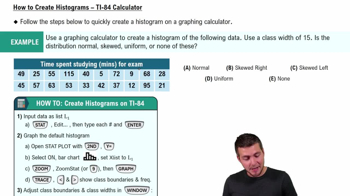
How to Create Histogram - TI-84 Calculator
Related Practice
Textbook Question

Seatbelts The Beams Seatbelts company manufactures—well, you know. When a sample of seatbelts is tested for breaking point (measured in kilograms), the sample data are explored. Identify the important characteristic of data that is missing from this list: center, distribution, outliers, changing characteristics over time.

105
views
Textbook Question

In Exercises 1–5, use the data listed in the margin, which are magnitudes (Richter scale) and depths (km) of earthquakes from Data Set 24 “Earthquakes” in Appendix B

[Image]

Data Type


a. The listed earthquake depths (km) are all rounded to one decimal place. Before rounding, are the exact depths discrete data or continuous data?

210
views
Textbook Question

Computers As a quality control manager at Texas Instruments, you find that defective calculators have various causes, including worn machinery, human error, bad supplies, and packaging mistreatment. Which of the following graphs would be best for describing the causes of defects: histogram; scatterplot; Pareto chart; dotplot; pie chart?

105
views
Textbook Question

Normal Distribution If the following data are randomly selected, which are expected to have a normal distribution?


d. Exact volumes of Coke in 12 oz cans

122
views
Textbook Question

In Exercises 1–5, use the data listed in the margin, which are magnitudes (Richter scale) and depths (km) of earthquakes from Data Set 24 “Earthquakes” in Appendix B

[Image]

Data Type


c. Identify the level of measurement of the listed earthquake depths: nominal, ordinal, interval, or ratio.

213
views
Textbook Question

In Exercises 1–5, use the data listed in the margin, which are magnitudes (Richter scale) and depths (km) of earthquakes from Data Set 24 “Earthquakes” in Appendix B

[Image]

Data Type


d. Given that the listed earthquake depths are part of a larger collection of depths, do the data constitute a sample or a population?

172
views