Ch. 3 - Describing, Exploring, and Comparing Data
Triola - Elementary Statistics 14th Edition
Triola14th EditionElementary StatisticsISBN: 9780137366446Not the one you use?Change textbook
Chapter 3, Problem 3.1.30

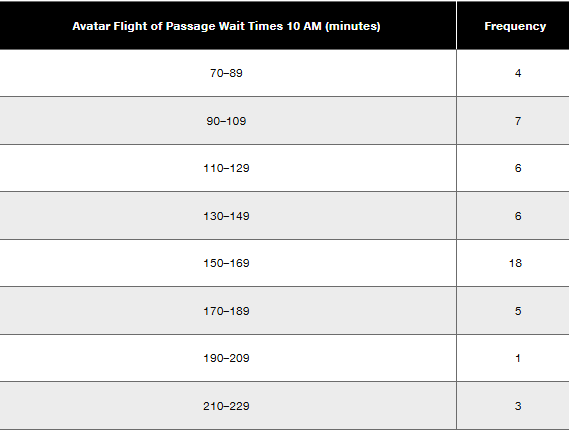
In Exercises 29–32, compute the mean of the data summarized in the frequency distribution. Also, compare the computed means to the actual means obtained by using the original list of data values, which are as follows: (29) 31.4 minutes; (Exercise 30) 140.6 minutes; (Exercise 31) 55.2 years; (Exercise 32) 240.2 seconds.


Table displaying wait times in minutes for the Avatar Flight of Passage ride, with corresponding frequency counts.

Verified step by step guidance
1
Step 1: Identify the midpoint of each class interval. The midpoint is calculated as the average of the lower and upper boundaries of each interval. For example, for the interval 70–89, the midpoint is (70 + 89) / 2 = 79.5.
Step 2: Multiply the midpoint of each class interval by its corresponding frequency to find the weighted contribution of each interval. For example, for the interval 70–89, the weighted contribution is 79.5 × 4.
Step 3: Sum all the weighted contributions obtained in Step 2. This gives the total weighted sum of the data.
Step 4: Sum all the frequencies to find the total number of data points. For example, add 4 + 7 + 6 + 6 + 18 + 5 + 1 + 3.
Step 5: Divide the total weighted sum (from Step 3) by the total frequency (from Step 4) to compute the mean of the data summarized in the frequency distribution.

Verified video answer for a similar problem:

This video solution was recommended by our tutors as helpful for the problem above.
Video duration:
4m
Was this helpful?

Key Concepts

Here are the essential concepts you must grasp in order to answer the question correctly.

Mean

The mean, or average, is a measure of central tendency calculated by summing all data values and dividing by the number of values. In the context of a frequency distribution, the mean can be computed by multiplying each midpoint of the class intervals by its corresponding frequency, summing these products, and then dividing by the total frequency. This provides a representative value of the dataset.
Recommended video:
Guided course
04:52
Calculating the Mean

Frequency Distribution

A frequency distribution is a summary of how often each value or range of values occurs in a dataset. It organizes data into classes or intervals, showing the number of observations (frequency) within each interval. This helps in visualizing the distribution of data and is essential for calculating measures like the mean, as it provides the necessary structure for analysis.
Recommended video:
Guided course
06:38
Intro to Frequency Distributions

Comparison of Means

Comparing the mean calculated from a frequency distribution to the mean derived from the original dataset allows for an assessment of accuracy and representation. Discrepancies between these means can indicate how well the frequency distribution captures the underlying data. This comparison is crucial for validating the results and understanding the potential impact of data summarization techniques.
Recommended video:
Guided course
04:52
Calculating the Mean
Related Practice
Textbook Question

Significant Values. In Exercises 9–12, use the range rule of thumb to identify (a) the values that are significantly low, (b) the values that are significantly high, and (c) the values that are neither significantly low nor significantly high.


IQ Scores The Wechsler test is used to measure intelligence of adults aged 16 to 80. The mean test score is 100 and the standard deviation is 15.

222
views
Textbook Question

Comparing Values. In Exercises 13–16, use z scores to compare the given values.


Tallest and Shortest Men The tallest adult male was Robert Wadlow, and his height was 272 cm. The shortest adult male was Chandra Bahadur Dangi, and his height was 54.6 cm. Heights of men have a mean of 174.12 cm and a standard deviation of 7.10 cm. Which of these two men has the height that is more extreme?

293
views
Textbook Question

Critical Thinking. For Exercises 5–20, watch out for these little buggers. Each of these exercises involves some feature that is somewhat tricky. Find the (a) mean, (b) median, (c) mode, (d) midrange, and then answer the given question.


Geography Majors The data listed below are estimated incomes (dollars) of students who graduated from the University of North Carolina (UNC) after majoring in geography. The data are based on graduates in the year 1984. The income of basketball superstar Michael Jordan (a 1984 UNC graduate and geography major) is included. Does his income have much of an effect on the measures of center? Based on these data, would the college have been justified by saying that the mean income of a graduate in their geography program is greater than \$250,000?


17,466 18,085 17,875 19,339 19,682 19,610 18,259 16,354 2,200,000
232
views
Textbook Question

Percentiles. In Exercises 17–20, use the following radiation levels (in W/kg) for 50 different cell phones. Find the percentile corresponding to the given radiation level.


1.47 W/kg

144
views
Textbook Question

Resistant Measures Listed below are 10 wait times (minutes) for “Rock ‘n’ Roller Coaster” at 10 AM (from Data Set 33 “Disney World Wait Times”). The data are listed in order from lowest to highest. Find the mean and median of these ten values. Then find the mean and median after excluding the value of 180, which appears to be an outlier. Compare the two sets of results. How much was the mean affected by the inclusion of the outlier? How much is the median affected by the inclusion of the outlier?


15 20 25 30 30 35 45 50 50 180 

170
views
Textbook Question

Estimating Standard Deviation with the Range Rule of Thumb. In Exercises 29–32, refer to the data in the indicated exercise. After finding the range of the data, use the range rule of thumb to estimate the value of the standard deviation. Compare the result to the standard deviation computed using all of the data.


Audiometry Use the hearing measurements from Data Set 7 “Audiometry.” Does it appear that the amounts of variation are different for the right threshold measurements and the left threshold measurements?

301
views