Ch. 7 - Estimating Parameters and Determining Sample Sizes
Triola - Elementary Statistics 14th Edition
Triola14th EditionElementary StatisticsISBN: 9780137366446Not the one you use?Change textbook
Chapter 7, Problem 7.4.18b

Caffeine in Soft Drinks Listed below are measured amounts of caffeine (mg per 12 oz of drink) obtained in one can from each of 20 brands (7UP, A&W Root Beer, Cherry Coke, . . . , TaB).


b. Given that Exercise 20 in Section 7-2 used the same data for a 99% confidence interval based on use of the t distribution, and given that the data do not appear to be from a normally distributed population, which confidence interval is likely to be better: The confidence interval from part (a) or the confidence interval found in Exercise 20 in Section 7-2?


Verified step by step guidance
1
Step 1: Analyze the data provided. The caffeine amounts (in mg per 12 oz of drink) are listed for 20 brands. Note that some values are 0, indicating no caffeine content in those drinks.
Step 2: Understand the problem context. The question asks which confidence interval is likely to be better: one based on the t-distribution (Exercise 20 in Section 7-2) or another method, given that the data do not appear to be from a normally distributed population.
Step 3: Recall that the t-distribution is typically used for small sample sizes or when the population standard deviation is unknown, assuming the data are approximately normally distributed. However, if the data are not normally distributed, the t-distribution may not provide the most accurate confidence interval.
Step 4: Consider alternative methods for constructing confidence intervals when the data are not normally distributed. Non-parametric methods, such as bootstrapping, may provide a better confidence interval in this case because they do not rely on the assumption of normality.
Step 5: Compare the two approaches. The confidence interval from Exercise 20 in Section 7-2, based on the t-distribution, may be less reliable due to the lack of normality in the data. A confidence interval constructed using a non-parametric method or a method robust to non-normality is likely to be better suited for this dataset.

Verified video answer for a similar problem:

This video solution was recommended by our tutors as helpful for the problem above.
Video duration:
2m
Was this helpful?

Key Concepts

Here are the essential concepts you must grasp in order to answer the question correctly.

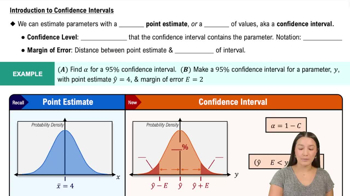
Confidence Interval

A confidence interval is a range of values, derived from sample statistics, that is likely to contain the true population parameter. It is expressed with a certain level of confidence, such as 95% or 99%. The interval provides an estimate of uncertainty around the sample mean, indicating how much the sample mean might vary from the actual population mean.
Recommended video:
06:33
Introduction to Confidence Intervals

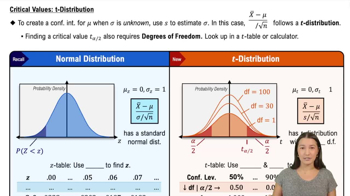
t Distribution

The t distribution is a type of probability distribution that is symmetric and bell-shaped, similar to the normal distribution but with heavier tails. It is used in statistics when the sample size is small and the population standard deviation is unknown. The t distribution accounts for the additional uncertainty introduced by estimating the population standard deviation from the sample.
Recommended video:
05:50
Critical Values: t-Distribution

Normality Assumption

The normality assumption refers to the requirement that the data should be approximately normally distributed for certain statistical methods to be valid. When this assumption is violated, as indicated in the question, the results of confidence intervals and hypothesis tests may be unreliable. Alternative methods, such as using the t distribution or non-parametric tests, may be more appropriate in such cases.
Recommended video:
Guided course
09:47
Finding Standard Normal Probabilities using z-Table
Related Practice
Textbook Question

Mint Specs Listed below are weights (grams) from a simple random sample of pennies produced after 1983 (from Data Set 40 “Coin Weights” in Appendix B).


b. How does the result compare to the confidence interval found in Exercise 14 in Section 7-3?


75
views
Textbook Question

Mean Pulse Rate of Females Data Set 1 “Body Data” in Appendix B includes pulse rates of 147 randomly selected adult females, and those pulse rates vary from a low of 36 bpm to a high of 104 bpm. Find the minimum sample size required to estimate the mean pulse rate of adult females. Assume that we want 99% confidence that the sample mean is within 2 bpm of the population mean.


b. Assume that sigma=12.5 bpm, based on the value of s=12.5 bpm for the sample of 147 female pulse rates.


77
views
Textbook Question

Smart Phone Apple is planning for the launch of a new and improved iPhone. The marketing team wants to know the worldwide percentage of consumers who intend to purchase the new model, so a survey is being planned. How many people must be surveyed in order to be 90% confident that the estimated percentage is within three percentage points of the true population percentage?


b. Assume that 11% of consumers have a smartphone and plan to upgrade to a new model.


101
views
Textbook Question

Finite Population Correction Factor If a simple random sample of size n is selected without replacement from a finite population of size (n>0.05N), and the sample size is more than 5% of the population size , better results can be obtained by using the finite population correction factor, which involves multiplying the margin of error E by [Image]. Refer to the weights of the M&M candies in Data Set 38 “Candies” in Appendix B.


b. Use only the red M&Ms and treat that sample as a simple random sample selected from the population of the 345 M&Ms listed in the data set. Find the 95% confidence interval estimate of the mean weight of all 345 M&Ms. Compare the result to the actual mean of the population of all 345 M&Ms.



420
views
Textbook Question

E-Cigarettes A New York Times article reported that a survey conducted in 2014 included 36,000 adults, with 3.7% of them being regular users of e-cigarettes. Because e-cigarette use is relatively new, there is a need to obtain today’s usage rate. How many adults must be surveyed now if we want a confidence level of 95% and a margin of error of 1.5 percentage points?


b. Use the results from the 2014 survey.


167
views
Textbook Question

Voting Survey In a survey of 1002 people, 70% said that they voted in a recent presidential election (based on data from ICR Research Group). Voting records show that 61% of eligible voters actually did vote.


b. Find a 95% confidence interval estimate of the percentage of people who say that they voted.


89
views