Skip to main content
Analytical Chemistry
My Course
Learn
Exam Prep
AI Tutor
Study Guides
Flashcards
Explore
Try the app
My Course
Learn
Exam Prep
AI Tutor
Study Guides
Flashcards
Explore
Try the app
Back
Electrochemical Cells definitions
You can tap to flip the card.
Galvanic Cell
You can tap to flip the card.
👆
Galvanic Cell
A spontaneous system generating electricity via oxidation at a negative electrode and reduction at a positive electrode, connected by a salt bridge.
Track progress
Control buttons has been changed to "navigation" mode.
1/15
Related flashcards
Related practice
Recommended videos
Electrochemical Cells quiz
Electrochemical Cells
15 Terms
Electrochemical Cells
13. Fundamentals of Electrochemistry
5 problems
Topic
Standard Potentials
13. Fundamentals of Electrochemistry
5 problems
Topic
13. Fundamentals of Electrochemistry - Part 1 of 2
4 topics
12 problems
Chapter
13. Fundamentals of Electrochemistry - Part 2 of 2
1 topic
3 problems
Chapter
Guided course
07:14
Line Notation Calculations
513
views
1
rank
Guided course
05:40
Galvanic or Voltaic Cell
576
views
6
rank
Guided course
04:03
Electrolytic Cells
454
views
2
rank
Terms in this set (15)
Hide definitions
Galvanic Cell
A spontaneous system generating electricity via oxidation at a negative electrode and reduction at a positive electrode, connected by a salt bridge.
Electrolytic Cell
A non-spontaneous system requiring external power to drive electron flow, with forced oxidation and reduction at its electrodes.
Anode
The electrode where oxidation occurs, electrons are lost, and mass decreases during cell operation.
Cathode
The electrode where reduction occurs, electrons are gained, and mass increases as ions deposit.
Salt Bridge
A tube containing neutral ions that completes the circuit by allowing ion flow between cell compartments.
Standard Cell Potential
A measure of the cell's ability to drive electron flow, with higher values favoring reduction and strong oxidizing agents.
Oxidizing Agent
A substance that gains electrons in a reaction, promoting reduction at the cathode.
Reducing Agent
A substance that loses electrons in a reaction, promoting oxidation at the anode.
Line Notation
A symbolic method using vertical lines to represent phase boundaries and salt bridges, summarizing cell components and reactions.
Half Reaction
A representation of either oxidation or reduction, showing electron transfer at a single electrode.
Gibbs Free Energy
A thermodynamic variable indicating reaction spontaneity; negative values correspond to spontaneous cell operation.
Equilibrium Constant
A value relating product and reactant concentrations at equilibrium, used to predict cell spontaneity.
Reaction Quotient
A ratio of current concentrations to equilibrium values, indicating the cell's progress toward equilibrium.
Standard Entropy
A measure of disorder under standard conditions, influencing the spontaneity and direction of cell reactions.
Phase Boundary
A separation between different physical states or oxidation states, represented by a single line in cell notation.
 BackBack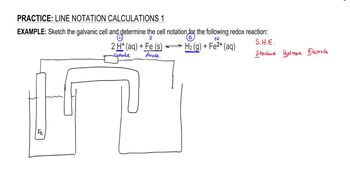
 07:14
07:14

