What is the main difference between a galvanic (voltaic) cell and an electrolytic cell?
A galvanic cell is spontaneous and produces electricity, while an electrolytic cell is non-spontaneous and requires an external power source to operate.
In a galvanic cell, which electrode is the anode and what process occurs there?
The anode is the negative electrode where oxidation occurs, meaning it loses electrons.
What is the function of the salt bridge in an electrochemical cell?
The salt bridge allows the movement of neutral ions to maintain charge balance and complete the circuit.
Which direction do electrons flow in a galvanic cell?
Electrons flow from the anode to the cathode.
What happens to the mass of the anode and cathode over time in a galvanic cell?
The anode loses mass as it dissolves, while the cathode gains mass as it plates out.
What type of ions typically move toward the anode through the salt bridge?
Negative ions, such as chloride or nitrate ions, move toward the anode.
How does the concentration of positive ions in the cathode solution affect electron movement?
A higher concentration of positive ions in the cathode solution attracts more electrons, facilitating reduction.
What is the relationship between standard cell potential and the likelihood of reduction?
A higher standard cell potential means reduction is more likely to occur, indicating a stronger oxidizing agent.
What variables can be used to predict if an electrochemical cell reaction is spontaneous?
Gibbs free energy, standard cell potential, and the equilibrium constant can be used to predict spontaneity.
In an electrolytic cell, why is an external power source needed?
Because the reaction is non-spontaneous and electrons must be forced to move against their natural direction.
What always occurs at the anode and cathode, regardless of cell type?
Oxidation always occurs at the anode and reduction always occurs at the cathode.
How is line (cell) notation used to represent an electrochemical cell?
Line notation uses single lines for phase boundaries and a double line for the salt bridge, listing the anode on the left and cathode on the right.
What does a double line in line notation represent?
A double line represents the salt bridge, which separates the two half-cells.
How are oxidation states arranged in line notation for an electrochemical cell?
Higher oxidation states are placed toward the center, and lower oxidation states are on the ends.
What does it mean if all variables (Gibbs free energy, cell potential, etc.) are zero or at equilibrium?
The cell is at equilibrium and represents a dead battery, with no net reaction occurring.
 Back
Back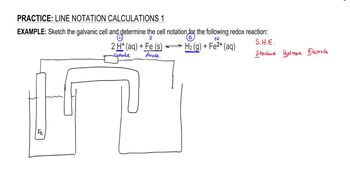
 07:14
07:14

