Skip to main content
Analytical Chemistry
My Course
Learn
Exam Prep
AI Tutor
Study Guides
Flashcards
Explore
Try the app
My Course
Learn
Exam Prep
AI Tutor
Study Guides
Flashcards
Explore
Try the app
Back
Precision and Accuracy quiz
You can tap to flip the card.
What is experimental error in chemistry?
You can tap to flip the card.
👆
What is experimental error in chemistry?
Experimental error refers to the inherent uncertainty present in all measurements and calculations in chemistry.
Track progress
Control buttons has been changed to "navigation" mode.
1/15
Related flashcards
Related practice
Recommended videos
Precision and Accuracy definitions
Precision and Accuracy
14 Terms
Precision and Accuracy
3. Experimental Error
5 problems
Topic
Types of Errors
3. Experimental Error
5 problems
Topic
3. Experimental Error - Part 1 of 2
4 topics
12 problems
Chapter
3. Experimental Error - Part 2 of 2
3 topics
9 problems
Chapter
Guided course
01:30
Precision and Accuracy
402
views
6
rank
Guided course
02:59
Precision and Accuracy
497
views
8
rank
Terms in this set (15)
Hide definitions
What is experimental error in chemistry?
Experimental error refers to the inherent uncertainty present in all measurements and calculations in chemistry.
How is precision defined in the context of chemical measurements?
Precision is the degree to which repeated measurements or calculations yield results that are close to each other.
What does accuracy measure in an experiment?
Accuracy measures how close a result is to the true or actual value.
Which principle assesses the reproducibility of results?
Precision assesses the reproducibility of results by examining how closely repeated results align.
Can precision be controlled in experiments?
Yes, precision is often controllable by the experimenter through careful technique and consistent procedures.
Is accuracy always within our control in chemical experiments?
No, accuracy may be influenced by uncontrollable factors and is not always fully within our control.
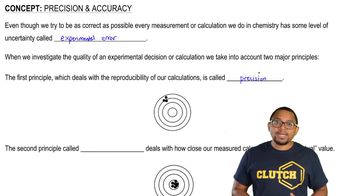
How can you visually represent precision using a dartboard analogy?
Precision is shown when multiple strikes are close to each other, regardless of their position relative to the bull's eye.
What does it mean if all strikes on a dartboard are dead center?
It means the results are both accurate (close to the true value) and precise (close to each other).
What is the difference between precision and accuracy?
Precision is about the closeness of repeated results to each other, while accuracy is about closeness to the true value.
Why are calculations in chemistry never perfect?
Calculations are never perfect due to experimental error and circumstances that may be beyond our control.
How can we evaluate the quality of experimental data?
We evaluate quality by considering both precision (reproducibility) and accuracy (closeness to true value).
What statistical measure can be used to assess precision?
Standard deviation can be used to assess how reproducible and precise a set of values is.
Why is understanding precision and accuracy important in chemistry?
It is essential for evaluating data quality, interpreting results, and performing reliable stoichiometry calculations.
What might cause a set of results to be precise but not accurate?
If repeated results are close to each other but far from the true value, they are precise but not accurate.
How do acid–base reactions and titrations relate to precision and accuracy?
Understanding precision and accuracy helps interpret results and assess data quality in acid–base reactions and titrations.
 BackBack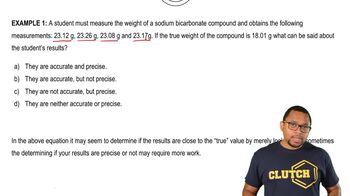
 01:30
01:30