Skip to main content
Analytical Chemistry
My Course
Learn
Exam Prep
AI Tutor
Study Guides
Flashcards
Explore
Try the app
My Course
Learn
Exam Prep
AI Tutor
Study Guides
Flashcards
Explore
Try the app
Back
Strong Acid-Strong Base Titrations definitions
You can tap to flip the card.
Titration
You can tap to flip the card.
👆
Titration
Analytical process where a solution of known concentration is gradually added to another to determine its concentration.
Track progress
Control buttons has been changed to "navigation" mode.
1/15
Related flashcards
Related practice
Recommended videos
Strong Acid-Strong Base Titrations quiz #1
Strong Acid-Strong Base Titrations
10 Terms
Strong Acid-Strong Base Titrations quiz
Strong Acid-Strong Base Titrations
15 Terms
Strong Acid-Strong Base Titrations
10. Acid-Base Titrations
5 problems
Topic
Weak Acid-Strong Base Titrations
10. Acid-Base Titrations
5 problems
Topic
10. Acid-Base Titrations - Part 1 of 2
4 topics
12 problems
Chapter
10. Acid-Base Titrations - Part 2 of 2
1 topic
3 problems
Chapter
Guided course
05:47
Strong Base-Strong Acid Titration
486
views
6
rank
2
comments
Guided course
02:55
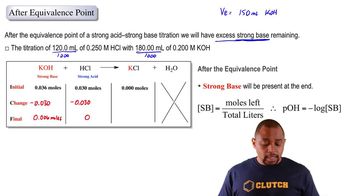
Strong Acid-Strong Base Titration
368
views
1
rank
Guided course
03:18
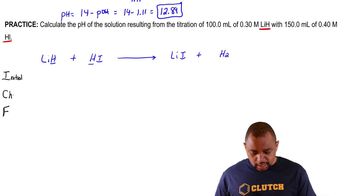
Strong Base-Strong Acid Calculations Practice
430
views
3
rank
Terms in this set (15)
Hide definitions
Titration
Analytical process where a solution of known concentration is gradually added to another to determine its concentration.
Strong Acid
Substance that dissociates completely in water, producing a high concentration of hydrogen ions.
Strong Base
Compound that fully dissociates in solution, yielding a high concentration of hydroxide ions.
ICF Chart
Tabular method using moles to track initial, change, and final amounts during reactions with complete dissociation.
Equivalence Point
Stage in titration where moles of acid and base are equal, resulting in complete neutralization.
Analyte
Substance in a titration whose concentration is being determined by reaction with a titrant.
Titrant
Solution of known concentration added to react with the analyte during titration.
Molarity
Measure of concentration expressed as moles of solute per liter of solution.
pH
Logarithmic scale representing the hydrogen ion concentration, indicating acidity or basicity.
pOH
Logarithmic measure of hydroxide ion concentration, related to pH by their sum equaling 14 at 25°C.
Conjugate Base
Species formed when an acid donates a proton during a neutralization reaction.
Neutral Salt
Product of strong acid-strong base titration that does not affect pH if activity coefficients are ignored.
Limiting Reactant
Reactant present in the smallest mole amount, determining the extent of reaction completion.
Conservation of Mass
Principle stating matter is neither created nor destroyed, only transformed during chemical reactions.
Activity Coefficient
Factor accounting for deviations from ideal behavior in ion interactions, often ignored in basic titration calculations.
 BackBack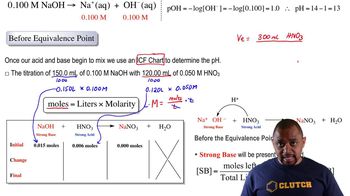
 05:47
05:47